

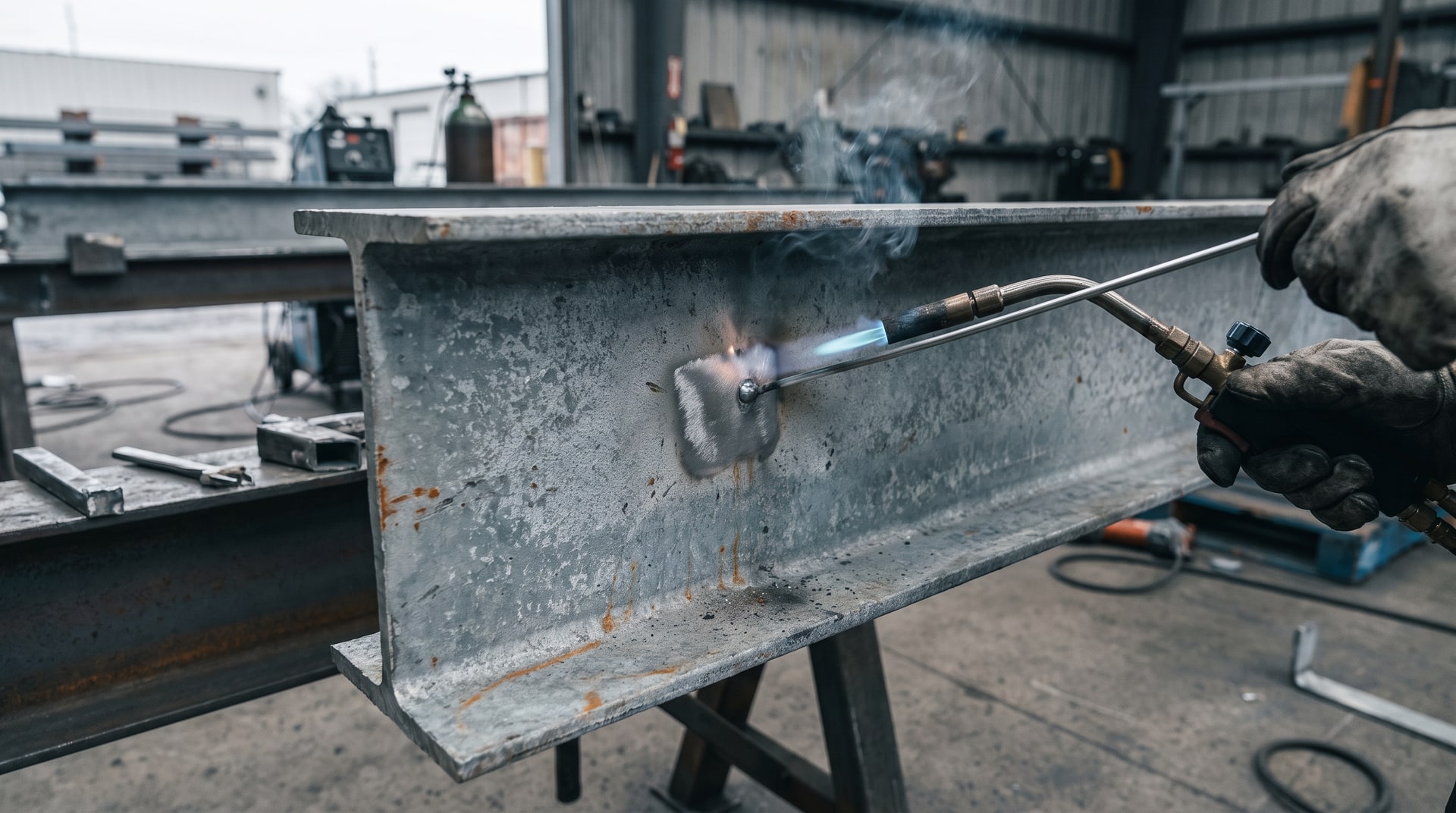
Even when the hot-dip galvanizing process is executed correctly, minor imperfections in the coating can appear. A small bare patch on a beam flange, a thin spot where two pieces contacted each other in the kettle, or localized damage from rough handling during transport, these situations are common enough in real fabrication workflows that the industry has well-established standards governing how to deal with them. The question is not whether repairs are ever acceptable, but rather when they are appropriate, how large an area qualifies, and which method actually delivers the protection the structure needs.
The American Galvanizers Association addresses this directly in their article on touch-up and repair of hot-dip galvanized steel. At V&S Galvanizing, we expand on that foundation to explain what is actually happening at the material level, how repair method selection influences long-term corrosion performance, and why the differences between these three approaches are often misunderstood or underestimated in the field.
Why Bare Spots Occur and When They Actually Matter
Hot-dip galvanizing produces zinc-iron alloy layers by a metallurgical reaction between molten zinc and the steel substrate. Under ideal conditions, the coating covers every surface uniformly. In practice, steel geometry, surface chemistry, flux coverage, and how parts are racked in the kettle all influence the final result. Occasionally, two pieces stick together during processing, or a contact point between a part and the racking fixture leaves a small uncoated zone. Post-galvanizing operations, including welding, cutting, drilling, and field assembly, can also damage the coating mechanically.
Not all of these situations require the same response. Small bare spots that fall within defined size limits can be repaired in the field or at the galvanizing facility using the methods described in ASTM A780. Larger or more extensive coating deficiencies, however, may require the part to be stripped and re-galvanized entirely. Understanding which category a defect falls into is the first step before any repair work begins.
What ASTM A123 Actually Limits
ASTM A123 is the governing specification for hot-dip galvanized coatings on fabricated structural steel, and it sets firm limits on what can be touched up versus what requires re-processing. Two specific paragraphs define those limits.
Paragraph 6.2.1 restricts any single bare area to 1 inch (25 mm) or less in its narrowest dimension. This phrasing is intentional. The standard is not simply capping bare spots at 1-inch squares or circles. It is written to allow repair of long, thin bare areas, such as the contact lines that result from pieces sticking together in the kettle, while prohibiting repair of large, blocky patches that likely indicate inadequate surface preparation or fluxing. A narrow strip 3 inches long may be repairable; a 2-inch-wide circular void is not.
Paragraph 6.2.2 limits the total area subject to renovation on a given part to 1% of the surface area to be coated on that article, or 36 square inches (22,500 square millimeters) per ton of piece weight, whichever is less. This is a cumulative limit. A part with many small bare spots scattered across its surface could collectively exceed the allowable renovation area even if each individual spot is within the narrowest-dimension rule. When total bare area approaches or exceeds these thresholds, re-galvanizing is the correct path forward.
The Three Repair Methods Under ASTM A780
ASTM A780 recognizes three distinct approaches for repairing damaged or uncoated areas: zinc-based solders, zinc-rich paints, and sprayed zinc (metallizing). Each method produces a zinc-bearing coating over the exposed steel, but the way they bond to the substrate, the protection mechanisms they rely on, and the practical constraints they impose differ considerably. No single method is universally superior, and choosing incorrectly for a given situation can result in a repair that fails well before the surrounding galvanized coating shows any sign of deterioration.
Zinc-Based Solders: Best Color Match, Demanding Application
Zinc-based solders are products formulated specifically for repairing hot-dip galvanized surfaces. The application process requires cleaning the bare area and preheating the steel to at least 600 degrees Fahrenheit (315 degrees Celsius). Once the steel reaches that temperature, the solder rod is rubbed directly onto the surface, where it melts and flows into the repair area. As it cools and solidifies, it leaves a zinc alloy layer behind. If flux is used during the process, flux residue must be removed before the repair is considered complete.
The resulting coating bonds well to the base steel and provides both barrier protection and sacrificial protection against corrosion. Sacrificial protection is critical: it means the zinc will preferentially corrode in place of the underlying steel even if the repair coating is scratched or nicked, which is the same fundamental mechanism that makes hot-dip galvanizing so durable over time. The color of a properly applied zinc solder repair also comes closer to matching the surrounding galvanized surface than the other two methods, which matters on architectural or highly visible structural components.
The limitations are real, though. Achieving the right preheat temperature without oxidizing the steel or scorching the adjacent galvanized coating demands skill and experience. Producing a coating of adequate, uniform thickness is difficult, and thin repairs reduce abrasion resistance. ASTM A123 requires the repaired area to meet the same minimum thickness as the rest of the part, which is a meaningful constraint when applying solder by hand. The method is also harder to use effectively on geometrically complex areas, such as deep recesses or tightly curved surfaces, where controlling heat distribution becomes unpredictable.
Zinc-Rich Paints: Easy to Apply, But Not a Full Performance Equivalent
Zinc-rich paints use organic binders to carry zinc dust in suspension. According to ASTM A780, these paints must contain no less than 65% zinc dust by weight in the dried film. They are pre-mixed and ready to apply, which makes them the most accessible of the three repair options in terms of equipment requirements and applicator skill. There is no heating involved, no special spray equipment, and no limitation based on the geometry of the exposed area. You can reach into corners, cover large irregular zones, and apply the material with basic tools.
Where zinc-rich paint falls short relative to the other methods is in sacrificial protection. While it does provide reasonable barrier protection by physically separating the steel from the environment, the paint film's ability to deliver electrochemical sacrificial protection is more limited than either solder or metallizing. The zinc particles must be in sufficient contact with each other and the steel to conduct the galvanic current that drives sacrificial protection. Paint binders can interfere with that continuity, particularly in areas where thick coats are applied, where the film is prone to flaking on impact.
To meet the ASTM A123 minimum thickness requirement for repaired areas, zinc-rich paint typically needs to be applied in multiple coats, building to a thickness approximately 50% greater than the minimum required for the rest of the galvanized article. That thicker coating is more vulnerable to impact-related flaking. Color matching is also a consistent challenge; the paint film rarely looks like the surrounding zinc, and the standard remedy is to apply an aluminum paint topcoat over the repaired area to approximate the appearance of newly galvanized steel. For functional industrial applications where appearance is secondary, this is often acceptable. For architectural or high-visibility projects, it may not be.
Zinc Metallizing: Highest Performance, Significant Equipment Requirements
Zinc metallizing, sometimes called thermal spray or arc spray zinc, involves projecting droplets of molten zinc onto the prepared steel surface using wire, ribbon, or powder feed systems. The droplets impact the steel at high velocity, flatten on contact, and build up a dense, interlocking coating. The surface must be clean, dry, and free of grease and corrosion products before spraying begins, and the metallizing should be applied as soon as possible after surface preparation to prevent any oxidation of the freshly prepared steel.
The resulting coating provides the best overall performance of the three repair methods. It delivers both barrier and sacrificial protection at levels closer to hot-dip galvanizing than either solder or paint can achieve. Its adhesion to the substrate is excellent, and its abrasion resistance is the highest of the three options, although the source data is clear that even metallized zinc offers less than half the abrasion resistance of a hot-dip galvanized coating. That is not a failure of the method; it reflects the fundamental difference between a coating formed by a metallurgical reaction with the steel and one that is mechanically deposited on top of it.
The practical limitation is equipment. The spray systems required for zinc metallizing are large, require power and compressed air or gas supply, and generate zinc fumes that demand proper ventilation controls. Transporting this equipment to a field site, particularly for a small repair on an already-erected structure, is often impractical. Metallizing is more commonly used for repairs performed before erection, in a controlled shop environment, or for large-scale restoration work on existing infrastructure where the scale of the project justifies mobilizing the equipment.
| Method | Advantages | Disadvantages |
|---|---|---|
| Zinc-Based Solder | Barrier and sacrificial protection; good adhesion; best color match to galvanized steel | Difficult to apply; low abrasion resistance; thin coatings tend to be produced; thick coatings needed to satisfy ASTM A123 |
| Zinc-Rich Paint | Easiest to apply; barrier protection; no limit on coverage area geometry; good adhesion in many cases | Limited sacrificial protection; low abrasion resistance; prone to flaking with thick coatings; thick coatings needed to satisfy ASTM A123; color does not match galvanized steel |
| Zinc Metallizing | Best overall barrier and sacrificial protection; good adhesion; highest abrasion resistance of the three methods; no limit on coverage area geometry | Extensive specialized equipment required; additional ventilation needed for zinc fumes; difficult to mobilize for field repairs |
Comparing the Methods: What the Table Tells You and What It Does Not
The summary table for these three methods provides a useful at-a-glance comparison, but it can oversimplify the decision if read without context. For instance, zinc-rich paint is listed as having no limit on coverage area, which is technically accurate in terms of geometry. But the cumulative area limits in ASTM A123 paragraph 6.2.2 still apply to any repair method. A zinc-rich paint repair covering 40 square inches on a lightweight structural member may still exceed the standard's renovation limit, regardless of whether the paint can physically be applied to that area.
Similarly, the color match advantage of zinc-based solder needs to be weighed against the applicator skill required to actually achieve that result. A poorly applied solder repair may look worse than a properly applied paint touch-up with a topcoat. In real project conditions, the capabilities of the available crew often constrain the method selection more than the theoretical performance data does.
Corrosion environment also matters. In highly aggressive environments, such as coastal or industrial chemical exposure zones, the difference in sacrificial protection between zinc-rich paint and zinc metallizing becomes more significant than it would be in a mild inland setting. Our team always considers the deployment environment when advising on repair method selection, because a repair that performs adequately in a suburban building structure may be insufficient on a marine pier or chemical processing facility.
Surface Preparation Is Not Optional for Any of These Methods
All three repair methods share one absolute prerequisite: the surface must be clean before any repair material is applied. For zinc-based solder, contamination prevents proper bonding and can cause the solder to ball up rather than flow. For zinc-rich paint, oil, grease, or residual corrosion products will compromise adhesion and create early failure points in the film. For metallizing, surface contamination reduces adhesion and can trap moisture under the coating, leading to blistering and delamination over time.
In the field, this requirement is easy to overlook when a crew is under schedule pressure. Brushing loose material off a bare spot and immediately painting over it is not adequate preparation. The steel surface needs to be mechanically or chemically cleaned to bright metal, and paint or metallizing should be applied promptly afterward to prevent re-oxidation. Skipping or shortcutting surface preparation is the single most common reason touch-up and repair work fails prematurely. The coating material itself is rarely the issue.
Work With a Team That Understands Repair as Part of the Overall Coating System
Touch-up and repair work exists within a larger quality framework, not as a workaround to bypass proper galvanizing. When performed correctly, within the limits ASTM A123 defines and using appropriate ASTM A780 methods with proper surface preparation, repairs maintain the corrosion protection that makes hot-dip galvanizing one of the most cost-effective long-term coating systems available. When performed incorrectly, whether by exceeding allowable repair area limits, skipping surface prep, or selecting a method that does not suit the environment, the repair becomes the weakest link in an otherwise durable system.
At V&S Galvanizing, our team works with engineers, fabricators, and contractors to identify when touch-up is appropriate, which method fits the application, and how to ensure the repair meets the same performance expectations as the surrounding coating. If you have questions about a specific part, a field repair situation, or how to specify repair requirements in a project contract, reach out through our contact page and we will work through the specifics with you.
Frequently Asked Questions About Touch-Up and Repair of Galvanized Steel
What is the maximum size of a bare spot that can be repaired without re-galvanizing?
Under ASTM A123, any single bare area must be 1 inch (25 mm) or less in its narrowest dimension to qualify for touch-up repair. This limit is designed to allow repair of long, narrow contact lines while preventing repair of large, blocky bare patches that suggest a more systemic coating deficiency. Additionally, the total area of all repaired zones on a single part cannot exceed 1% of the total coatable surface area or 36 square inches (22,500 square millimeters) per ton of piece weight, whichever is the smaller value.
Does zinc-rich paint provide sacrificial protection the same way hot-dip galvanizing does?
Not to the same degree. Zinc-rich paint does contain zinc dust and provides some sacrificial protection, but the organic binder can interfere with the electrochemical continuity between zinc particles and the steel. Hot-dip galvanizing forms a direct metallurgical bond with the steel, enabling more reliable sacrificial action. Zinc metallizing and zinc-based solder both provide better sacrificial protection than zinc-rich paint, though none of the three repair methods fully replicates the performance of the original galvanized coating.
Why does zinc-rich paint need to be applied thicker than the surrounding galvanized coating?
ASTM A123 requires repaired areas to meet the minimum thickness for the rest of the galvanized article, and zinc-rich paint typically needs to be applied at roughly 50% greater thickness than that minimum to deliver comparable protection. This is because zinc-rich paint relies on barrier protection more than sacrificial protection, and a thicker film compensates for the lower zinc efficiency of the paint system compared to a metallurgically bonded coating. Multiple coats are usually required to achieve adequate thickness.
Can zinc metallizing be done in the field on an erected structure?
In most cases, no. Zinc metallizing requires specialized spray equipment, a reliable power or gas supply, and ventilation controls to manage zinc fumes. This equipment is not easily transportable for small field repairs on already-erected structures. Metallizing is better suited to shop repairs before erection or to large-scale restoration projects where the scope justifies full equipment mobilization. For typical field touch-up situations, zinc-based solder or zinc-rich paint is more practical.
How do I know if surface preparation is adequate before applying a repair coating?
The steel surface in the repair area must be clean, dry, and free of oil, grease, existing paint, and corrosion products. All three ASTM A780 methods require this baseline. For zinc-based solder, the preheating step will reveal surface contamination as the solder will not flow or bond properly. For paint and metallizing, visual inspection after cleaning should show bright, bare metal with no visible residue. If re-oxidation (surface rust) appears before the coating is applied, the area must be re-cleaned. Prompt application after cleaning is important for both paint and metallizing.
What is the best repair method for architectural galvanized steel where appearance matters?
Zinc-based solder provides the closest color match to the surrounding hot-dip galvanized coating and is generally the preferred option when appearance is a priority. However, achieving a good color match requires skilled application and proper temperature control during the repair. Zinc-rich paint can be made more visually acceptable by applying an aluminum paint topcoat over the repaired area, which approximates the look of newly galvanized steel, but this is a secondary workaround rather than a true match.
Is abrasion resistance of repaired areas comparable to the original galvanized coating?
No repair method fully matches the abrasion resistance of hot-dip galvanizing. Zinc metallizing has the highest abrasion resistance of the three ASTM A780 methods but still provides less than half the abrasion resistance of a hot-dip galvanized coating. Zinc-based solder and zinc-rich paint both offer lower abrasion resistance than metallizing, with thin solder coatings being particularly vulnerable. For applications involving significant abrasion exposure, this performance gap should factor into the decision about whether repair is sufficient or re-galvanizing is more appropriate.
Can a part be re-galvanized if the bare area exceeds the ASTM A123 repair limits?
Yes. If the bare area on a part exceeds the limits defined in ASTM A123 paragraphs 6.2.1 or 6.2.2, the appropriate corrective action is to strip the existing coating and re-galvanize the part. Touch-up and repair using ASTM A780 methods is only appropriate within the defined size and area limits. Attempting to repair a part with excessive bare areas using paint or solder does not bring it into compliance with ASTM A123 and may leave significant portions of the steel inadequately protected.
