

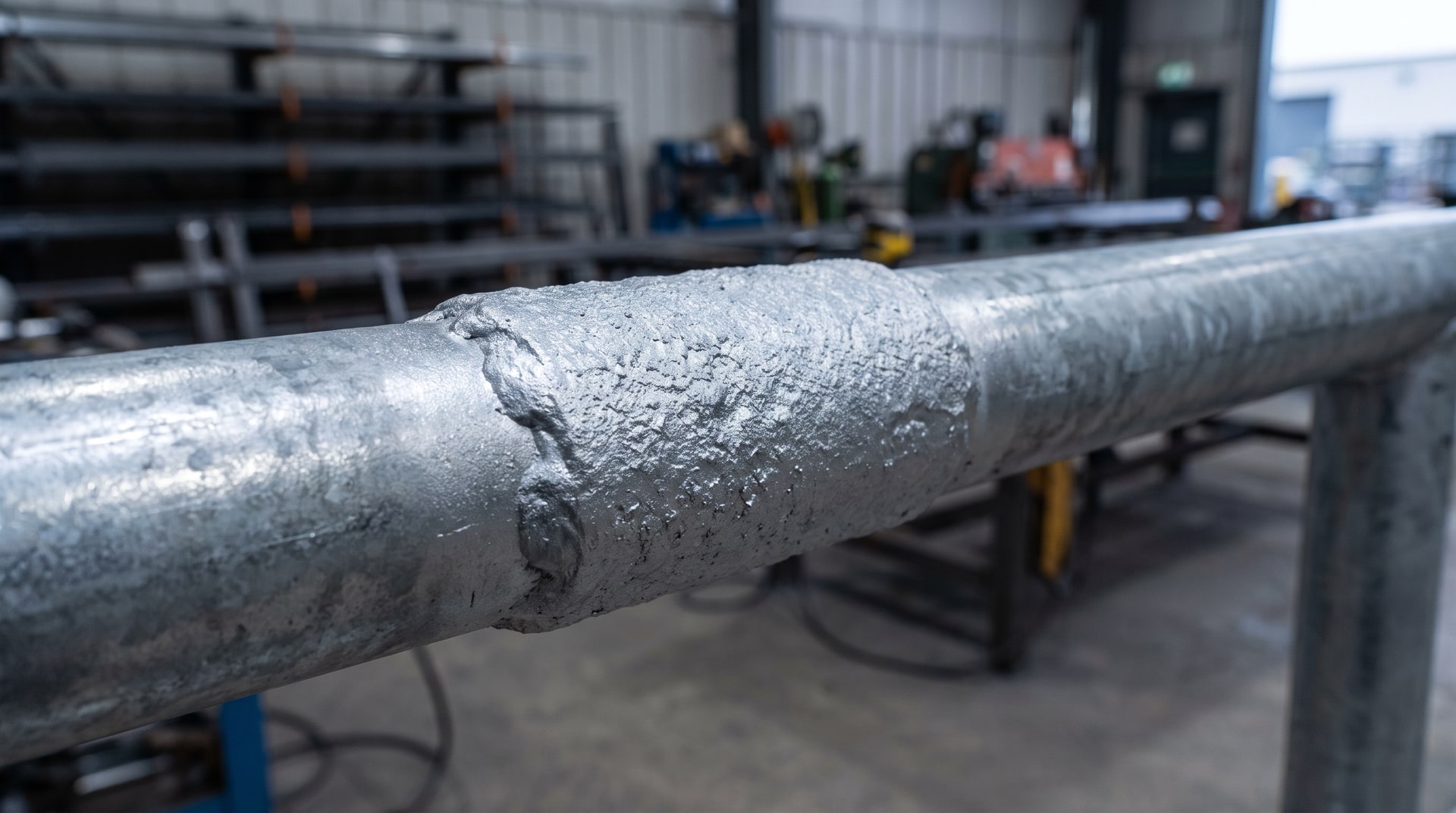
One of the more frustrating surprises in hot-dip galvanizing happens when a fabricator puts serious effort into grinding welds perfectly smooth, only to find that those same weld zones look like raised speed bumps after the steel comes out of the zinc bath. The handrail looks worse after galvanizing than it did before, and from the outside it seems like something went wrong in the process. The zinc went on too thick, or it pooled, or the temperature was wrong. Almost always, that instinct is incorrect.
The actual cause is rooted in the chemistry of the weld consumable itself, specifically the silicon content of the filler rod used during fabrication. This is not a galvanizing defect. It is a material compatibility issue, and understanding why it happens is essential for anyone specifying, designing, or fabricating steel that will go through the hot-dip galvanizing process.
The American Galvanizers Association addresses this directly in their article on thick coating on welded areas. At V&S Galvanizing, we expand on that foundation to explain what is actually happening at the material level, how silicon content influences coating growth, and why this is one of the most commonly misunderstood issues we see come through our facility.
How the Galvanizing Reaction Actually Works
Hot-dip galvanizing is not simply a coating applied to the outside of steel. It is a metallurgical reaction. When steel is immersed in a molten zinc bath at approximately 830 to 850 degrees Fahrenheit, zinc and iron atoms interdiffuse at the interface. This forms a series of zinc-iron alloy layers that bond directly to the base steel, topped by a layer of relatively pure zinc on the outermost surface.
The thickness and character of those alloy layers depend heavily on how reactive the steel is with the zinc. That reactivity is significantly influenced by the silicon content in the steel or weld material. When silicon levels are low or moderate, the reaction rate slows down naturally after an initial growth phase. The alloy layers reach a certain thickness and the kinetics of further diffusion diminish. This self-limiting behavior is what produces the predictable, smooth coatings that most base steel exhibits.
When silicon levels are elevated, that self-limiting behavior does not occur. The reaction continues to proceed in a roughly linear relationship over time, building up far more coating mass than the surrounding steel for the same duration in the bath.
The Silicon Ranges That Drive Coating Behavior
Not all silicon levels create problems. The source of difficulty lies in how specific ranges affect the zinc-iron reaction rate. Based on the AGA's guidance, silicon content in steel or weld material falls into three general categories that determine galvanizing behavior.
Silicon levels below 0.04% are considered low silicon. Steel in this range reacts with zinc in a well-controlled, tapering fashion and generally produces thinner, brighter coatings. Silicon content between 0.15% and 0.25% is considered moderate, and it behaves similarly, with the reaction slowing after an initial period. These two ranges tend to produce coatings that stabilize after typical immersion times.
The problematic ranges are those between 0.05% and 0.15%, and anything above 0.25%. Both of these are classified as high silicon, and in both ranges the coating continues to grow at a linear rate throughout the immersion period without the self-limiting effect seen in the low and moderate categories. This is not intuitive. A steel with 0.08% silicon might seem low on its face, but it falls squarely in the reactive range. The relationship between silicon content and reactivity is not a simple linear function, which is part of why fabricators who are unfamiliar with this issue can be caught off guard.
What the Coating Thickness Data Actually Shows
The coating weight and thickness differences between reactive and non-reactive steel at the same immersion time are substantial, not marginal. For a five-minute immersion, which is a typical galvanizing duration for something like handrail, low or moderate silicon steel produces a coating weight of approximately 2.0 oz/ft². That translates to roughly 3.4 mils of thickness, or about 85 microns.
That same five-minute immersion on high silicon steel yields approximately 4.25 oz/ft², which corresponds to 7.0 mils, or about 180 microns. The high-silicon steel accumulates more than twice the coating thickness in exactly the same processing conditions. When the base tube steel and the weld bead at its center are both present on the same part, immersed at the same time, those two materials do not grow to the same coating thickness. The weld builds up dramatically faster, and the result is visible as a raised ridge exactly where the fabricator worked hardest to create a smooth transition.
| Silicon Level | Silicon Range | Coating Weight (oz/ft²) | Coating Thickness (mils) | Coating Thickness (microns) |
|---|---|---|---|---|
| Low / Moderate Silicon (Unkilled steel behavior) | <0.04% or 0.15-0.25% | 2.0 | 3.4 | 85 |
| High Silicon (Killed steel behavior) | 0.05-0.15% or >0.25% | 4.25 | 7.0 | 180 |
Why Appearance Signals More Than Just Aesthetics
The visual outcome of this phenomenon goes beyond the raised weld profile. High silicon steel and weld material tend to produce a matte, dull grey finish after galvanizing. Low silicon steel produces a brighter, more reflective coating in its freshly galvanized state. When these materials coexist on the same fabricated assembly, the color and sheen difference is visible even without a raised profile.
This matters for projects where appearance is a specification requirement. Handrail is the classic example, but the same issue appears on ornamental fencing, entry gates, architectural tubing, and any fabricated assembly where the end user expects a consistent, smooth surface. The mismatched finish is not a defect in the galvanizing process. It is a direct consequence of mixing steel and weld rod materials with incompatible silicon levels, and no amount of processing adjustment on the galvanizer's end will eliminate it once the fabrication is complete.
It is also worth clarifying something that comes up regularly: the dull grey appearance of high-silicon coatings is not a sign of poor zinc quality, contamination, or a failed bath. It reflects the microstructure of the zinc-iron alloy layers. Thicker alloy-dominant coatings scatter light differently than thinner coatings with a substantial pure zinc layer on top. The appearance difference is a symptom of the underlying metallurgical reality, not a quality failure.
The Fabrication Decision That Determines the Outcome
By the time steel arrives at a galvanizing facility, the outcome on welded areas is already largely determined. If the fabricator selected a weld rod with high silicon content, the raised, thick coating over those welds is going to happen regardless of how the galvanizing is carried out. This is a point worth emphasizing clearly to anyone in the design or fabrication chain.
The solution is to match weld rod silicon content to the silicon level of the base steel. For tube steel that falls in the low or moderate silicon range, the weld consumable should also be selected to fall within those ranges. The AGA maintains guidance on appropriate weld rod materials for use before hot-dip galvanizing, and fabricators with regular galvanizing work should familiarize themselves with that resource before selecting consumables.
This is a specification and procurement decision, not a galvanizing process adjustment. Galvanizers can advise on what to expect from mixed-silicon assemblies, but they cannot change the material chemistry once a weld is laid. Raising this issue early in the project, ideally at the design or fabrication planning stage, is the only reliable way to prevent the problem from appearing after parts have already been processed.
What Remediation Options Actually Exist
When the thick, bumpy weld coating is already present on a finished part, the options narrow considerably. None of them are fully satisfying, and they each come with trade-offs.
One approach some galvanizers have tried is stripping the coating and re-galvanizing the parts. The theory is that the first galvanizing cycle may consume some of the reactive silicon near the surface of the weld material, potentially reducing the reactivity enough that the second coating grows more uniformly. In practice, this meets with limited success. Occasionally the silicon is reduced enough to make a difference on the second cycle, but most of the time the same thick, raised coating reappears. Stripping and re-galvanizing also adds cost and time without a reliable result.
A more pragmatic solution is to grind down the raised coating over the weld areas until the profile is smooth. This restores the geometry the fabricator was trying to achieve, but it creates a visible surface appearance difference between the ground area and the surrounding galvanized steel. The ground zone will look and weather differently, at least initially. However, as the AGA notes, after approximately one year of outdoor exposure, the appearance difference between thick and thin galvanized areas becomes significantly less noticeable as the coating weathers to a more uniform grey patina.
If neither of those outcomes is acceptable to the customer, the last resort is to remake the affected components using properly matched weld material. That is obviously the most expensive path when it comes after fabrication and galvanizing are already complete, which is exactly why this conversation belongs at the front end of a project rather than after the fact.
What This Means for Engineers and Specifiers
Engineers and architects specifying hot-dip galvanized assemblies for projects with appearance requirements should include weld rod silicon compatibility as part of the fabrication specification. This does not require deep metallurgical knowledge on the specifier's side; it simply requires flagging the issue as a requirement and directing fabricators to reference AGA guidance on compatible consumables.
For structural applications where appearance is less critical, the thick coating over high-silicon welds is not a structural or corrosion protection failure. The coating is thick, and thickness is generally correlated with service life in galvanized steel. The weld area may actually provide more protective mass than the surrounding steel. The performance concern is primarily when the raised profile creates a maintenance, safety, or inspection issue, such as on a handrail where users expect a smooth grip surface.
Where galvanized assemblies will receive a topcoat as part of a duplex system, the uneven profile over weld areas can interfere with paint adhesion or create visible irregularities through the paint film. In those cases, addressing the weld profile before topcoating is essential, and understanding the root cause helps determine the right corrective action.
Work With a Team That Understands the Full Material Story
Thick coatings on welded areas are one of the most consistently misattributed issues in hot-dip galvanizing. When a fabricator or end user sees a raised, discolored ridge over a ground weld, the assumption is almost always that something went wrong in the galvanizing process. In reality, the decision that caused the outcome was made when the weld rod was selected, often long before the steel ever reached our facility. Understanding silicon's role in coating growth is fundamental to specifying and fabricating steel that performs and looks the way it should after galvanizing.
At V&S Galvanizing, we work with fabricators and project teams to identify these issues before they become problems. If you are planning a project involving fabricated steel with welded assemblies and you want to understand how material selection will affect the finished galvanized product, reach out to our team through our contact page. Early coordination prevents expensive surprises.
Frequently Asked Questions About Thick Galvanized Coatings on Welded Areas
Why does my weld look like a raised bump after hot-dip galvanizing even though I ground it smooth?
Grinding the weld smooth before galvanizing addresses the geometric profile of the weld bead, but it does not change the silicon content of the weld filler material. When the weld consumable contains high silicon levels (between 0.05-0.15% or above 0.25%), the zinc-iron reaction continues to grow at a linear rate during immersion, building up significantly more coating thickness over the weld than on the surrounding base steel. The result is a raised ridge where the weld was, regardless of how smooth it was before entering the zinc bath.
What silicon level in a weld rod will cause problems in hot-dip galvanizing?
Two ranges are problematic: silicon content between 0.05% and 0.15%, and content above 0.25%. Both are classified as high silicon and cause the galvanizing reaction to proceed in a sustained linear manner rather than tapering off. Silicon below 0.04% (low) or between 0.15% and 0.25% (moderate) produces self-limiting coating growth and is generally compatible with base steel in those same ranges.
How much thicker can a weld coating get compared to the surrounding steel?
At a typical five-minute immersion time for handrail, low or moderate silicon steel produces approximately 3.4 mils (85 microns) of coating. The same five-minute immersion on high-silicon weld material produces approximately 7.0 mils (180 microns). That is more than double the coating thickness on the weld zone compared to the adjacent tube steel, which is what creates the visible speed-bump profile.
Will stripping and re-galvanizing fix the thick, bumpy weld coating?
Sometimes, but not reliably. Stripping and re-galvanizing can occasionally reduce the reactivity of silicon near the weld surface enough that the second coating grows more uniformly. However, most of the time the thick, raised coating reappears on the second galvanizing cycle. This approach has limited success and adds cost without a guaranteed outcome.
Is a thick galvanized coating over a weld actually a corrosion protection problem?
Not from a protection standpoint. A thicker coating generally provides more zinc mass and longer service life. The problem with thick weld coatings is primarily one of appearance and profile, particularly for handrail, architectural assemblies, or any application where a smooth, consistent surface is expected. For structural applications where aesthetics are secondary, the thick coating over the weld is not a functional failure.
What is the best way to prevent thick coatings on welds before galvanizing?
Select weld rod materials with silicon content compatible with the base steel. If the base steel falls in the low or moderate silicon range, the weld consumable should be specified to match those ranges. This is a fabrication and procurement decision that must be made before welding begins. Once the weld is complete and the part is fabricated, the silicon content of the weld material cannot be changed.
Will the appearance difference between the thick weld coating and the surrounding steel go away over time?
Yes, to a significant degree. After approximately one year of outdoor exposure, the galvanized surface weathers to a more uniform grey patina, and the appearance difference between thick and thin coated areas becomes much less noticeable. In the fresh condition, the contrast between bright low-silicon coatings and dull grey high-silicon weld coatings can be quite visible, but this diminishes with weathering.
Does a dull grey finish on the weld area mean the galvanizing failed or the zinc quality was poor?
No. The dull grey appearance on high-silicon weld material reflects the microstructure of the thicker zinc-iron alloy layers, which scatter light differently than a thinner coating with a prominent pure zinc outer layer. It is a direct consequence of the material chemistry, not an indicator of bath contamination, zinc quality issues, or a process error at the galvanizing facility.
