

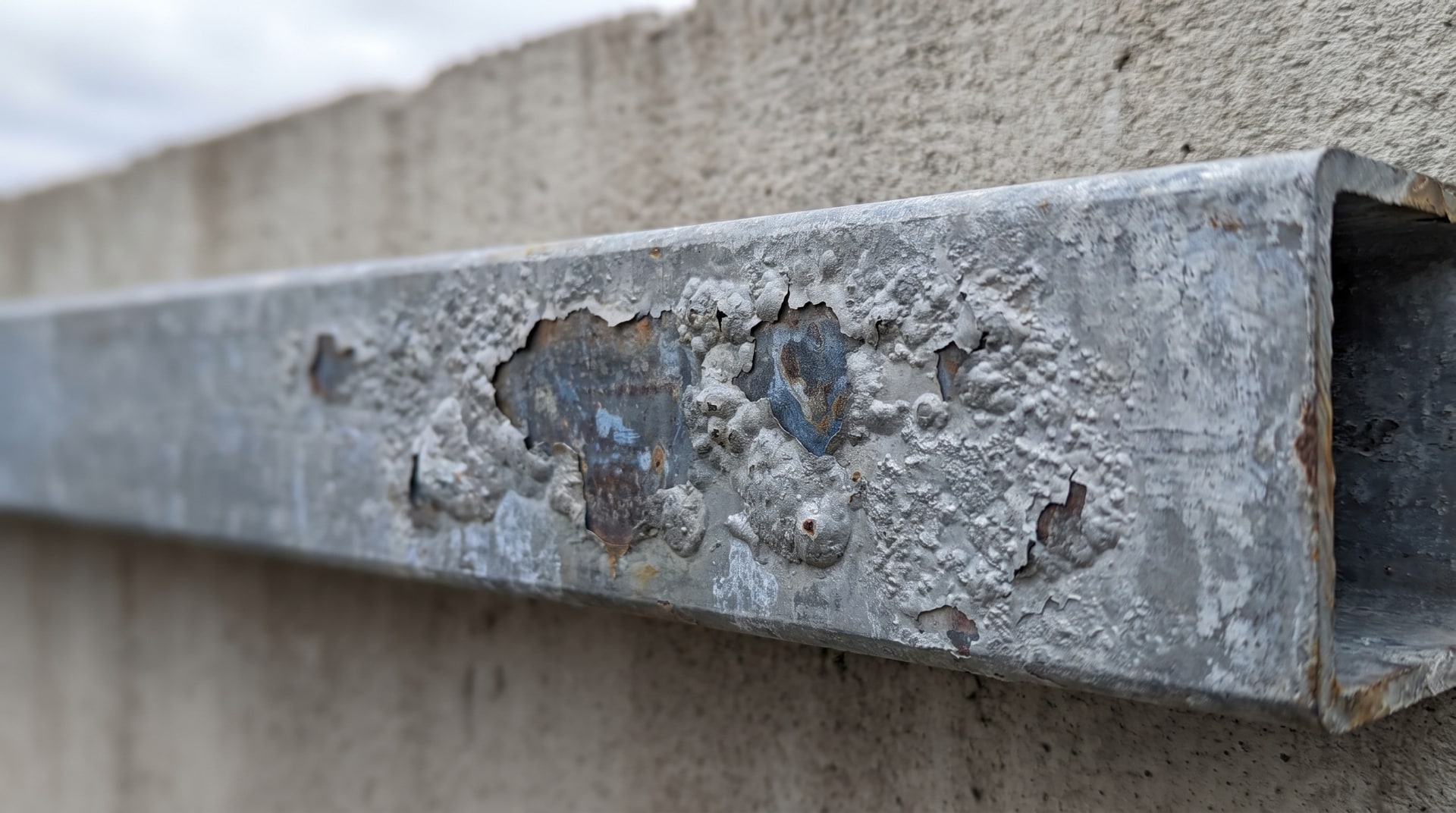
Surface preparation before painting galvanized steel is one of those steps where good intentions and poor execution can quietly destroy the very coating you are trying to protect. Sweep blasting, when done correctly, is an effective and widely used method for creating the surface profile that paint adhesion requires. But the margin between a proper sweep blast and a damaging one is narrower than most blasting operators realize, and the consequences of crossing that line show up as coating defects that are both expensive to address and easy to misidentify on the job site.
The American Galvanizers Association addresses this directly in their article on sweep blasting galvanized steel. At V&S Galvanizing, we expand on that foundation to explain what is actually happening at the material level, how abrasive selection and blast parameters influence coating performance, and why the distinction between peeling and flaking is often misunderstood in the field.
The Layered Architecture of a Hot-Dip Galvanized Coating
To understand what goes wrong during overblasting, you first need a clear picture of what the galvanized coating actually is. Hot-dip galvanizing does not simply deposit a uniform layer of zinc on steel. The coating that forms is a metallurgically bonded structure made up of several intermetallic alloy layers, each with a progressively higher iron content as you move from the outer surface toward the base steel.
The outermost layer, known as the eta layer or free zinc layer, is essentially pure zinc. Beneath it sit a series of zinc-iron intermetallic phases, each harder and more brittle than the one above it. This layered architecture is what gives the galvanized coating its durability: the intermetallic layers bond tightly to the steel, while the eta layer provides the sacrificial zinc that weathers and corrodes in service instead of the base metal.
When sweep blasting is performed within the correct parameters, it roughens the surface of the eta layer without disturbing the intermetallic layers beneath. That controlled surface profile is exactly what paint adhesion requires. The trouble begins when the blast is aggressive enough to damage or remove the eta layer and compromise the bond between the outer zinc and the intermetallic zones below it.
Peeling Versus Flaking: Two Different Problems
In the field, the terms "peeling" and "flaking" are often used interchangeably to describe coating coming off steel. They are not the same thing, and confusing the two leads to incorrect diagnosis and the wrong corrective approach.
Peeling is specifically what happens when the free zinc eta layer separates from the intermetallic layers beneath it. Because only the outermost layer has lifted, a measurable coating thickness typically remains on the steel surface at the affected area. Visually, peeling tends to look like thin sections of zinc lifting away from the surface, sometimes resembling tin foil, or as blisters where the outer layer has begun to separate without fully detaching. A coating thickness measurement in a peeled area will generally read approximately one mil or more, confirming that material still exists beneath the separation.
Flaking, on the other hand, involves the entire galvanized coating, including both the free zinc and the intermetallic layers, coming away from the steel. The substrate is exposed or nearly so, and a thickness gauge will return a near-zero reading. Flaking debris tends to come off in stiffer, more defined chunks rather than the thin, foil-like strips associated with peeling. The root causes of flaking and peeling overlap in some cases but can also differ significantly, so accurate diagnosis matters before deciding on a repair approach.
When sweep blasting is the culprit, the defect pattern is almost always peeling rather than flaking, because the blast is acting on the outer zinc surface rather than penetrating all the way to the steel interface.
Why Sweep Blasting Exists in the First Place
Standard abrasive blasting applied to galvanized steel without restraint will strip the coating down to bare metal. That is clearly counterproductive if the goal is painting over an intact zinc surface. Sweep blasting was developed as a controlled alternative: using lighter media, lower pressure, and a shallower angle to create a surface profile on the zinc without removing the zinc itself.
The reason a surface profile matters at all comes down to paint adhesion mechanics. A completely smooth zinc surface offers limited mechanical keying for a paint or coating system. By introducing a controlled roughness, sweep blasting increases the effective contact area between the topcoat and the zinc, improving adhesion without sacrificing the corrosion protection the zinc layer provides. This makes sweep blasting a standard preparatory step in duplex systems, where a paint or powder coating is applied over an intact hot-dip galvanized surface.
The critical distinction between sweep blasting and conventional blasting is not just a matter of degree. It reflects a fundamentally different objective: profiling the surface versus cleaning or stripping it. Achieving the right outcome depends entirely on controlling the variables that govern how aggressively the abrasive contacts the coating.
The Four Parameters That Determine Whether Sweep Blasting Damages the Coating
Overblasting is not always an act of carelessness. In many documented cases, operators who are skilled at blasting concrete, structural steel, or other substrates apply those same techniques to galvanized steel without realizing the coating responds very differently. Four parameters directly control whether sweep blasting achieves its goal or causes peeling damage.
Abrasive selection is arguably the most consequential factor. Galvanized steel requires soft media with a Mohs hardness rating of five or less. Materials that have been used successfully include aluminum/magnesium silicate, soft mineral sands, organic media such as corn cobs or walnut shells, and stone materials such as corundum and limestone. Particle size should stay between 200 and 500 micrometers. Using harder abrasives, even at low pressure, introduces excessive impact energy per particle and can shear the eta layer away from the intermetallic zone beneath it.
Blast pressure should be held at 40 psi or below. Above that threshold, even softer abrasives can become damaging because the kinetic energy delivered at impact exceeds what the outer zinc layer can absorb without debonding. Blast angle should be kept between 30 and 60 degrees relative to the steel surface. Shallow angles reduce impact energy; steep angles approaching 90 degrees concentrate that energy in a way that tends to peel rather than profile.
The fourth variable, often overlooked on job sites, is substrate temperature. The steel surface should be maintained at least three degrees Celsius above the dew point during blasting. Moisture condensation on a zinc surface creates a film that can interfere with adhesion during subsequent painting, but it can also affect how the abrasive interacts with the coating during blasting itself. Keeping the substrate above dew point is a simple precaution that costs nothing to implement.
How Overblasting Happens in Real Projects
One of the more instructive examples of unintentional overblasting involves a scenario where galvanized steel angles were attached to a concrete wall that needed blasting to achieve a specified surface finish for the concrete. The blasting contractor used the pressure and media appropriate for concrete, which is significantly more aggressive than what zinc can tolerate. The galvanized angles on the same wall received the same blast treatment. The result was blistering and peeling of the galvanized coating on the angles, even though the blaster had done nothing wrong from a concrete-surface-preparation standpoint.
This example highlights a real coordination problem that shows up on mixed-substrate projects. When concrete, structural steel, and galvanized steel are in close proximity, the requirements for each substrate do not overlap. Blasting parameters suitable for one can be destructive to another. Awareness of what is in the blast path, and which surfaces have coating systems that require protection or modified technique, is essential to avoiding this outcome.
The damage in these cases is not a product failure. The galvanizing itself performed correctly until it was subjected to conditions it was never designed to withstand. Responsibility for prevention sits with project coordination and operator knowledge, not with the coating.
Steel Shot and Grit: A Separate Set of Trade-offs
Steel shot and steel grit are occasionally considered for preparing galvanized surfaces, and both have been used with some success. The performance characteristics they produce, however, come with specific trade-offs that designers and specifiers should understand before calling them out in a project specification.
Steel grit, because of its angular geometry, creates sharper peak-and-valley profiles than steel shot, which produces a more rounded texture. For industrial coating systems requiring higher surface profiles, grit can achieve characteristics that softer media cannot match. That is a legitimate advantage in certain applications.
The significant concern with iron-containing abrasives is embedment. When steel shot or grit contacts the relatively soft surface of the zinc eta layer, small particles of the abrasive can become mechanically lodged in the surface. Once embedded, those iron-containing particles create sites of dissimilar metal contact between the steel abrasive and the zinc surface, which introduces the potential for bimetallic corrosion. For a coating system where long-term corrosion protection is the primary objective, that is a meaningful risk. The paint or powder coating applied over the prepared surface may also behave differently over embedded abrasive particles compared to clean zinc, potentially affecting long-term adhesion and barrier performance.
This does not mean iron-containing abrasives are categorically prohibited, but their use requires a deliberate evaluation of whether the surface profile advantage outweighs the embedment risk for the specific application and environment.
Other Causes of Galvanized Coating Peeling Unrelated to Blasting
Peeling that occurs after fabrication or on installed structures is not always caused by abrasive blasting. Understanding the other mechanisms that produce the same visual symptom helps engineers and inspectors avoid incorrectly attributing the damage to surface preparation when the root cause lies elsewhere.
Exposure to elevated temperatures is one established pathway to peeling. When galvanized steel is subjected to temperatures above approximately 390 degrees Fahrenheit for extended periods, whether that means a few minutes at very high temperatures or a few hours at moderately elevated ones, the thermal stress can cause the eta layer to separate from the intermetallic layers beneath. This can happen in service environments near heat sources or during secondary fabrication operations that involve heating.
Slow cooling after galvanizing is another mechanism. On thick steel sections, pipe and tubing, or steel that was stacked while still hot from the galvanizing bath, the retained heat causes extended time at elevated temperatures that can compromise the bond between coating layers. The result looks identical to thermally induced peeling from post-fabrication heating, though the timing and context differ. When peeling is found on a structure that has never been blasted or heated in service, investigating whether the original galvanizing process involved conditions that could produce this outcome is the appropriate diagnostic step.
The ability to distinguish blast-induced peeling from thermal peeling matters practically because the remediation approach, and the allocation of responsibility, depends on correctly identifying the cause.
Work With a Team That Understands the Coating You Are Protecting
Sweep blasting is not complicated in principle, but the gap between theory and field execution is where most damage occurs. The parameters are straightforward: the right abrasive hardness and particle size, pressure at or below 40 psi, angle between 30 and 60 degrees, substrate above dew point. What makes the difference in practice is whether everyone involved in the project, from the specifier to the blasting contractor, understands that these parameters exist for a reason rooted in the material science of how zinc bonds to steel.
At V&S Galvanizing, we work with engineers, fabricators, and contractors at every stage of a project, not just during the galvanizing process itself. When questions come up about surface preparation, coating defects, or preparing galvanized steel for a duplex coating system, we can help interpret what you are seeing and identify the right path forward. Misdiagnosis at this stage is costly, and the right guidance early prevents rework later.
If you are dealing with a coating appearance issue, planning a painting specification over galvanized steel, or trying to determine whether blast damage has compromised the corrosion protection on a fabricated assembly, reach out to our team through the contact page. We are here to help you make informed decisions backed by accurate technical understanding.
Frequently Asked Questions About Sweep Blasting Galvanized Steel
What is the maximum blast pressure allowed when sweep blasting galvanized steel?
Blast pressure should not exceed 40 psi when sweep blasting a galvanized surface. Pressures above this threshold deliver enough kinetic energy to shear the outer free zinc layer away from the intermetallic layers beneath it, causing peeling regardless of abrasive type.
How do you tell the difference between peeling and flaking on a galvanized coating?
Take a coating thickness measurement in the affected area. If the gauge reads approximately one mil or more, the defect is peeling: the outer eta layer has separated but underlying intermetallic layers remain. If the reading is near zero, the defect is flaking, meaning the entire coating system has detached from the steel. Visually, peeling looks like thin foil-like strips or blisters; flaking produces stiffer, more defined chunks with sharper edges.
Can steel shot or grit be used to prepare galvanized steel for painting?
Both have been used successfully, but iron-containing abrasives carry a real risk of particle embedment in the soft zinc surface. Embedded steel particles create sites of dissimilar metal contact that can initiate bimetallic corrosion and may affect the long-term performance of the applied paint or powder coating system. This trade-off should be evaluated deliberately before specifying iron-containing abrasives on galvanized steel.
What abrasive materials are appropriate for sweep blasting zinc-coated steel?
Materials that have been used successfully include aluminum/magnesium silicate, soft mineral sands with a Mohs hardness rating of five or less, organic media such as corn cobs or walnut shells, and stone materials such as corundum and limestone. Particle size should be between 200 and 500 micrometers. Harder abrasives risk peeling the coating even at compliant pressures.
What angle should the blast nozzle be held at relative to a galvanized surface?
The blast angle should be between 30 and 60 degrees relative to the steel surface. Steeper angles approaching 90 degrees concentrate impact energy in a way that tends to peel the outer zinc layer rather than creating a uniform surface profile.
Why does substrate temperature matter during sweep blasting?
The steel surface should be at least three degrees Celsius above the dew point during blasting. Moisture condensation on the zinc surface can affect how the abrasive interacts with the coating and can compromise adhesion in the subsequent paint system. Maintaining proper substrate temperature is a simple precaution that costs nothing operationally.
Can peeling be caused by something other than overblasting?
Yes. Peeling also results from exposing galvanized steel to temperatures above approximately 390 degrees Fahrenheit for prolonged periods. It can also occur when steel cools too slowly after galvanizing, which is most common on thick steel sections one inch or greater, pipe and tubing, or steel that was stacked while still hot from the galvanizing bath. Diagnosing peeling correctly requires considering all three potential causes before determining a corrective action.
Does sweep blasting remove the entire galvanized coating?
When performed correctly, sweep blasting removes zinc corrosion compounds and profiles the outer free zinc layer without removing the zinc metal itself. Standard abrasive blasting applied without the controlled parameters required for sweep blasting can strip most of the coating. The controlled parameters of sweep blasting, specifically softer media, lower pressure, and shallower blast angle, are what preserve the coating while creating the adhesion profile that paint requires.
