
The galvanizing kettle is the physical heart of any hot-dip galvanizing operation. It holds hundreds of thousands of pounds of molten zinc at temperatures typically between 815 and 850 degrees Fahrenheit, and it does so continuously, day after day, for years at a time. The structural integrity of that vessel is not an abstract concern. It directly governs whether a facility can operate safely, consistently, and without catastrophic interruption. Among all the dimensions a galvanizer monitors about a kettle, sidewall thickness may be the single most consequential variable in long-term equipment health.
The American Galvanizers Association addresses this directly in their article on sidewall kettle thickness. At V&S Galvanizing, we expand on that foundation to explain what is actually happening at the material level, how wall degradation influences process reliability and safety, and why this topic is often underappreciated until a problem is already developing.
What the Kettle Sidewall Actually Does
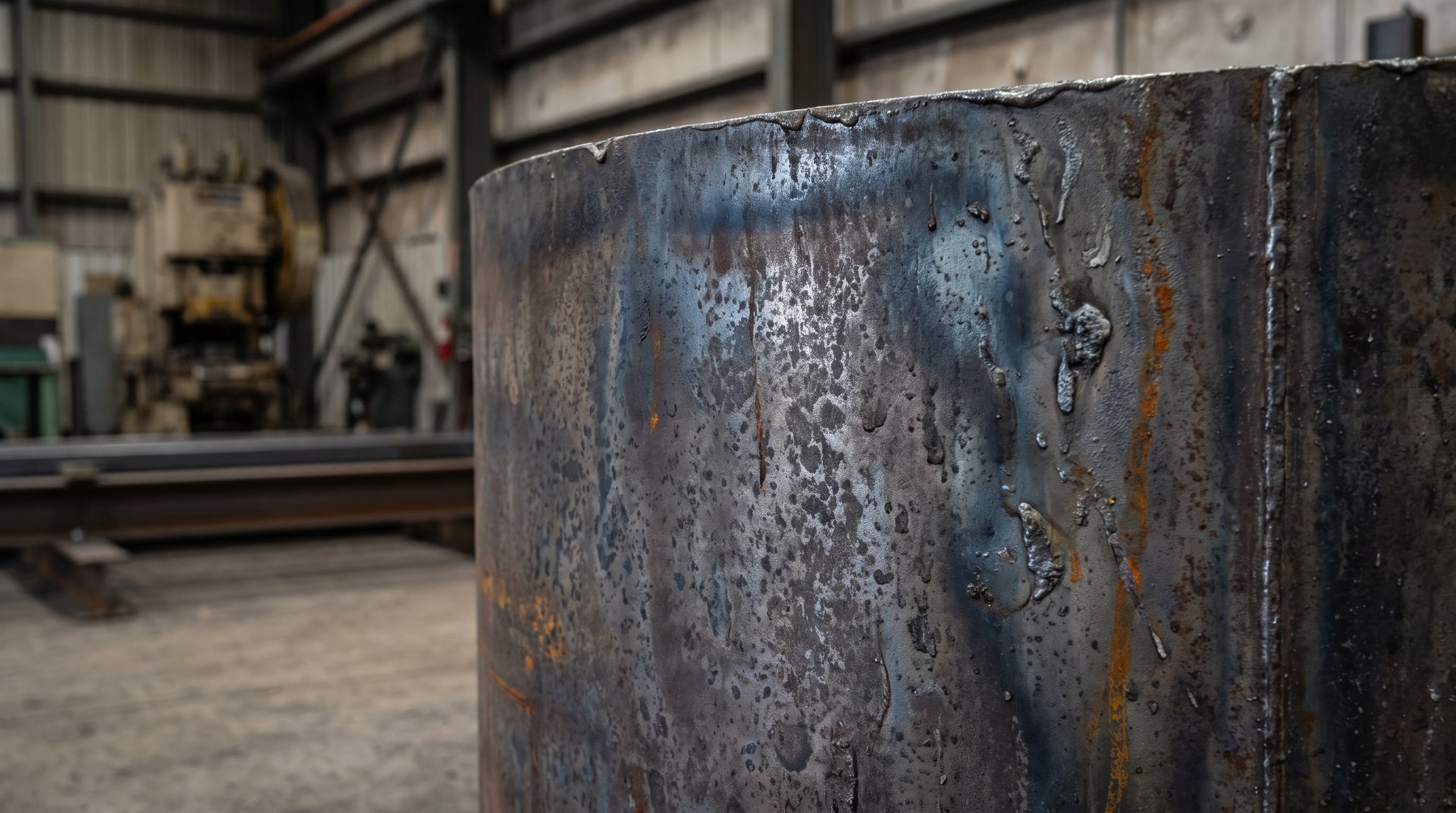
A galvanizing kettle is not a simple container. It is a precision-engineered vessel manufactured from low-carbon, low-silicon steel, designed specifically to resist the chemical and thermal attack of molten zinc over an extended service life. The sidewalls bear both the hydrostatic load of the zinc bath and the thermal stress created by uneven heating from the burner system below. At any cross-section along the kettle wall, the steel must maintain enough thickness to carry these combined loads without yielding or developing stress cracks.
The sidewall is exposed to two degradation mechanisms simultaneously. From the inside, molten zinc dissolves iron from the steel surface in a slow but continuous process called iron-zinc interdiffusion. From the outside, the combustion environment around the kettle creates oxidation and, in some configurations, localized hot spots that accelerate surface loss. Neither mechanism is dramatic on any given day, but over a service life measured in years, the cumulative material loss becomes significant and, eventually, critical.
Why Molten Zinc Erodes the Kettle Wall Over Time
This erosion is not incidental. It is a fundamental consequence of the thermodynamic relationship between iron and zinc at elevated temperatures. Molten zinc at galvanizing temperatures has a measurable solubility for iron, meaning it continuously draws iron atoms out of any steel surface it contacts. The rate at which this happens depends on zinc temperature, bath chemistry (particularly aluminum and lead content), and fluid dynamics within the kettle.
Turbulence matters more than many people realize. Areas of the kettle wall where zinc circulation is most active lose material faster than quieter zones. The bottom corners and lower sidewalls, which are nearest the burner zones and experience the highest zinc temperatures, tend to show the greatest erosion over time. This is why inspection programs that measure only a single point on the sidewall give an incomplete picture. Wall thickness varies across the kettle surface, and the thinnest region at any given time is the one that governs remaining service life.
Additionally, the iron that dissolves from the kettle walls does not simply vanish. It contributes to the formation of bottom dross, the intermetallic compound that settles to the floor of the kettle. A rising iron content in the bath, sometimes observed as unexpected dross accumulation, can be an indirect signal that kettle wall erosion is progressing faster than normal.
How Galvanizers Measure Sidewall Thickness
Because the inside of an operating kettle cannot be accessed directly, galvanizers rely on non-destructive evaluation (NDE) techniques applied to the exterior surface. Ultrasonic thickness testing is the standard method. A transducer coupled to the outer kettle wall sends a high-frequency sound pulse through the steel, which reflects off the inner surface and returns to the sensor. The time of flight of that pulse is converted to a thickness measurement based on the known acoustic velocity of the steel.
This sounds straightforward, but there are real complications in practice. The kettle exterior is hot, which degrades coupling efficiency and can introduce measurement error if proper high-temperature transducers and couplants are not used. Surface oxide and scale on the kettle exterior must be prepared to a consistent condition for repeatable readings. Perhaps most importantly, a useful inspection program maps thickness at a grid of points across the entire sidewall, not just at a few convenient locations. Single-point measurements are almost never adequate for trending purposes.
The resulting data is compared against baseline measurements taken when the kettle was new or last inspected, and against minimum allowable thickness values that account for the applied loads and required safety margins. When measured thickness at any location approaches those minimums, the kettle is approaching the end of its serviceable life in that region, regardless of what other areas look like.
Minimum Thickness Thresholds and What They Mean in Practice
Minimum acceptable sidewall thickness is not arbitrary. It is derived from the structural analysis of the kettle under full zinc load, accounting for the yield strength of the kettle steel at operating temperature. Steel loses a meaningful portion of its room-temperature strength as temperature rises, so the allowable stress at 840 degrees Fahrenheit is lower than it would be at ambient conditions. The minimum thickness threshold must account for this elevated-temperature strength reduction.
What this means operationally is that a kettle with sidewalls that appear visually adequate from the outside may already be below minimum allowable thickness in localized zones. Visual inspection alone cannot detect this. A galvanizer relying on visual assessment without periodic ultrasonic measurement is, in practical terms, not monitoring kettle integrity at all. The consequences of a kettle failure, which can involve rapid release of molten zinc, are severe enough that this kind of monitoring gap is a real safety concern, not just a quality issue.
When measurements reveal that a zone of the sidewall has thinned to near-minimum or below-minimum values, the operator faces a decision about continued service, repair, or kettle replacement. Some operations have successfully extended kettle life through weld repair of locally thinned areas, though this introduces its own considerations around heat-affected zone properties and the potential for stress concentration at repair boundaries.
The Role of Operating Temperature in Wall Degradation Rate
Temperature is the most powerful variable controlling how fast the kettle wall erodes. The iron-zinc dissolution rate increases substantially with temperature, following an approximately exponential relationship. Operating a kettle at 850 degrees Fahrenheit rather than 820 degrees Fahrenheit may not seem like a large difference, but it meaningfully accelerates the rate at which iron is pulled from the kettle wall into the bath.
This creates an important practical tension. Higher bath temperatures can improve galvanizing fluidity and drainage on complex parts, and may be operationally attractive for that reason. But every degree above the minimum necessary temperature is contributing to faster kettle wall erosion and shorter equipment life. Disciplined temperature management is not just about zinc consumption or coating quality. It is also about how long the kettle itself will last.
Similarly, bath chemistry influences the rate of iron dissolution. Aluminum additions, which are routine in modern galvanizing for surface quality reasons, can influence the iron-zinc reaction kinetics at the kettle wall surface. This is one reason why bath chemistry records and kettle thickness records should be maintained together as part of an integrated equipment management program, rather than treated as separate operational concerns.
Kettle Geometry and Its Influence on Where Thinning Occurs
Not every square foot of a galvanizing kettle sidewall degrades at the same rate, and the pattern of thinning is not random. It follows from the geometry of the kettle, the placement of the burner system, and the circulation patterns of the zinc bath during operation.
Burner placement creates localized thermal gradients along the kettle exterior. Zones directly adjacent to burner ports or flame impingement areas experience higher exterior surface temperatures, which elevates the steel temperature at that cross-section and increases the local zinc dissolution rate on the interior. Over time, these zones develop measurably thinner walls than areas further from heat sources. A well-designed inspection grid specifically targets these predictable high-erosion zones, taking more measurement points in areas of known elevated risk rather than distributing readings uniformly across the surface.
The lower sidewall near the kettle floor is also a common thinning location for a different reason. Zinc circulation near the bottom of the kettle, driven by thermal convection and the introduction of cold steel during immersion, keeps the zinc in motion against the lower wall. The combination of higher local zinc temperature and greater fluid contact time accelerates erosion at the lower sidewall relative to the upper regions, where the zinc surface is calmer.
Inspection Frequency and Record-Keeping Practices
There is no single universally mandated inspection interval for galvanizing kettle sidewall thickness. Responsible galvanizers establish their own programs based on kettle age, operating history, temperature regime, and the rate of thickness change observed in previous inspections. A kettle that is five years old and showing minimal thinning relative to baseline might be inspected annually. A kettle approaching its tenth or twelfth year of service, or one that has shown an accelerating rate of wall loss, warrants more frequent assessment.
What matters as much as the frequency is the quality of the data. Each inspection should use a consistent grid, documented point locations, calibrated instrumentation, and a comparison against prior measurements at the same locations. Trends over multiple inspections are more informative than any single set of readings. A kettle that has lost 10 percent of its sidewall thickness over the past two years warrants a different operational response than one that lost that same amount over eight years.
Record retention is not optional for a serious program. When a kettle reaches end of life, those thickness records provide the documentation needed to understand where the vessel failed in its service life relative to initial expectations, which informs purchasing decisions for the replacement kettle and calibrates the inspection program going forward. At V&S Galvanizing, our approach to hot-dip galvanizing process management incorporates this kind of longitudinal equipment thinking, because the quality of the coating we produce depends on the reliability of the equipment producing it.
Consequences of Deferred Monitoring and What Failure Looks Like
A kettle sidewall failure is not a gradual, manageable event. When a zone of steel that has been reduced to or beyond its minimum thickness gives way under the combined thermal and hydrostatic load, the result is rapid and potentially catastrophic. Molten zinc at 840 degrees Fahrenheit is not merely a process hazard in the abstract sense. It is a high-energy liquid that will flow, ignite nearby combustibles, and cause severe thermal injury to anyone in its path.
This is why the monitoring program described above is fundamentally a safety program, not merely a maintenance scheduling tool. The risk is not that production will slow down because the kettle is unavailable for repair. The risk is that without monitoring, the first indication of a sidewall thickness problem may be the failure itself.
Industry experience also shows that kettle failures often occur during periods of thermal cycling, such as when a kettle is being reheated after a planned or unplanned cooldown. The thermal stresses introduced during reheating add to the static load the thinned wall must carry, and this is sometimes when a marginal zone reaches its limit. This is one reason why galvanizers who operate their kettles more continuously tend to see more predictable degradation patterns than those whose operations involve frequent temperature fluctuations.
Work With a Team That Treats Equipment Integrity as Part of Process Quality
Kettle sidewall thickness is one of those topics that reveals something important about how a galvanizing operation is run. A facility that tracks wall thickness systematically, maintains records across inspection cycles, manages bath temperature conservatively, and plans kettle replacement proactively is a facility that understands the relationship between equipment condition and coating quality. These are not separate concerns. The zinc bath chemistry, the coating thickness your steel receives, and the consistency of results across your order all depend on a kettle that is operating within its intended design parameters.
At V&S Galvanizing, we take the mechanical and operational condition of our equipment seriously because our customers depend on the predictability and quality of what comes out of that kettle. If you have questions about our galvanizing process, equipment capabilities, or how we handle quality assurance from the kettle outward, we encourage you to reach out through our contact page. Our team is glad to discuss the details with engineers, fabricators, and project teams who want to understand the process behind the coating.
Frequently Asked Questions About Sidewall Kettle Thickness
What causes a galvanizing kettle sidewall to thin over time?
The primary cause is iron-zinc interdiffusion. Molten zinc at galvanizing temperatures continuously dissolves iron from any steel surface it contacts, including the interior kettle wall. This process is slow but cumulative, and it is accelerated by higher bath temperatures, turbulent zinc flow near the walls, and localized hot spots created by burner placement on the kettle exterior.
How is sidewall thickness measured on an operating galvanizing kettle?
Ultrasonic thickness testing is the standard non-destructive method. A transducer is applied to the cooler exterior surface of the kettle, and the transit time of a sound pulse through the steel gives a calculated thickness. High-temperature transducers and appropriate couplants are required for accuracy, and measurements must be taken at a systematic grid of points to capture variation across the kettle surface.
Where does the most wall thinning typically occur on a galvanizing kettle?
The lower sidewalls and zones adjacent to burner placements tend to show the greatest erosion. Near burners, exterior wall temperatures are higher, which elevates the local zinc dissolution rate. Near the kettle floor, convective zinc circulation maintains active fluid contact against the wall over long periods. Both mechanisms concentrate material loss in these predictable regions.
What happens if a galvanizing kettle sidewall drops below minimum allowable thickness?
Below minimum thickness, the remaining steel may not be able to carry the combined hydrostatic load of the zinc bath and the thermal stresses at operating temperature. This creates risk of sudden structural failure, which can release large quantities of molten zinc rapidly. The minimum thickness threshold is calculated from the structural requirements of the vessel under full load, with reductions for elevated-temperature steel strength.
How often should a galvanizing kettle be inspected for sidewall thickness?
There is no single universal requirement, but responsible galvanizers establish inspection intervals based on kettle age, operating temperature history, and the rate of thinning observed in previous inspections. Older kettles and those showing accelerating thickness loss warrant more frequent assessment. Annual inspection is a common starting point, with shorter intervals as the kettle ages toward end of service life.
Can a thinned kettle sidewall be repaired rather than replaced?
In some cases, localized weld repair has been used to restore wall thickness in zones that have thinned beyond acceptable limits. However, this introduces heat-affected zone considerations and potential stress concentration at repair boundaries. Repair decisions should be made carefully, with engineering analysis, and are not always a substitute for planned kettle replacement when thinning is widespread.
Does bath chemistry affect how fast the kettle wall erodes?
Yes. Bath chemistry, including aluminum and lead content, influences the kinetics of iron dissolution at the kettle wall surface. Because the iron dissolved from the kettle walls contributes to dross formation, unusual increases in dross accumulation can sometimes signal accelerated wall erosion. This is one reason why bath chemistry records and kettle thickness inspection records are best maintained together.
Why does operating temperature matter for kettle sidewall longevity?
The iron-zinc dissolution rate increases significantly with temperature, following an approximately exponential relationship. Even modest increases above the minimum required bath temperature meaningfully accelerate material loss from the kettle wall. Disciplined temperature management extends kettle service life and is one of the most effective levers an operator has for managing long-term equipment costs alongside coating quality.
