

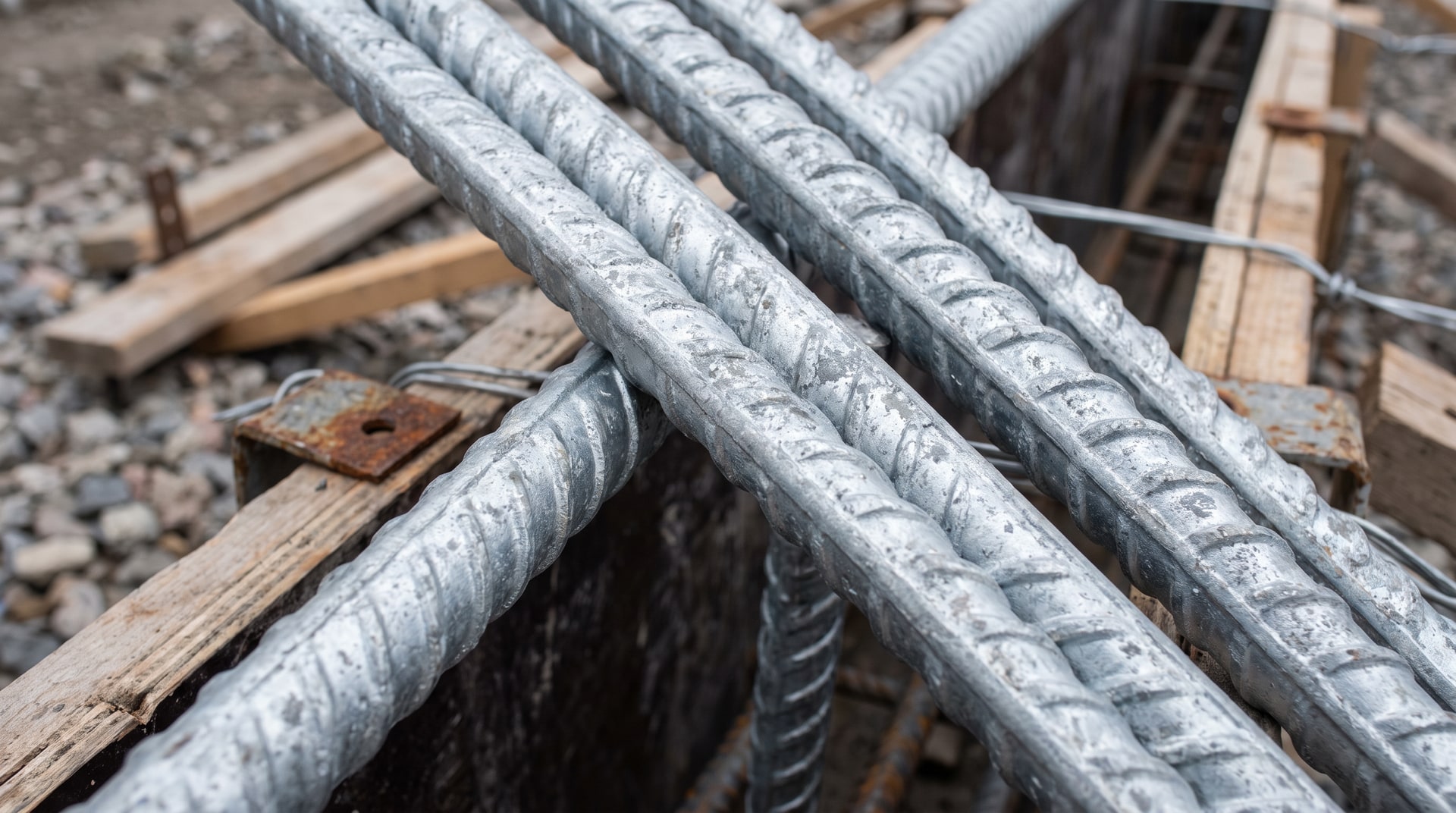
When reinforced concrete is designed to perform over decades, the bond between rebar and the surrounding concrete matrix is not a secondary concern. It is foundational. That bond is what allows stress to transfer between two materials with very different properties, and it is what keeps a structure behaving as its engineer intended. Any coating applied to rebar changes that interface, and that change either helps or hurts load transfer depending on what is actually happening at the material level.
Hot-dip galvanized rebar has historically been viewed with some skepticism on this point. The smooth, bright appearance of a freshly galvanized bar gives the impression of a surface that concrete will not grip well. That intuition is understandable, but it turns out to be wrong in practice. The American Galvanizers Association addresses this directly in their article on bond strength of galvanized rebar. At V&S Galvanizing, we expand on that foundation to explain what is actually happening at the material level, how the zinc-concrete interface influences performance, and why this is often misunderstood in the field.
The Bond Strength Question and Why It Confused Researchers Early On
Early testing on hot-dip galvanized rebar bond strength produced contradictory results. Some studies showed strong performance; others showed underperformance relative to black steel. That inconsistency was enough to keep the question open for years and contribute to a general wariness about specifying galvanized rebar in structural concrete applications.
The problem was not the material. It was the variables in the test conditions themselves. Differences in concrete mix chemistry, curing environments, chromate treatment practices, and test methodology all influenced outcomes in ways that were not always controlled or reported consistently. When researchers began standardizing those variables and applying more rigorous protocols, the results aligned: hot-dip galvanized rebar consistently matches or exceeds black rebar bond strength. Three dedicated studies on this question reached the same conclusion: Zinc Coated Reinforcement for Concrete, The Influence of Steel Galvanization on Rebars Behavior in Concrete, and Bond of Ribbed Galvanized Reinforcing Steel in Concrete. In all three, galvanized rebar showed higher bond strength to concrete than black rebar.
The earlier confusion is worth acknowledging because it shaped industry perception for a long time. Some engineers who trained in the 1970s or 1980s may still carry assumptions that the data no longer support.
What Actually Creates Bond Strength at the Zinc-Concrete Interface
The mechanism behind galvanized rebar's bond performance is specific and well-documented. When hot-dip galvanized steel is embedded in concrete, the zinc coating reacts with calcium hydroxide in the cement paste. This reaction produces calcium hydroxyzincate crystals at the interface between the zinc coating and the concrete matrix.
Those crystals are not incidental. They form a physical interlocking structure between the bar surface and the surrounding paste, and that interlocking increases adhesion measurably. This is not the same mechanism that gives black rebar its bond strength, which relies more on mechanical interlock from the deformed rib geometry and friction from surface texture. Galvanized rebar gets both: the mechanical interlock from deformations and the additional adhesion contribution from calcium hydroxyzincate crystal formation. That combination is why the three studies cited above consistently found galvanized rebar coming out ahead.
This is also why the smooth, bright appearance of galvanized steel is misleading to visual inspection. The chemistry at the interface after embedment creates adhesion that no visual assessment of the dry bar surface can predict. Engineers and inspectors who dismiss galvanized rebar based on appearance are working from the wrong information.
The Hydrogen Evolution Concern: What It Is and How Significant It Actually Is
One of the legitimate technical concerns raised about galvanized rebar in concrete has been the possibility of hydrogen evolution. When zinc reacts with the alkaline environment of wet cement paste, hydrogen gas can be produced during the curing period. If hydrogen develops between the concrete and the surface of the galvanized bar, it could theoretically create voids at that interface and reduce bond strength.
This concern has not been dismissed outright, but more recent testing has significantly reduced its practical weight. Two findings in particular are important. First, hydrogen evolution appears to occur for a much shorter duration than originally assumed. The reaction window is narrow, and the amount of gas produced during that window may not be enough to meaningfully compromise the interface. Second, and perhaps more significantly, there is evidence that hydrogen evolution may not occur at the cement matrix-to-galvanized bar interface at all. It may instead occur at the iron-zinc alloy layer within the coating itself, which would mean the gas never reaches the bond zone between the bar and the concrete. If that is where the reaction is happening, the structural bond is not affected.
Neither of these findings eliminates hydrogen evolution as a consideration, but they do reframe it from a likely problem to a manageable one with known mitigation strategies already embedded in the relevant specification.
How ASTM A767 Addresses the Hydrogen Evolution Issue
ASTM A767/A767M is the governing specification for hot-dip galvanized reinforcing bars for concrete. It requires that galvanized rebar be dipped into a chromate quench solution after the galvanizing process. This chromate treatment passivates the zinc surface and significantly reduces or eliminates the reaction between the zinc coating and the alkaline cement paste during the early curing phase.
The chromate quench is not optional under ASTM A767. It is a required step precisely because the standard accounts for the hydrogen evolution concern and provides a defined solution. Any galvanizer producing rebar to this specification is already applying this treatment as part of normal process compliance.
It is also worth noting that certain concrete mix designs naturally contain enough chromates to achieve the same passivating effect without requiring additional treatment at the rebar level. The standard's quench requirement covers the general case, but in practice the system has multiple potential safeguards depending on the concrete chemistry involved.
For engineers specifying galvanized rebar, referencing ASTM A767/A767M in project documents ensures the chromate quench requirement is contractually enforced and not left to processor discretion. Our team at V&S Galvanizing processes rebar in full compliance with this specification, and we can discuss documentation and certification needs with project teams before fabrication begins. You can learn more about our process at /services/hot-dip-galvanizing.
Epoxy-Coated Rebar: The Bond Strength Comparison That Changes the Calculus
The comparison between galvanized and black rebar is informative, but the comparison between galvanized and epoxy-coated rebar may be more relevant for many engineers making specification decisions. Fusion-bonded epoxy has been widely used as a corrosion protection coating for rebar, particularly in bridge decks and marine structures, and it is often treated as the default corrosion-resistant option.
The bond strength data for epoxy-coated rebar tell a different story than many specifiers expect. Research published by the American Society of Civil Engineers, the International Journal of Cement Composites and Lightweight Concrete, and the Proceedings of the Institution of Civil Engineers found that epoxy-coated rebar exhibits a 20% to 50% reduction in bond strength compared to black rebar. That is not a minor penalty. A 50% reduction in bond strength means the bar is performing roughly on par with plain round rebar, which lacks the mechanical interlock of deformed bar geometry entirely.
The reason is straightforward: epoxy is a smooth polymer coating, and it does not form a chemical or crystalline bond with the concrete matrix. The deformed geometry of the bar is still present, but the epoxy layer acts as a low-friction interface that limits the full mechanical contribution of those ribs. The concrete is gripping the epoxy, not the steel.
This finding applies not just to traditional fusion-bonded epoxy rebar but also to proprietary systems in which zinc-coated rebar is subsequently epoxy-coated. When epoxy is the outermost layer, epoxy is the surface in contact with the concrete, and the bond behavior reflects that regardless of what is underneath.
When you place hot-dip galvanized rebar alongside epoxy-coated rebar in this comparison, the galvanized option is not slightly better. It is substantially better. Galvanized rebar outperforms black rebar on bond, and epoxy-coated rebar significantly underperforms black rebar on bond. That gap has real design implications.
What This Means for Lap Splice and Development Length Design
One of the most practical takeaways from the bond strength data is the implication for lap splice design and development length calculations. In reinforced concrete design, the required overlap length for spliced bars or the required embedment depth for developed bars is directly tied to the bond strength between the bar and the concrete. Lower bond strength means longer required lengths to transfer the same load.
For epoxy-coated rebar, this relationship is already addressed in ACI 318, which includes modification factors that increase required development lengths to account for the bond strength reduction. Engineers working with epoxy-coated rebar are already paying a design penalty in the form of longer laps and more congestion in reinforced sections.
For hot-dip galvanized rebar, the AGA's position based on the research is that no such penalty is required. The bond strength of galvanized rebar is high enough that lap splice and development lengths can be designed using the same values as black rebar. That means a project can gain the corrosion protection benefit of the zinc coating without changing the structural geometry of the reinforcement layout. In congested sections or where concrete cover is limited, that is a meaningful design advantage.
Addressing the Visual Impression: Why Smooth Does Not Mean Weak
We want to address directly what the AGA article also calls out: the visual impression of galvanized rebar creates a persistent misconception in the field. A freshly galvanized bar looks smooth and bright. Compared to mill-scaled black rebar or rebar with surface rust, it looks like something that concrete would have trouble holding onto.
That impression is intuitive but incorrect, and it matters because field decisions sometimes get made on intuition rather than data. An inspector or contractor who sees galvanized rebar and assumes it will perform poorly at the bond interface is working from an assumption that the experimental record has overturned. The calcium hydroxyzincate crystal formation that drives the bond advantage is not visible. It happens after embedment, during curing, and it cannot be assessed by looking at a dry bar on a jobsite.
The takeaway for anyone involved in specifying, inspecting, or placing galvanized rebar is that the visual smoothness of the coating is irrelevant to bond performance. The relevant factors are coating integrity, compliance with ASTM A767 including the chromate quench, and proper concrete placement practices. Those are the variables that control outcomes, not the surface appearance of the bar.
Work With a Team That Understands the Full Picture
Bond strength is one of the more nuanced aspects of galvanized rebar performance, and it is one where the gap between common perception and experimental reality is particularly wide. The data are consistent across multiple independent studies: hot-dip galvanized rebar equals or exceeds black rebar in bond strength, significantly outperforms epoxy-coated rebar in bond strength, and can be designed to the same lap and development length requirements as black rebar. The mechanism behind that performance, calcium hydroxyzincate crystal formation at the zinc-concrete interface, is well-characterized and reproducible when the coating is applied correctly and the ASTM A767 chromate quench requirement is met.
At V&S Galvanizing, our team works regularly with engineers, fabricators, and contractors on galvanized rebar projects where specification compliance and process documentation matter. If you are evaluating galvanized rebar for a structural concrete application, or if you have questions about ASTM A767 compliance, chromate quench procedures, or how to address bond strength in your design documents, we are ready to work through those details with you. Reach out through our contact page and our technical team will get back to you promptly.
Frequently Asked Questions About Bond Strength of Galvanized Rebar
Does hot-dip galvanized rebar have better or worse bond strength than black rebar?
Hot-dip galvanized rebar has equal or higher bond strength than black rebar. Three independent research studies all found galvanized rebar outperforming black rebar on bond strength to concrete. The improvement is attributed to calcium hydroxyzincate crystals that form at the zinc-concrete interface during curing, which increase adhesion beyond what mechanical interlock alone provides.
What is calcium hydroxyzincate and why does it matter for rebar performance?
Calcium hydroxyzincate is a crystalline compound that forms when zinc reacts with calcium hydroxide in cement paste. At the interface between a galvanized rebar surface and the surrounding concrete, these crystals create a physical and chemical bond that adds to the mechanical interlock from the bar's deformed geometry. This crystal formation is the primary reason galvanized rebar achieves higher bond strength than black rebar in experimental testing.
How much does epoxy coating reduce rebar bond strength?
Research published by the American Society of Civil Engineers and other peer-reviewed sources found that fusion-bonded epoxy-coated rebar exhibits a 20% to 50% reduction in bond strength compared to black rebar. At the high end of that range, epoxy-coated rebar performs similarly to plain round rebar with no deformations. This reduction occurs because the epoxy layer creates a smooth, low-friction interface between the bar and the concrete matrix.
Do I need to increase lap splice lengths when using galvanized rebar instead of black rebar?
No. Based on the available research, hot-dip galvanized rebar bond strength is high enough that lap splice and development lengths can be designed using the same values as black rebar. Unlike epoxy-coated rebar, which requires modification factors in design codes to account for its bond strength reduction, galvanized rebar does not carry that design penalty.
What does ASTM A767 require to address hydrogen evolution concerns?
ASTM A767/A767M requires that hot-dip galvanized reinforcing bars be dipped into a chromate quench solution after galvanizing. The chromate treatment passivates the zinc surface and reduces or prevents the reaction between zinc and wet cement paste that could otherwise produce hydrogen gas during the early curing period. Some concrete mix designs also contain enough chromates naturally to provide this protection at the mix level.
Is the hydrogen evolution concern with galvanized rebar still considered a significant risk?
More recent research has reduced the weight of this concern considerably. Testing indicates that hydrogen evolution may occur for a shorter time period than originally assumed, and there is evidence that the reaction may occur within the iron-zinc alloy layers of the coating rather than at the cement matrix-to-bar interface. If the reaction is occurring within the coating rather than at the bond zone, it does not affect bond strength. The ASTM A767 chromate quench requirement provides the standard industry mitigation regardless.
Does the smooth appearance of galvanized rebar indicate poor adhesion to concrete?
No. The bright, smooth appearance of a well-galvanized bar is not predictive of bond performance. Bond strength is determined by what happens chemically and physically at the cured interface, not by the appearance of the dry bar surface. The calcium hydroxyzincate crystals that contribute to galvanized rebar's bond advantage form after embedment during concrete curing and are not visible during inspection or placement.
Does epoxy coating applied over a zinc coating improve or hurt bond strength compared to plain galvanized rebar?
It hurts it. When epoxy is applied as an outer coating over zinc-coated rebar, the epoxy becomes the outermost surface in contact with the concrete. Bond behavior therefore reflects the epoxy-concrete interface, not the zinc-concrete interface. This means the 20% to 50% bond strength reduction associated with epoxy-coated rebar applies to these proprietary dual-coating systems as well, regardless of the zinc layer underneath.
