

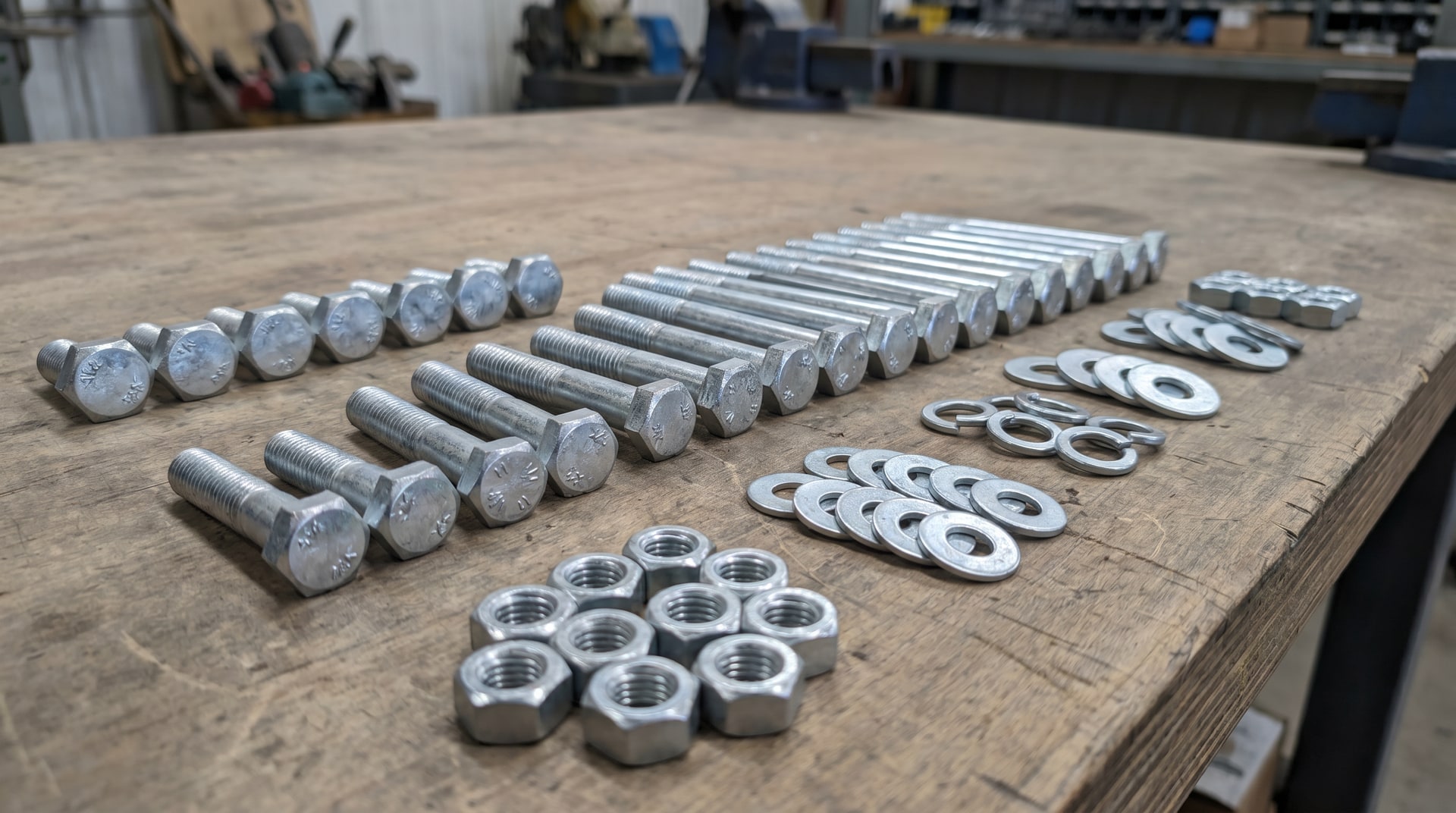
Hardware assemblies such as bolts, nuts, washers, and small fabricated components play a critical role in structural performance. While these items may seem minor compared to large structural members, specifying the correct galvanizing standard is essential to ensure proper coating thickness, fit, and long-term corrosion protection.
Unlike large structural steel, hardware components often require a different galvanizing approach due to their size, threading, and tolerance requirements. The American Galvanizers Association outlines these requirements here.
At V&S Galvanizing, we help customers ensure the right specification is selected for their hardware assemblies so performance, fit, and durability all align with project expectations.
Why Hardware Requires Different Specifications
Hardware assemblies have unique requirements compared to structural steel.
Key differences include:
- Tight dimensional tolerances
- Threaded components that must remain functional
- Smaller sizes that behave differently in the galvanizing process
If standard batch galvanizing methods were applied without adjustment, threads could become oversized or unusable due to coating buildup.
This is why specific ASTM standards exist for hardware.
ASTM Standards for Galvanized Hardware
The most commonly referenced standard for hardware is:
ASTM A153
ASTM A153 covers zinc coatings applied to iron and steel hardware items.
Within ASTM A153, different classes apply depending on the type of component:
- Fasteners such as bolts and screws
- Nuts and threaded components
- Washers and small parts
This standard ensures that coating thickness is appropriate for the component while maintaining functionality.
The Role of Spin Galvanizing
For threaded hardware and small parts, spin galvanizing (also called centrifuge galvanizing) is commonly used.
In this process:
- Parts are galvanized in batches
- Excess zinc is removed using a centrifuge
- Coating thickness is controlled to maintain thread fit
Spin galvanizing is essential for components where dimensional accuracy is critical.
Without it, threads could become too thick to assemble properly.
Thread Fit and Assembly Considerations
One of the most important aspects of galvanizing hardware is ensuring proper fit between components.
Typical practices include:
- Tapping nuts after galvanizing
- Using oversized threads where required
- Controlling coating thickness through spin galvanizing
These methods ensure that bolts and nuts can be assembled without compromising corrosion protection.
Matching Specifications Across Components
All components within a hardware assembly should be specified consistently.
This includes:
- Bolts
- Nuts
- Washers
- Anchors
- Connectors
Using mismatched specifications can lead to uneven coating performance or assembly issues.
Consistency ensures that all components perform together as a system.
V&S Spin Galvanizing Capabilities
At V&S Galvanizing, we support both batch galvanizing and spin galvanizing for hardware assemblies.
Select V&S locations are equipped to perform spin galvanizing for fasteners, threaded components, and small parts where coating control and thread functionality are critical. At the same time, every V&S location can help coordinate your project needs and ensure you are routed to the right facility for your specific requirements.
Whether your project involves structural steel, hardware assemblies, or a combination of both, our team works together across locations to provide a consistent solution.
If you are unsure which specification or process is right for your hardware, we can help guide you.
Avoiding Common Specification Mistakes
Incorrect specification is one of the most common issues with galvanized hardware.
Common mistakes include:
- Using structural galvanizing standards for threaded hardware
- Not accounting for thread fit after coating
- Mixing coated and uncoated components
- Overlooking centrifuge requirements
These issues can lead to installation challenges and reduced performance.
Proper specification eliminates these risks.
Early Coordination Improves Results
Hardware assemblies are often specified late in the design process, but early coordination can prevent issues.
Working with a galvanizer early helps:
- Confirm the correct ASTM standard
- Determine if spin galvanizing is required
- Ensure compatibility across components
- Avoid costly rework or delays
At V&S Galvanizing, we encourage early discussions to ensure everything fits and performs as intended.
Work With a Team That Understands Hardware Galvanizing
Hardware may be small, but it plays a big role in structural performance. Choosing the right galvanizing specification ensures long-term durability without sacrificing functionality.
If you need help selecting ASTM standards, evaluating hardware assemblies, or determining whether spin galvanizing is required, visit our contact page to connect with our team.
Selecting the correct ASTM specification for galvanized hardware assemblies is essential for ensuring proper coating thickness, thread functionality, and long-term corrosion protection. Spin galvanizing plays a critical role in maintaining dimensional accuracy for fasteners, and coordination across all components ensures reliable performance in the field.
Frequently Asked Questions About Galvanized Hardware Specifications
What ASTM standard applies to galvanized fasteners?
ASTM A153 is commonly used for galvanizing hardware such as bolts, nuts, and washers. It defines coating requirements based on component type.
Why can’t standard galvanizing be used for threaded fasteners?
Standard batch galvanizing can create coatings that are too thick for threaded components, making assembly difficult. Spin galvanizing controls coating thickness to maintain proper fit.
What is spin galvanizing?
Spin galvanizing is a process where small parts are centrifuged after galvanizing to remove excess zinc and maintain dimensional accuracy.
Do all V&S locations perform spin galvanizing?
Select V&S locations perform spin galvanizing, but every V&S location can help coordinate your project and ensure it is handled by the appropriate facility.
Why is thread fit important after galvanizing?
Thread fit ensures that bolts and nuts can be assembled properly. If coating thickness is not controlled, threads may become too tight or unusable.
Should nuts be galvanized the same as bolts?
Yes, but nuts are often tapped after galvanizing to ensure proper fit with coated bolts.
What happens if hardware specifications are incorrect?
Incorrect specifications can lead to assembly issues, coating failures, and reduced corrosion protection performance.
When should galvanizing requirements be defined in a project?
Galvanizing specifications should be defined early in the design phase to ensure compatibility, performance, and proper processing.
