

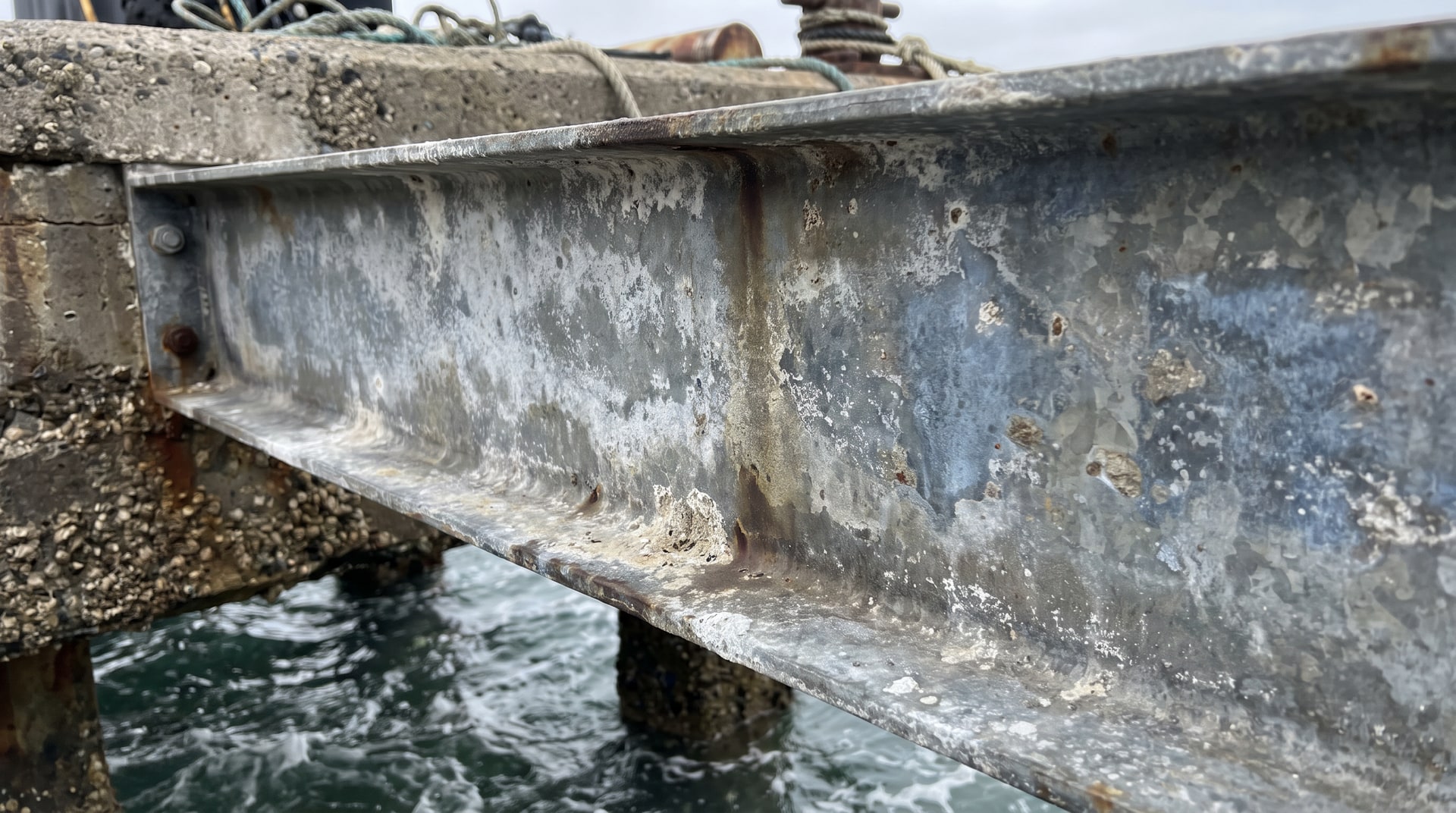
When a customer or project specifier asks for salt spray test results on hot-dip galvanized steel, the instinct is to treat that request as routine. Salt spray testing has been used for decades to evaluate coated metal products, and ASTM B117 is one of the most recognized test standards in the coatings world. The problem is that for hot-dip galvanized steel specifically, salt spray testing measures the wrong thing. It attacks the wrong material, drives the wrong corrosion mechanism, and produces results that have little to no correlation with how galvanized steel actually performs in service over time.
This is not a minor procedural nuance. It is a fundamental mismatch between the test method and the material behavior being evaluated. The American Galvanizers Association addresses this directly in their article on salt-spray/fog accelerated corrosion testing of HDG steel. At V&S Galvanizing, we expand on that foundation to explain what is actually happening at the material level, how wet-dry cycling influences zinc's protective behavior, and why this is often misunderstood in the field.
How Zinc Actually Protects Steel
To understand why salt spray testing fails for galvanized steel, you first need to understand what makes zinc an effective long-term corrosion barrier. Zinc does not simply act as a physical barrier that sacrifices itself uniformly over time. It actively develops a protective reaction product layer on its surface as it weathers.
When galvanized steel is exposed to normal atmospheric conditions, the zinc surface undergoes a staged chemical transformation. Zinc oxide forms first, followed by zinc hydroxide, and eventually zinc carbonate. This stable, adherent outer layer, commonly called the zinc patina, is what makes galvanized steel so remarkably durable in real-world environments. The patina resists further attack by chlorides, sulfates, and other aggressive species precisely because it is a thermodynamically stable compound under ambient conditions. Once formed, it dramatically slows the underlying corrosion rate.
This is not an incidental property. It is the core mechanism behind why hot-dip galvanized coatings can last for many decades in demanding environments without any maintenance. The patina is the product, not just a byproduct. And critically, it requires both wet and dry periods to develop. The cycling between moisture exposure and drying is what drives the carbonate formation chemistry.
What ASTM B117 Actually Measures on Zinc
ASTM B117 exposes a coated surface to a continuous fine mist of 5% sodium chloride solution at approximately room temperature. There is no drying phase. The surface remains continuously wetted throughout the test duration.
For many coating systems, this continuous wetting is a reasonable approximation of a hostile environment. For zinc, it is not. Because the surface never dries, the wet-dry cycles that are essential to zinc carbonate formation cannot occur. The protective patina never develops. Instead, the sodium chloride solution interacts directly with bare zinc metal, which is far less resistant to chloride attack than the mature zinc carbonate layer that would form under natural exposure.
The result is a corrosion rate that is dramatically and artificially accelerated, but not in a way that reflects real-world behavior. The test is accelerating the wrong mechanism entirely. It is measuring how bare zinc responds to continuous chloride immersion, which is not representative of any natural atmospheric environment. As ASTM B117 itself acknowledges in section 3.2, prediction of performance in natural environments has seldom been correlated with salt spray results when used as standalone data.
When these test results surface in engineering evaluations, they often lead to false conclusions about the corrosion resistance and expected service life of galvanized coatings. A galvanized part that would perform reliably for 50 years or more in a real marine or industrial environment may appear to fail rapidly in a salt spray chamber, not because the coating is deficient, but because the test method strips it of its primary defense mechanism.
The Role of Wet-Dry Cycling in Zinc Patina Formation
The formation of zinc carbonate is not a surface reaction that happens instantly. It proceeds through intermediate steps that require alternating contact with moisture (which provides the hydroxide chemistry) and exposure to atmospheric carbon dioxide during the drying phase (which converts zinc hydroxide to zinc carbonate). Without both stages, the reaction cannot complete.
This is why zinc performs so differently across climates. In regions with frequent rain-and-dry cycles, the patina develops robustly and quickly. In permanently submerged or continuously wet environments, the patina development is suppressed, and zinc's corrosion behavior is quite different from what is observed in atmospheric service. The ASTM B117 test chamber essentially creates a simulated permanent immersion condition for the zinc surface, which is simply not applicable to how galvanized steel is used in most structural and architectural applications.
Understanding this distinction matters for specification decisions. An engineer evaluating galvanized steel for an outdoor structure in a coastal environment should not be drawing conclusions from a salt spray chamber test. The data coming out of that chamber describes zinc in a condition it will never actually experience in service.
A More Realistic Alternative: ASTM G85 and Wet-Dry Cycling
If accelerated laboratory testing is required for a specific application, ASTM G85 (Standard Practice for Modified Salt Spray (Fog) Testing) provides a more defensible methodology for zinc and galvanized steel. The key difference is the introduction of wet-dry cycling within the test protocol.
In a wet-dry salt spray test conducted under ASTM G85, the exposure cycles between one hour of fog application and one hour of drying at elevated temperature, approximately 95 degrees Fahrenheit. The fog solution used for zinc testing is a dilute mixture of ammonium sulfate and sodium chloride, which is tailored to reproduce the corrosion chemistry seen in real atmospheric environments. The test should run for a minimum of 16 hours to produce meaningful data.
The wet-dry cycling allows the zinc surface to progress through at least some of the patina-forming reactions, producing corrosion products and surface morphologies that are more representative of natural exposure. The results are still accelerated and still imperfect as a predictor, but they are substantially more meaningful than ASTM B117 data for galvanized steel.
Even so, it is important to recognize the limitation: all accelerated corrosion tests have constraints when applied to zinc. The corrosion chemistry of zinc is sensitive enough to environmental conditions that no single accelerated test captures its full behavior across the range of real-world exposures. The test environment must match the chemistry of the intended service environment to produce useful data, which is why appropriate salt solution selection matters alongside cycling protocol.
Decades of Field Data Versus Weeks in a Chamber
Since the 1920s, hot-dip galvanized steel samples have been placed in thousands of different environments worldwide and their corrosion rates measured over extended periods. This body of long-term exposure data spans five broadly recognized environment types: rural, urban, industrial, temperate marine, and tropical marine. Each category carries a measured corrosion rate that has been validated by decades of observation across multiple continents and climates.
This is the dataset that actually matters for predicting galvanized steel performance. It is grounded in real material behavior, real patina development, and real atmospheric chemistry. Salt spray chamber results, by contrast, represent weeks of continuous chloride exposure with no analog in any of those five environment categories.
The AGA Time to First Maintenance charts, which plot estimated durability against coating thickness across these environment types, are built on this long-term atmospheric data. These charts give engineers and specifiers a rational basis for evaluating galvanized coating performance without relying on a test method that misrepresents zinc behavior at a fundamental level.
| Environment Type | Description | Relative Corrosivity |
|---|---|---|
| Rural | Low pollution, low chloride, inland | Lowest |
| Urban | Moderate pollution, vehicle emissions, inland | Low-Moderate |
| Industrial | Elevated sulfur dioxide, chemical pollutants | Moderate-High |
| Temperate Marine | Coastal, moderate chloride, seasonal variation | High |
| Tropical Marine | Coastal, high chloride, high humidity and temperature | Highest |
Passivation Treatments Do Not Fix the Problem
One common workaround that sometimes appears in specifications is requiring a passivation treatment, such as chromating or phosphating, on the galvanized surface before salt spray testing. The reasoning is that passivation will inhibit white rust formation and improve short-term salt spray performance, making the results look better.
This does not solve the underlying problem. Even with a passivation treatment applied, salt spray results for hot-dip galvanized steel do not correlate with the long-term corrosion data collected from real-world atmospheric exposures. The test is still suppressing patina development and still attacking the zinc metal rather than a mature protective carbonate layer. Passivation may change the short-term surface chemistry enough to affect the test result, but it does not restore the test's validity as a predictor of actual service life.
Specifying salt spray performance with or without passivation as a quality acceptance criterion for galvanized steel creates a situation where the acceptance metric has no meaningful relationship to the performance characteristic it is supposed to represent. That is a problem worth explaining clearly to customers and specifiers before it influences a procurement or fabrication decision.
Practical Tools for Estimating Real-World Galvanized Steel Performance
When the goal is a genuine estimate of how long a hot-dip galvanized coating will perform before first maintenance is needed, several validated tools exist that are rooted in the long-term atmospheric data rather than chamber testing.
For atmospheric environments, the AGA Time to First Maintenance charts translate coating thickness and environment type into durability estimates. These charts cover the five recognized environment categories and reflect real corrosion rates derived from decades of field measurements. For soil applications, a separate service life chart addresses the distinct electrochemical conditions that buried galvanized steel encounters.
For project-specific estimates, the Zinc Coating Life Predictor tool allows users to input local environmental data including average precipitation, average salinity, and average sulfur dioxide concentration to generate a more precise corrosion rate estimate for the specific site. This type of environmentally calibrated prediction is considerably more reliable than extrapolating from a salt spray chamber result, and it produces information that is actually useful for long-term asset planning and maintenance scheduling.
When clients or specifiers come to us asking for salt spray data, our approach is to explain the limitation directly and then redirect the conversation toward these field-validated resources. That conversation is more technically honest and ultimately more useful for the project.
Work With a Team That Understands Zinc Corrosion at the Material Level
Misapplication of salt spray testing to hot-dip galvanized steel is one of those issues that persists largely because the test is so well established in other coating categories that people assume it transfers. It does not, and the reason it does not is rooted in the specific electrochemistry and surface reaction behavior of zinc. A test that works well for organic coatings or electroplated finishes can produce systematically misleading results when applied to a material whose primary protection mechanism depends on a reaction product that the test actively prevents from forming.
At V&S Galvanizing, we work with engineers, fabricators, and project owners who need accurate information about how galvanized steel will perform in their specific environment. That means being direct about what test data is relevant, what data is not, and what tools actually give you a defensible durability estimate grounded in real-world behavior. Our team is available to work through corrosion environment assessments, coating thickness requirements, and specification language that reflects how hot-dip galvanizing actually performs in the field rather than in a test chamber.
If you have questions about salt spray testing, corrosion performance evaluation, or how to specify galvanized steel for a demanding environment, reach out through our contact page. We are glad to help you navigate these decisions with the technical accuracy your project requires.
Frequently Asked Questions About Salt Spray Testing and Hot-Dip Galvanized Steel
Why does ASTM B117 salt spray testing give misleading results for hot-dip galvanized steel?
ASTM B117 uses continuous wetting with a 5% sodium chloride solution, which prevents the wet-dry cycles that zinc needs to form its protective zinc carbonate patina. Without the patina, the salt solution attacks bare zinc metal directly, producing corrosion rates that are not representative of real atmospheric service life. The test accelerates the wrong corrosion mechanism for this material.
What is the zinc patina, and why does it matter for corrosion resistance?
The zinc patina is a stable surface layer composed primarily of zinc oxide, zinc hydroxide, and zinc carbonate that forms when galvanized steel is exposed to normal atmospheric conditions. Once established, it significantly slows further corrosion by resisting chloride and sulfate attack. The patina is what allows hot-dip galvanized coatings to last for many decades without maintenance in real-world environments.
Is ASTM G85 a better test for evaluating galvanized steel corrosion resistance?
ASTM G85 modified salt spray testing is more appropriate than ASTM B117 for zinc and galvanized steel because it introduces wet-dry cycling. The specific annex used for zinc employs one-hour fog cycles alternated with one-hour drying periods at approximately 95 degrees Fahrenheit, using a dilute ammonium sulfate and sodium chloride solution. This allows partial patina development and produces corrosion products more representative of real atmospheric exposure. The test should run a minimum of 16 hours.
Does passivation treatment (chromating or phosphating) make salt spray testing valid for galvanized steel?
No. While passivation treatments can alter short-term salt spray performance results, they do not restore the test's ability to predict long-term corrosion behavior. Even passivated galvanized steel samples do not produce salt spray results that correlate with the decades of long-term atmospheric exposure data collected for hot-dip galvanized coatings worldwide.
What tools should engineers use instead of salt spray data to predict galvanized coating service life?
The AGA Time to First Maintenance charts, which are based on decades of field exposure data across five recognized environment types (rural, urban, industrial, temperate marine, and tropical marine), provide validated durability estimates based on coating thickness. For site-specific predictions, the Zinc Coating Life Predictor accepts local precipitation, salinity, and sulfur dioxide data to generate calibrated corrosion rate estimates. For buried applications, a separate soil service life chart applies.
How does coating thickness relate to service life in different environments?
The relationship between coating thickness and service life is well established through long-term atmospheric exposure studies. In low-corrosivity rural environments, a heavier coating provides proportionally longer protection before first maintenance is needed. In more aggressive industrial or marine environments, the corrosion rate is higher, so the same coating thickness will last fewer years. The AGA Time to First Maintenance charts plot this relationship across environment categories, giving engineers a quantitative basis for specification decisions that salt spray data cannot provide.
Can salt spray test results ever be used in conjunction with galvanized steel evaluations?
ASTM B117 itself notes in section 3.2 that correlation with natural environments should only be considered when appropriate corroborating long-term atmospheric exposure data exists. For hot-dip galvanized steel, that corroborating data consistently shows no meaningful correlation with salt spray results. Salt spray testing may have a limited role in comparative screening of different surface treatments or passivation processes, but it should never be used as a standalone acceptance criterion or service life predictor for galvanized coatings.
Why do some specifications still require salt spray testing for galvanized steel if it is not valid?
Salt spray testing is so well established for other coating types, particularly organic coatings and electrodeposited finishes, that it often appears in specifications by default or because it is familiar to the specifier. The fundamental difference in zinc's protection mechanism, which depends on a reaction product that requires atmospheric cycling to form, is not always well understood outside of galvanizing-specific technical communities. Educating clients and specifiers about this distinction is an important step before accepting specification language that would apply ASTM B117 as a quality criterion for hot-dip galvanized steel.
