
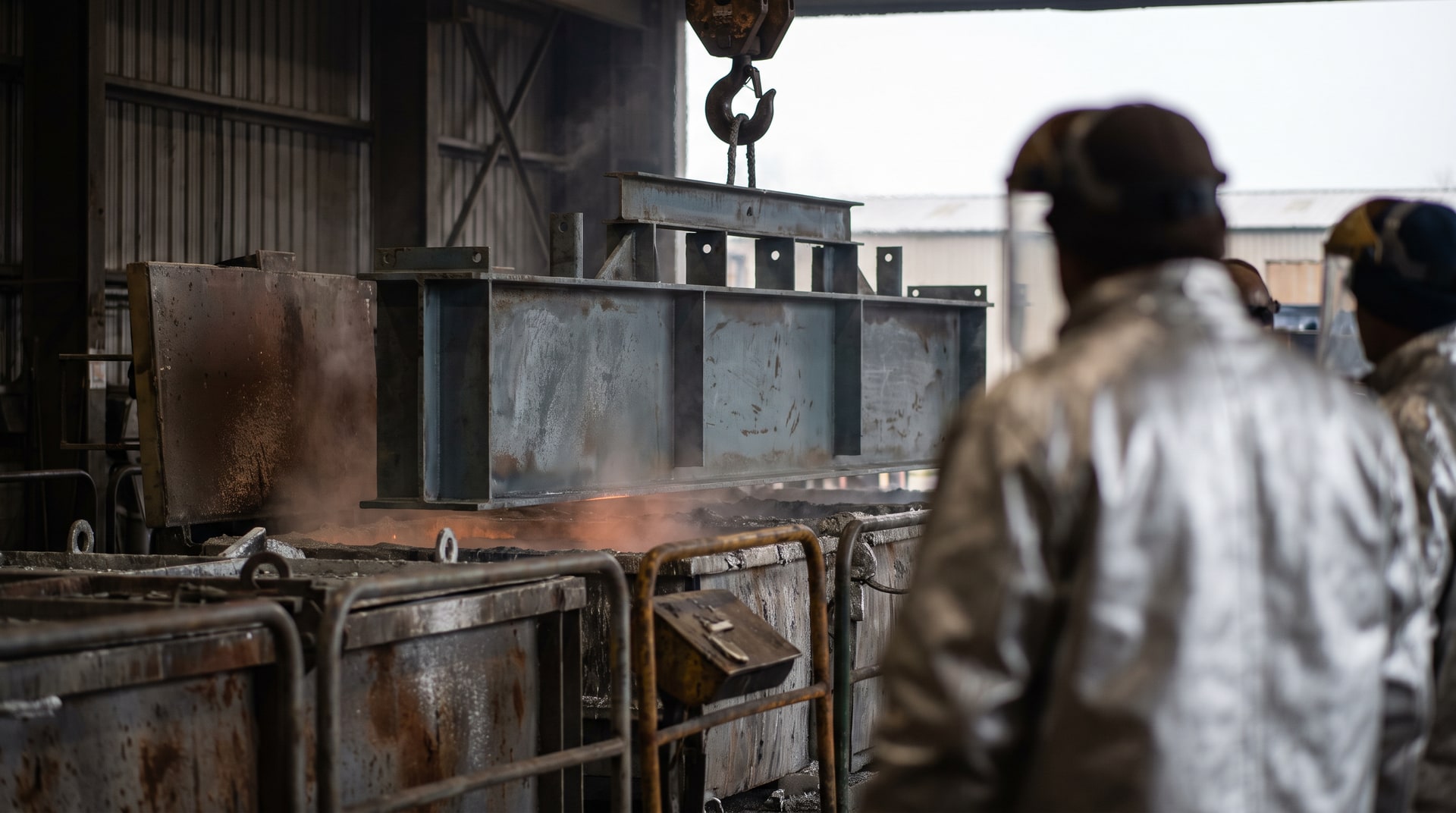
Every galvanizing plant operates around a central constraint: the kettle. It defines what can be processed, how quickly, and in what combinations. When a plant is running near full capacity, decisions about how steel is loaded, oriented, and sequenced through the zinc bath have real consequences for coating quality, throughput consistency, and the structural integrity of the finished product. It is not simply a matter of fitting more steel into the bath. The physics of immersion, zinc reactivity, and thermal dynamics all interact in ways that reward thoughtful planning and punish shortcuts.
For fabricators and engineers specifying galvanized steel, understanding what happens inside a kettle at or near capacity helps set realistic expectations and informs smarter design choices upstream. The American Galvanizers Association addresses this directly in their article on running more steel in the kettle at full capacity. At V&S Galvanizing, we expand on that foundation to explain what is actually happening at the material level, how loading density influences coating formation, and why this is often misunderstood in the field.
What Kettle Capacity Actually Means
Kettle capacity is not a single fixed number. It encompasses physical volume, thermal mass, zinc chemistry, and the operational limits of the equipment handling steel in and out of the bath. A kettle rated for a certain tonnage per day can theoretically process that weight, but whether the coating that results meets ASTM A123 requirements depends on how that weight is distributed across individual lifts and how each lift interacts with the molten zinc.
The zinc bath maintains a processing temperature typically in the range of 820 to 850 degrees Fahrenheit. When steel enters the bath, it draws heat from the zinc. A single, thermally heavy piece or a densely packed load of smaller parts can drop the local bath temperature significantly. If that temperature drop is severe enough or the steel is not fully immersed and brought to bath temperature before withdrawal, the metallurgical reaction that forms the zinc-iron alloy layers at the steel surface may be incomplete. The result is a coating that appears galvanized but lacks the adhesion and thickness that the specification requires.
Running more steel through the kettle, then, is really a question of managing the thermal budget of the bath and ensuring that every piece of steel spends adequate time at the right temperature to form a proper coating.
The Metallurgical Case for Controlled Immersion
The galvanizing coating is not a paint or a plating. It is a series of zinc-iron intermetallic alloy layers that form through a diffusion reaction between the steel substrate and the molten zinc. These layers, progressing outward from the steel surface, are designated gamma, delta, zeta, and eta in the galvanizing literature. Each layer has distinct hardness and zinc concentration characteristics, and together they create a coating that is metallurgically bonded to the steel rather than merely adhered to it.
This reaction requires both temperature and time. If the steel surface does not reach bath temperature quickly and uniformly, the diffusion kinetics are disrupted. In a scenario where the kettle is heavily loaded, the thermal demand placed on the zinc bath is amplified. The bath temperature recovers as the steel heats up, but there is a window during immersion where incomplete reaction can occur if the loading is poorly managed.
Steel chemistry also plays a role here. Silicon and phosphorus content in the base steel can accelerate zinc-iron reactivity, sometimes to the point where the zeta layer grows excessively thick and the coating becomes brittle or develops a rough, matte surface. When running at higher throughput, these reactive steels require additional attention because their behavior in the bath is less predictable under non-ideal thermal conditions.
How Load Geometry Affects What Happens in the Bath
Geometry is one of the most practical levers a galvanizer has for managing kettle performance. The way steel is racked, jigged, and oriented for immersion affects both the flow of zinc across the steel surface and the drainage of excess zinc during withdrawal. When pieces are tightly nested or stacked without adequate spacing, zinc cannot circulate freely around all surfaces. Areas that do not receive full zinc contact may show thin spots, bare patches, or uneven coating thickness.
Good jigging practice ensures that hollow sections have properly placed vent and drain holes so that zinc can enter, react, and drain cleanly without trapping air or pooling in corners. On structural steel like angle iron, channels, and beams, orientation during immersion and withdrawal controls where zinc drains and where it might accumulate in runs or drips. These considerations do not change when the kettle is running at higher capacity, but the margin for error narrows.
When a galvanizer is processing a high volume of work, the temptation can be to maximize the weight of each lift rather than optimize the geometry of each lift. That trade-off may improve short-term throughput but introduces risk of non-conforming coatings, particularly on complex fabrications with blind corners, overlapping surfaces, or varied cross-sections. Our approach at V&S Galvanizing prioritizes load geometry because coating quality on every piece matters regardless of how the day's production schedule looks.
Zinc Bath Chemistry and the Demands of High Throughput
The zinc bath is a living system. As steel passes through it, iron dissolves into the zinc from the steel surface and from the kettle walls. Over time, this iron accumulates in the bath and eventually precipitates out as zinc-iron dross, which settles to the bottom of the kettle. Dross that is disturbed during immersion or withdrawal can become entrained in the coating surface, appearing as rough or gritty inclusions that compromise both appearance and corrosion performance.
Running higher throughput accelerates the iron pickup rate. A plant processing significantly more steel per day will generate dross more quickly and will also consume zinc faster. Both require more frequent monitoring and management. Bath chemistry must be tested regularly to ensure that iron content remains within acceptable limits. Aluminum additions, which promote a smoother, brighter surface and slow the zeta layer growth on reactive steels, must be balanced carefully because their effect is sensitive to bath temperature and iron levels.
Flux residue from the pretreatment process also enters the bath with the steel, and at higher throughput volumes this increases the rate at which flux ash forms on the bath surface. If ash becomes trapped under the steel during immersion, it creates surface defects. Managing the bath surface, skimming ash, and controlling immersion technique all become more demanding as throughput increases.
What Full Capacity Means for Coating Thickness Compliance
ASTM A123 sets minimum coating thickness requirements based on the steel category and thickness. These minimums exist because the zinc coating provides corrosion protection proportional to its thickness: a thicker coating contains more zinc and therefore offers a longer service life before the underlying steel is exposed. Meeting the minimum is not optional on a compliant job, and the consequences of under-thickness coatings extend beyond the job site to include the corrosion protection assumptions embedded in the design.
Coating thickness is a product of bath temperature, immersion time, steel reactivity, and withdrawal speed. At higher throughput, if immersion times are shortened to maintain production pace, or if the bath temperature has not fully recovered between lifts, the coating thickness on individual pieces may fall below the specified minimum. This is particularly true for thinner steel sections, which form thinner coatings to begin with and have less tolerance for process variation.
Inspection after galvanizing, using a calibrated magnetic thickness gauge, provides the verification that the coating meets specification regardless of what happened during production. But inspection is a check, not a control. The control is the process discipline applied during production, and that discipline is what separates a plant running well at high capacity from one that is simply running fast.
Practical Implications for Fabricators and Specifiers
If you are submitting steel to a galvanizer who is operating near peak capacity, there are several things worth understanding on your end. Fabrication quality directly affects what is achievable in the bath. Steel that arrives with tight back-to-back angles, overlapping plates without adequate clearance, or closed hollow sections without vent holes creates problems that no amount of process skill can fully overcome. The coating that results will reflect the limitations imposed by the fabrication.
Design for galvanizing is not a burdensome constraint. It typically means adding vent and drain holes in hollow sections, avoiding detail geometries that trap zinc, and specifying steels with silicon and phosphorus levels that produce predictable coating behavior. These practices are outlined in ASTM A385 and the AGA's own design guidelines. When fabricators follow them, the galvanizer can process work efficiently and produce coatings that meet specification consistently, even at high production volumes.
Scheduling also matters. Sending a large, complex order to a galvanizer at short notice when they are already running at capacity is a recipe for rushed decisions on load geometry or immersion sequencing. Communicating early about volume, delivery timing, and the nature of the fabrications allows the galvanizer to plan appropriately and allocate the kettle time and bath conditions that complex work requires. At V&S, we encourage that kind of early coordination on large or technically demanding orders.
Why This Is Frequently Misunderstood in the Field
The common assumption is that galvanizing is a simple, robust process: dip the steel, pull it out, done. That picture is accurate enough for straightforward structural shapes processed under normal conditions. It becomes less accurate as throughput increases, load complexity rises, or the steel itself introduces variables like reactive chemistry or difficult geometry.
There is also a misconception that a thicker coating is always the result of a longer bath time. In reality, overly long immersion, particularly on reactive steels, can produce coatings that are thick but brittle, with a dominant zeta layer that is prone to flaking under mechanical stress. Optimal coating formation is about achieving the right layer structure, not simply maximizing zinc uptake. That nuance gets lost when throughput pressure pushes toward quick-dip, quick-out production rhythms.
Finally, some specifiers assume that if a coating passes a thickness inspection, every other quality attribute is also acceptable. Thickness is necessary but not sufficient. Adhesion, surface condition, and the absence of flux inclusions or dross entrapment are also part of a properly galvanized surface. These attributes are shaped by the process discipline applied during production, and they are harder to verify after the fact than thickness alone.
Work With a Team That Understands the Full Picture
Running a galvanizing kettle at or near full capacity is not inherently problematic. Efficient throughput is part of how a galvanizing plant serves its customers and sustains operations. The critical distinction is whether that throughput is managed with the process discipline that coating quality requires. That means maintaining bath temperature recovery between lifts, monitoring zinc chemistry continuously, applying rigorous attention to load geometry, and never letting production pace override the conditions needed to form a compliant coating.
At V&S Galvanizing, our teams are trained to manage exactly this balance. We process a wide range of structural steel, fabricated components, and specialty items through our hot-dip galvanizing operations, and we bring that same process discipline to every lift regardless of where we are in the day's production schedule. If you have questions about how your project will be processed, what design modifications might improve coating results, or how to sequence a large order for best outcomes, we are ready to talk through it with you. Reach out through our contact page and let us help you plan for a result that meets specification and performs in the field.
Frequently Asked Questions About Galvanizing Kettle Capacity and Throughput
Does running more steel through the kettle in a day affect coating thickness?
It can, if the higher throughput shortens immersion times or prevents the bath from recovering its operating temperature between lifts. Coating thickness is a function of bath temperature, immersion duration, and steel reactivity. When any of these variables is compromised by production pressure, the resulting coating may fall below the ASTM A123 minimum thickness requirement for that steel category. Proper process management keeps these variables in range regardless of daily volume.
What is dross, and why does it matter more at high production volumes?
Dross is a zinc-iron intermetallic compound that precipitates out of the bath as iron accumulates from dissolving steel and kettle walls. It settles to the kettle floor but can be disturbed during immersion and become trapped in the coating surface. At higher throughput, iron pickup accelerates and dross generation increases, requiring more frequent monitoring and skimming to prevent surface quality problems on processed steel.
How does steel chemistry interact with high-throughput galvanizing conditions?
Steels with elevated silicon or phosphorus content react more aggressively with molten zinc. This accelerated reactivity produces thicker but often more brittle coatings with a dominant zeta layer. Under non-ideal thermal conditions, such as those that can occur when the bath temperature is recovering between heavy lifts, the reaction behavior of reactive steels becomes less predictable. Specifying steels within the silicon ranges recommended by ASTM A385 reduces this variability.
What design steps reduce problems when steel is processed at high production volumes?
Adequate vent and drain holes in hollow sections, clearance between overlapping plates, and avoiding back-to-back or nested geometries that trap zinc or block circulation are the primary design measures. These practices are codified in ASTM A385 and allow the galvanizer to maintain proper zinc flow and drainage even when the production pace is high. Steel that arrives designed for galvanizing is far more reliably coated than steel that requires workarounds in jigging or immersion technique.
Can a galvanizer tell from inspection whether throughput pressure affected a coating?
Thickness inspection with a magnetic gauge will identify coatings that fall below the ASTM A123 minimum, and visual inspection can identify flux inclusions, dross entrapment, bare areas, or surface irregularities. However, some effects of compromised process conditions, such as reduced adhesion or a structurally weak layer composition, are not easily detected by standard field inspection. Process discipline during production is the primary safeguard; inspection confirms compliance but does not substitute for controlled processing.
Does load geometry matter more at high throughput than at normal production levels?
Yes, in the sense that the margin for error is smaller. At normal throughput, a suboptimal jig arrangement may produce a coating with minor surface variation but still within specification. At high throughput, when the bath is under greater thermal demand and the production pace is faster, a poorly jigged load is more likely to produce non-conforming results because there is less buffer in the system to absorb the additional variables. Good jigging practice is important at any throughput level but becomes more critical as volume increases.
How does withdrawal speed from the zinc bath affect coating quality at full capacity?
Withdrawal speed controls how much zinc drains from the steel surface before it solidifies. A slow withdrawal allows excess zinc to drain cleanly, producing a smoother, more uniform surface. A rapid withdrawal, which may be tempting to maintain production pace, retains more zinc on the surface but can also trap flux ash or dross and create runs, drips, or uneven deposits. Maintaining consistent, controlled withdrawal speeds is part of the process discipline that protects coating quality at any production volume.
If I have a large order, when should I communicate with the galvanizer about scheduling?
As early as possible. For large or complex orders, coordinating with the galvanizer before fabrication is complete allows them to plan kettle time, bath chemistry preparation, and jigging strategy appropriately. Last-minute large orders submitted to a plant already near capacity create conditions where shortcuts are more likely. Early communication also gives the galvanizer the opportunity to flag any design details that might cause coating problems, while there is still time to address them during fabrication.
