

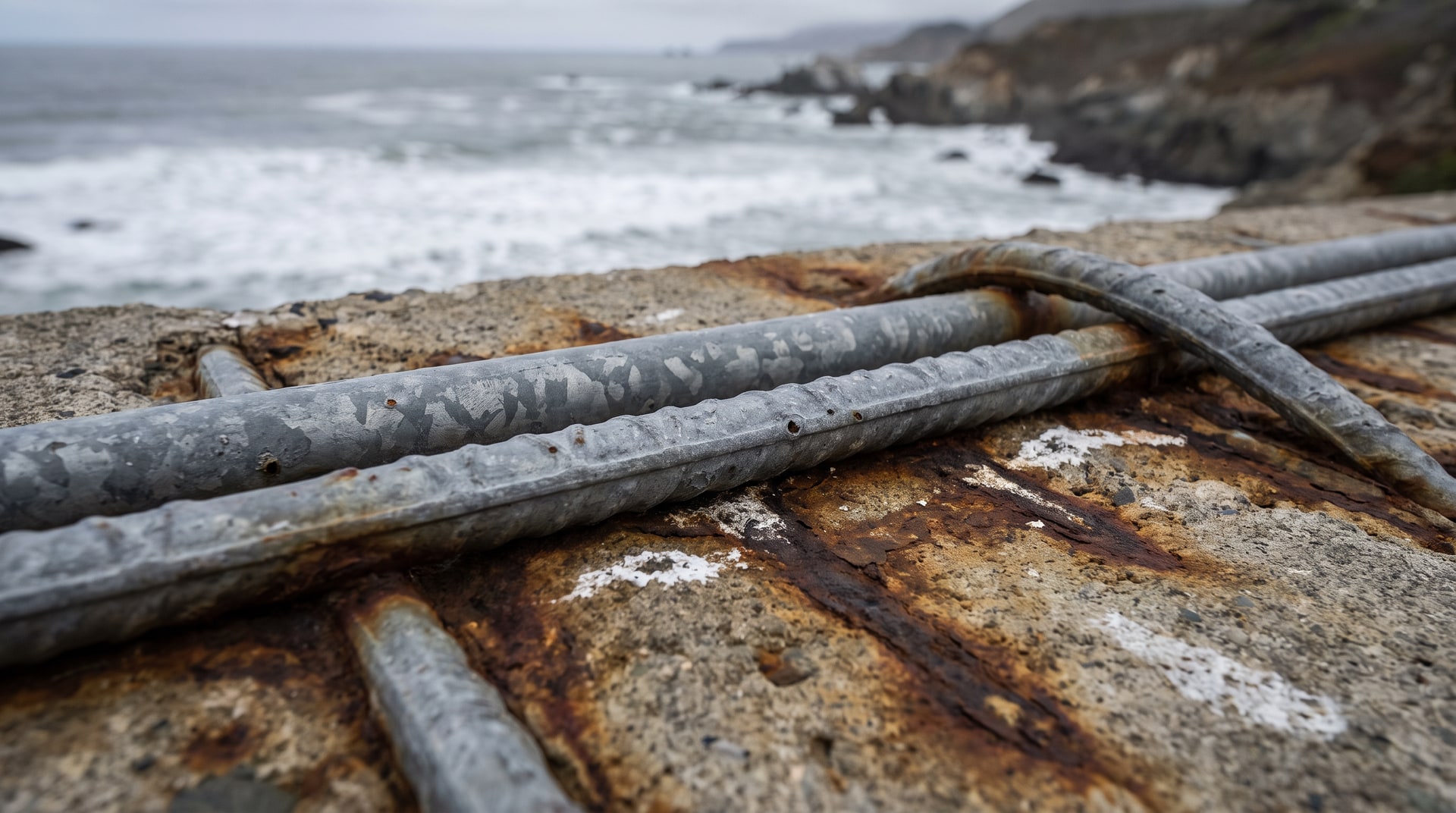
Marine environments are among the most demanding settings for reinforced concrete. Whether it is a coastal bridge deck, a wharf, a pier, or a seawall, structures exposed to seawater or salt-laden air face a relentless chloride load that works its way through the concrete cover and eventually reaches the embedded rebar. When that happens with conventional black steel, the corrosion process is aggressive, and the consequences are visible: cracking, spalling, and structural degradation that can compromise safety and trigger costly repairs well before the intended service life is reached.
The case for using hot-dip galvanized (HDG) rebar in these applications has grown considerably over the decades, backed by both laboratory research and long-term field performance data from actual structures. Engineers specifying reinforcing steel for marine or chloride-exposed concrete have increasingly turned to galvanized rebar not simply as a precaution, but as a technically justified choice grounded in the chemistry of zinc and how it behaves inside a concrete matrix.
The American Galvanizers Association addresses this directly in their article on galvanized rebar performance in marine environments. At V&S Galvanizing, we expand on that foundation to explain what is actually happening at the material level, how chloride threshold chemistry influences long-term performance, and why the behavior of zinc corrosion products is often misunderstood in the field.
The Role of Chloride Ions in Rebar Corrosion
To understand why galvanized rebar performs better, it helps to first understand why black steel fails in marine concrete. Corrosion of embedded steel is electrochemical. A voltaic cell forms at the steel surface, requiring four components: an anode, a cathode, an electrolyte, and a return current path. In marine applications, the electrolyte is seawater or pore water contaminated with chloride ions derived from seawater. The concrete cover provides a physical barrier, but it is permeable over time, and chloride ions migrate inward through capillary absorption and diffusion.
The critical factor is not merely the presence of chloride, but whether the chloride concentration at the rebar surface reaches what is known as the critical chloride threshold. Below this threshold, the passive film on the steel remains intact and corrosion does not initiate. Once the threshold is exceeded, depassivation occurs and active corrosion begins. For black steel, the commonly accepted critical chloride threshold is 1.1 lbs/yd³. That number represents the practical limit beyond which conventional rebar in concrete will begin to corrode.
The implications for design are significant. In a marine environment, the rate at which chlorides penetrate the concrete cover, combined with the chloride concentration of the surrounding water, determines how long a structure can resist the onset of corrosion. Any material or coating that raises this threshold effectively buys time, often measured in decades.
Why Galvanized Rebar Has a Higher Chloride Tolerance
Field evaluations conducted by CTL on behalf of the International Lead Zinc Research Organization (ILZRO) documented HDG rebar performing corrosion-free in chloride environments that substantially exceeded the black steel threshold value. These were not short-term laboratory observations; they were measurements taken from real structures over extended periods, some spanning more than four decades after construction.
| Bridge / Structure | Location | Construction Year | 1975 ZE 206 | 1977 ZE 247 | 1982 ZE 320 | 1992 ZE 389 | 1994 ZC 1 | Years to Date Above CI Corrosion Threshold |
|---|---|---|---|---|---|---|---|---|
| PCA Slabs | IL | 1963-1969 | [6] | |||||
| Boca Chica | FL | 1972 | [3] | [19] | [21] | |||
| Seven Mile | FL | 1972 | [3] | [19] | ||||
| Longbird | Bermuda | 1952 | [23] | [42] | [42] | |||
| Flatts | Bermuda | 1966 | 8 | [28] | [28] | |||
| Arnes | IA | 1967 | 7 | 14 | [26] | |||
| Montpelier | VT | 1971 | 3 | [10] | [21] | |||
| Manicouagan | Quebec | 1966 | 8 | |||||
| Penno's Wharf | Bermuda | 1964/1966/1969 | [28*] | [28*] | ||||
| Hamilton Dock | Bermuda | 1966 | [28] | [28] | ||||
| RBYC Pier | Bermuda | 1968 | [26] | [26] | ||||
| Athers | PA | 1973 | [8] | [18] | [20] | |||
| Betsy Ross | PA | 1973 | 8 | |||||
| Corapolis | PA | 1972 | 9 | [19] | [21] | |||
| Hershey | PA | 1975 | [6] | [16] | ||||
| Orangeville | PA | 1974 | 7 | |||||
| Tioga | PA | 1974 | 7 | 19 |
The data compiled from that research, covering bridges and structures in Florida, Bermuda, Iowa, Vermont, Quebec, and Pennsylvania, consistently showed galvanized rebar remaining above the chloride corrosion threshold far longer than black steel would be expected to. The Longbird Bridge in Bermuda, constructed in 1952, was evaluated as corrosion-free 42 years after construction. Multiple Bermuda structures from the 1960s showed similar results after 26 to 28 years of service in a genuinely aggressive marine climate.
The reasonable conclusion drawn from this body of evidence is that the critical chloride threshold for galvanized steel is substantially higher than that of black steel. But the threshold alone does not explain the full performance picture. There are two additional mechanisms at work that are equally important.
Zinc Passivation Inside Fresh Concrete
When galvanized rebar is embedded in freshly mixed concrete, the zinc coating is exposed to a high-pH environment dominated by saturated calcium hydroxide solution. Rather than degrading under these alkaline conditions, the zinc surface undergoes a passivation reaction, forming a calcium hydroxyl-zincate layer. This passive layer is not a liability; it is one of the key reasons galvanized rebar performs so well in the long term.
Research by Andrade and Macias demonstrated that this passive zincate layer reduces corrosion currents by an order of magnitude compared to unpassivated zinc. Corrosion current is the electrochemical measure of how actively a metal is corroding, so reducing it by a factor of ten is a meaningful and substantial improvement. Their measurements were conducted in chloride-free suspension, which isolates the passivation effect cleanly from the complicating variable of chloride presence.
The interaction between chlorides and this passive layer is not fully resolved in the research literature. Andrade and Macias found that chloride concentrations between 0.3 and 0.9 molar do not interfere with formation of the passive zincate layer. Work by Sergi, Short, and Page suggests that higher concentrations may have an effect, though they did not identify a specific threshold value at which the passive layer is compromised. The nuance here matters for engineers: the passive layer appears robust across a wide range of chloride concentrations relevant to real structures, but the precise upper boundary remains an open research question.
What is clear from bench-scale testing is that galvanized coatings after passivation show corrosion rates equating to zinc losses of approximately 1.5 micrometers per year. For an ASTM A767 Class I coating, this corresponds to a projected service life of 100 years. That is a meaningful number when evaluating the lifecycle cost and inspection burden of marine infrastructure.
The Concrete Chemistry Connection: What Happens at the Interface
It is worth pausing on what the ASTM A767 specification actually means in this context. ASTM A767 covers zinc-coated (galvanized) steel bars for concrete reinforcement, and the Class I designation refers to a heavier coating weight. Specifying this standard for marine or chloride-exposed concrete ensures that the zinc layer present on the rebar is thick enough to provide both the passivation benefit and the extended corrosion resistance that makes the 100-year service life projection credible.
The passivation reaction also has implications for how the rebar interacts with the concrete mix during placement. Zinc can react with the alkalis in fresh concrete, and historically there was concern about hydrogen evolution at the zinc surface in the early hydration period. The formation of the calcium hydroxyl-zincate passive layer is part of how this early-age chemistry stabilizes. Understanding this mechanism reassures engineers that the coating is not simply a sacrificial layer burning off during cure; it is transitioning into a chemically stable, protective form that continues to function throughout the service life of the structure.
Corrosion Products and Concrete Integrity: A Fundamental Difference
Perhaps the most practically significant difference between HDG and black rebar in concrete is not the threshold or the passivation, but what happens when corrosion does eventually occur. This distinction is visible at the microscopic level and has direct structural consequences at the macroscopic level.
When black steel corrodes inside concrete, the iron oxide corrosion products that form are voluminous relative to the original metal. They occupy significantly more space than the steel from which they were derived. That volumetric expansion has nowhere to go inside a rigid concrete matrix, so pressure builds at the rebar-concrete interface. Once the tensile strength of the surrounding concrete is exceeded, cracking initiates. Continued corrosion feeds more product into the crack, widening it, and eventually the cover concrete spalls off entirely. The rebar is then directly exposed to the environment, and deterioration accelerates rapidly.
Zinc corrosion products behave differently. They are physically smaller and less dense than iron corrosion products, and critically, they are mobile within the concrete matrix. Rather than accumulating at the rebar surface where they exert pressure, they migrate away from the coating and disperse into the surrounding concrete. This dispersal mechanism means that the internal pressure buildup at the rebar-concrete interface occurs much more slowly, and at a much lower rate, than it does with corroding black steel.
An elemental map of galvanized rebar cross-sections confirms this behavior visually: the zinc corrosion products appear distributed throughout the concrete matrix rather than concentrated in a pressure-building layer directly against the bar. The practical result is a structure that, even when some zinc corrosion is occurring, does not exhibit the cracking and spalling pattern that makes black steel corrosion so structurally destructive. Service life is extended not just because corrosion starts later, but because when it does begin, it proceeds in a manner that is far less damaging to the concrete itself.
What the Field Data Actually Shows
Laboratory data is instructive, but the ILZRO field evaluation data carries particular weight because it comes from real structures exposed to real marine conditions over multi-decade timeframes. The structures included coastal bridges in Florida, a dock in Bermuda, a pier, and highway bridges in multiple northeastern states. The range of construction years spans from the early 1950s to the mid-1970s, giving researchers a natural experiment across different chloride exposures, concrete mix designs, and climate conditions.
Structures like the Boca Chica Bridge in Florida, built in 1972, were evaluated at multiple points and showed no corrosion through at least 21 years of service in a high-chloride coastal environment. The Seven Mile Bridge, also in Florida and also constructed in 1972, similarly showed corrosion-free performance through 19 years. The Bermuda structures are particularly telling because Bermuda's marine environment is among the more aggressive in the documented dataset; yet those structures consistently showed HDG rebar performing corrosion-free for 26 to 42 years.
This is not a matter of a few isolated favorable outcomes. The data set covers structures across different geographic regions, construction methods, and exposure conditions, and the pattern holds consistently. HDG rebar in these marine environments remained above the chloride corrosion threshold for periods far exceeding what would be expected from black steel under comparable conditions.
Design and Specification Considerations for Marine Applications
For engineers and specifiers working on marine or coastal concrete structures, translating this technical understanding into practical specification language involves a few key considerations. First, specifying ASTM A767 Class I coating weight ensures the zinc thickness is appropriate for the projected service environment and aligns with the coating thickness from which the 100-year service life projection is derived.
Second, the behavior of the passive zincate layer means that galvanized rebar should be handled and stored appropriately prior to embedment. The zinc coating should arrive at the job site in sound condition, and practices that might mechanically damage the coating should be avoided. Hot-dip galvanizing produces a metallurgically bonded coating with meaningful resistance to handling damage, but the integrity of that coating directly influences the passivation performance in the concrete.
Third, the reduced spalling risk associated with zinc corrosion product mobility has real implications for structures where concrete cover is limited by design constraints, or where the consequences of spalling are particularly serious, such as overhead highway structures or marine piers with pedestrian exposure. In these cases, the difference in corrosion product behavior is not merely academic; it is a structural safety consideration.
Finally, the field data and research consistently point to HDG rebar as a system that extends service life through multiple concurrent mechanisms, not just one. The higher chloride threshold delays initiation. The passive zincate layer reduces corrosion current after initiation begins. And the mobile, low-density corrosion products reduce concrete damage even as the zinc coating is eventually consumed. These mechanisms compound over time, which is why the performance gap between HDG and black rebar widens rather than narrows over the service life of a structure.
Work With a Team That Understands Rebar Galvanizing From the Inside Out
The performance of galvanized rebar in marine environments is not accidental. It follows directly from the electrochemical behavior of zinc, the chemistry of the zinc-concrete interface, and the physical properties of zinc corrosion products. Each mechanism is well-documented in the research literature and confirmed by field evaluations spanning multiple decades and continents. When engineers understand what is actually happening at the material level, the specification decision becomes much clearer.
At V&S Galvanizing, we work with fabricators, engineers, and contractors who are specifying galvanized reinforcing steel for demanding applications, including marine structures, coastal infrastructure, and other chloride-exposed concrete environments. Our team can speak to coating specifications, ASTM standards, and the process factors that influence coating performance in service. If you are working through a specification decision or want to discuss the specifics of your project, reach out through our contact page and we will connect you with someone who can give you technically grounded answers.
Frequently Asked Questions About Galvanized Rebar in Marine Environments
What is the critical chloride threshold for galvanized rebar compared to black steel?
The commonly accepted critical chloride threshold for black steel embedded in concrete is 1.1 lbs/yd³. Field evaluations of HDG rebar conducted by CTL for the ILZRO documented galvanized rebar performing corrosion-free in chloride environments that far exceeded this value, indicating that the threshold for galvanized steel is substantially higher, though a single precise figure has not been universally established.
What is the calcium hydroxyl-zincate layer and why does it matter?
When zinc is exposed to the high-pH environment of fresh concrete (essentially a saturated calcium hydroxide solution), the zinc surface passivates and forms a calcium hydroxyl-zincate layer. Research by Andrade and Macias showed this passive layer reduces corrosion currents by an order of magnitude compared to unpassivated zinc, translating to very low zinc loss rates and significantly extended service life.
Does chloride contamination in the concrete prevent the passive zincate layer from forming?
Research indicates that chloride concentrations between 0.3 and 0.9 molar do not prevent formation of the passive calcium hydroxyl-zincate layer. Work by Sergi, Short, and Page suggests higher concentrations may have some effect, but no threshold value has been published. The passive layer appears effective across a wide range of real-world chloride concentrations.
Why does zinc corrosion not cause concrete spalling the way black steel corrosion does?
Iron oxide corrosion products from black steel are voluminous and accumulate at the rebar-concrete interface, building pressure that cracks and eventually spalls the concrete cover. Zinc corrosion products are smaller, less dense, and migrate away from the coating surface into the surrounding concrete matrix rather than concentrating at the interface. This dispersal mechanism results in far lower pressure buildup and a much slower progression of concrete damage.
What ASTM standard governs galvanized rebar, and which coating class should be specified for marine applications?
ASTM A767 covers zinc-coated (galvanized) steel bars for concrete reinforcement. Class I designates a heavier coating weight and is the basis for the 100-year projected service life derived from bench-scale corrosion current measurements showing zinc losses of approximately 1.5 micrometers per year. Class I is appropriate for aggressive environments including marine exposure.
How long has galvanized rebar been used in marine concrete structures, and what does the long-term data show?
Galvanized rebar has been used in marine concrete structures since at least the 1950s. The ILZRO field evaluation dataset includes structures such as the Longbird Bridge in Bermuda, built in 1952, which showed corrosion-free performance 42 years after construction. Multiple structures in Florida and Bermuda from the late 1960s and early 1970s similarly showed no corrosion through 19 to 28 years of service in high-chloride marine environments.
Is the improved performance of HDG rebar due to a single protective mechanism or multiple factors?
Multiple mechanisms work together. The zinc coating raises the chloride threshold for corrosion initiation. After embedment, zinc passivates in the alkaline concrete environment, significantly reducing corrosion current. And when corrosion does occur, zinc corrosion products disperse into the concrete matrix rather than accumulating at the surface, slowing structural damage. Each mechanism independently extends service life; together, they compound over time.
Does the galvanized coating interact chemically with fresh concrete during placement and curing?
Yes. Zinc reacts with the alkaline pore solution in fresh concrete, and in the early hydration period there is potential for hydrogen evolution at the zinc surface. However, the formation of the calcium hydroxyl-zincate passive layer is part of how this early-age chemistry stabilizes. The coating transitions from reactive zinc into a chemically stable passive layer that remains protective throughout the service life of the structure.
