

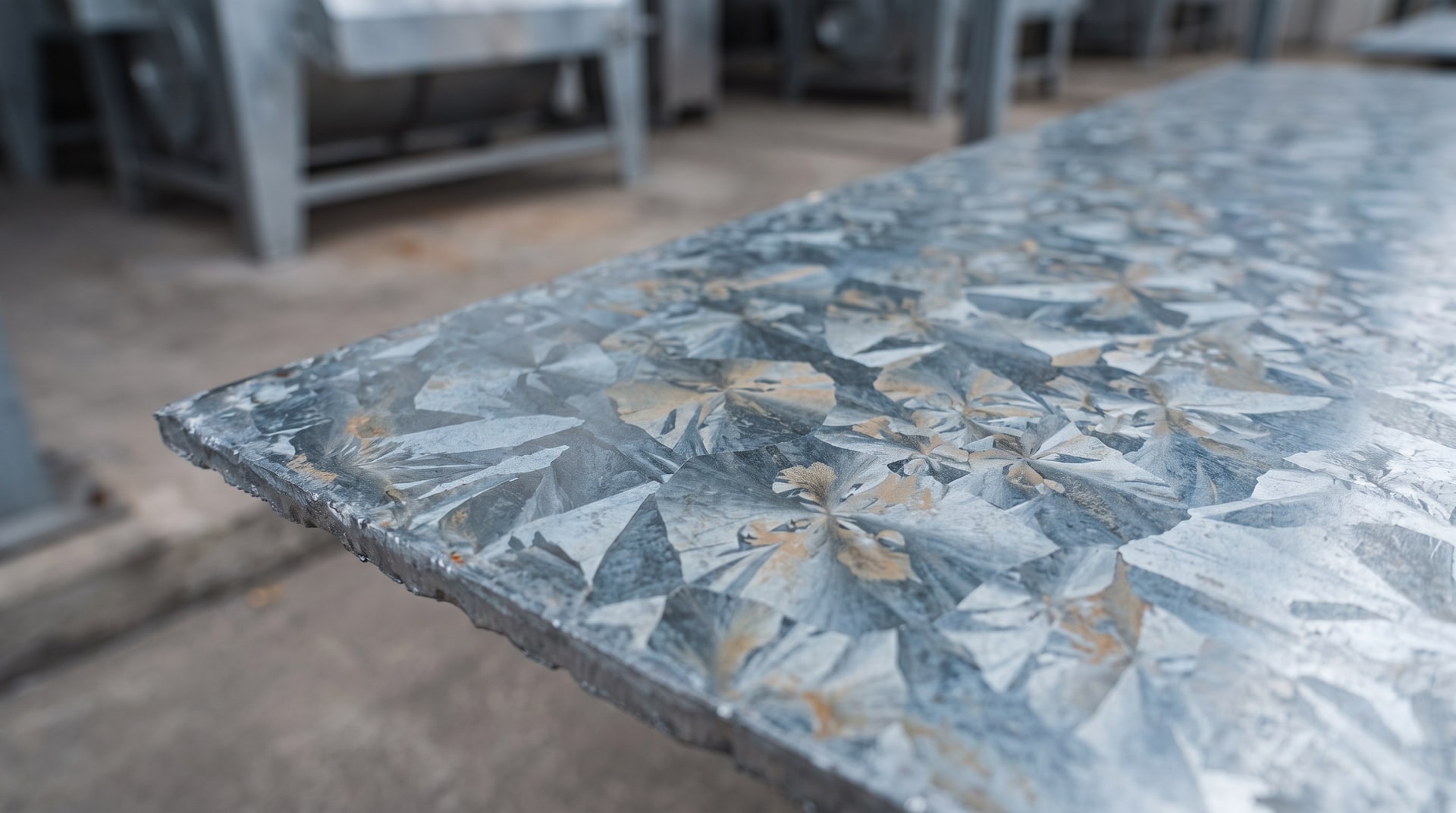
When architects and engineers specify hot-dip galvanizing, they are almost always focused on corrosion protection. But a subset of those specifiers also care deeply about what the coating looks like, and for good reason. The spangled surface of a galvanized coating, that distinctive pattern of triangular and flower-shaped zinc crystals, carries visual weight in exposed structural applications. Decorative galvanized panels, architectural metalwork, and exposed structural steel in public spaces are all contexts where the aesthetic outcome matters as much as the protective one.
Spangle is not simply a byproduct of the galvanizing process. It is a phenomenon that can be deliberately controlled or deliberately suppressed, depending on what the application demands. The variables involved range from bath chemistry to steel surface condition to the way parts are handled after they leave the kettle. Understanding those variables is what separates consistent, predictable results from a coating appearance that feels like guesswork.
The American Galvanizers Association addresses this directly in their article on controlling spangle influences in galvanized coatings. At V&S Galvanizing, we expand on that foundation to explain what is actually happening at the material level, how bath composition and process variables influence crystal formation, and why this topic is often misunderstood in the field.
What Spangle Actually Is
The term "spangle" refers to the visible crystalline pattern that forms on the outer surface of a hot-dip galvanized coating as it solidifies. These crystals typically appear as tiny triangular shapes or broader flower-like formations, which is why they are sometimes called "flowers of zinc." The pattern emerges as the outer zinc layer transitions from a liquid melt to a solid crystalline structure during cooling.
This is not an imperfection. It is a natural consequence of how zinc solidifies, and when the conditions are right, it produces a surface that is visually striking. The key word is "when the conditions are right," because spangle formation is highly sensitive to a combination of factors that must be managed intentionally if a specific aesthetic outcome is the goal.
The outer layer of a galvanized coating, the free zinc layer directly exposed to the atmosphere, is the zone where spangle forms. The intermetallic alloy layers beneath it, which are the iron-zinc compounds that develop during immersion, do not produce spangle. This distinction matters because anything that reduces the thickness of that free zinc layer, or consumes it entirely, will reduce or eliminate the spangled appearance.
Bath Chemistry: The Primary Control Variable
The most direct lever for controlling spangle is zinc bath composition. Spangle forms because minor alloying elements dissolved in the bath create nucleation sites during solidification. As the outer zinc layer cools, these alloying elements trigger crystal growth that radiates outward from each nucleation point, producing the characteristic flower patterns.
The elements most commonly associated with spangle formation include lead, tin, aluminum, cadmium, antimony, and copper. In commercial practice, the most frequently used bath chemistries are either a zinc-lead-tin combination or a zinc-aluminum-lead combination. Both systems can produce spangle, but the size and character of the crystals depend heavily on the specific concentrations of each alloying element.
Looking at the relationship between tin concentration and spangle size in a zinc-lead-tin kettle, a clear trend emerges: higher concentrations of tin produce larger, more defined spangle crystals. This holds across both low-lead bath formulations (around 0.5% Pb) and high-lead formulations (around 1.3% Pb). The lead content in the bath also plays a role, with higher lead levels generally supporting larger crystal development when combined with tin. The interaction between these two variables is not linear, which is why galvanizers who are serious about controlling spangle outcomes maintain careful records of bath chemistry and test results over time.
| Tin Concentration | Slow Cooling | Fast Cooling |
|---|---|---|
| Low tin | Small to medium spangle | Small or minimal spangle |
| Medium tin | Medium spangle | Small spangle |
| High tin | Large, well-defined spangle | Medium spangle |
| Tin Concentration | Slow Cooling | Fast Cooling |
|---|---|---|
| Low tin | Medium spangle | Small spangle |
| Medium tin | Large spangle | Medium spangle |
| High tin | Very large, highly defined spangle | Large spangle |
Cooling Rate and Its Effect on Crystal Growth
Bath chemistry sets the conditions for spangle formation, but cooling rate determines how fully those conditions are realized. Crystal growth takes time. The longer the outer zinc layer remains in a semi-liquid or transitional state during solidification, the more time the crystals have to grow and branch outward.
Slow cooling, whether through air cooling in a still environment or by allowing parts to cool on racks without forced airflow, gives crystals the time they need to develop into large, well-defined patterns. Faster cooling cuts that development time short, producing smaller crystals or a finer, less pronounced spangle. This is a consistent pattern across all bath compositions studied, and it is reinforced by the data shown in the AGA's spangle size charts.
Quenching, the practice of immersing freshly galvanized parts in water immediately after withdrawal from the kettle, is the most dramatic cooling intervention available. Quenching drops the zinc coating temperature so rapidly that it passes through the solidification zone before any meaningful crystal growth can occur. The result is a coating with minimal to no visible spangle. For applications where a smooth, uniform matte finish is preferred over a crystalline appearance, quenching is an effective tool. But if spangle is the goal, quenching is exactly what not to do.
Surface Condition of the Steel: An Underappreciated Factor
Steel surface roughness has a measurable influence on spangle formation that tends to be overlooked in conversations about bath chemistry. Rougher steel surfaces produce smaller spangle than smooth ones. The mechanism behind this is related to how crystals nucleate and grow: a rough surface creates many more nucleation sites per unit area, which means crystal growth starts at more points simultaneously. With more competing growth fronts, each individual crystal has less room to expand before it runs into an adjacent one. The result is a denser, finer pattern of smaller crystals.
Smooth steel surfaces, by contrast, offer fewer nucleation sites. This allows individual crystals to grow larger before they encounter neighboring growth fronts. Coupled with slow cooling and an appropriate bath chemistry, a smooth steel surface is one of the enabling conditions for producing the most visually dramatic spangle patterns.
Steel grain size also plays a role. Studies referenced by the AGA indicate that grain size affects crystal formation, though the relationship is part of the broader interaction between steel microstructure and coating behavior. For fabricators and engineers who are designing parts with aesthetic spangle as a priority, surface preparation method matters. Mill scale removal, acid pickling parameters, and blast profile all contribute to the final surface condition that goes into the kettle.
Immersion Time and the Role of Intermetallic Layer Growth
The amount of time a part spends submerged in the galvanizing kettle directly affects the thickness of the intermetallic iron-zinc alloy layers. These layers develop at the steel-zinc interface during immersion and continue to grow as long as the part remains in the molten bath. The longer the dip, the thicker these alloy layers become.
This matters for spangle because the intermetallic layers and the outer free zinc layer are in competition for the total coating thickness. A thicker intermetallic zone means a thinner free zinc layer remains at the surface after the part is withdrawn. Since spangle forms exclusively in that outer free zinc layer, less free zinc means less potential for crystal formation.
This is one of the reasons why controlling dip time is relevant not just for meeting coating thickness specifications, but also for managing appearance outcomes. For parts that are intended to display pronounced spangle, minimizing excess dip time (while still achieving the required coating thickness) helps preserve the free zinc layer that crystal formation depends on.
Reactive Steels and the Limits of Spangle Production
Not all steels respond to the galvanizing process in the same way. Steels with elevated silicon or phosphorus content are classified as reactive steels because they produce an accelerated, often uncontrolled growth of the intermetallic layers during galvanizing. This rapid alloy layer development can consume virtually all of the free zinc at the surface, leaving a coating that is predominantly composed of iron-zinc intermetallic phases with little or no outer zinc layer remaining.
The visual result is a dark gray or matte gray coating rather than the bright, shiny surface that spangle requires. When the intermetallic layers consume all available free zinc, there is simply no material left at the surface from which crystals can form. Aesthetically pleasing spangle cannot be produced on reactive steels under standard conditions.
The exception is when bath chemistry is specifically adjusted to control the rapid coating growth that reactive steels produce. Certain bath additions can moderate the reaction rate, leaving more free zinc at the surface and creating at least the possibility of some crystal formation. This is a more complex and constrained scenario than galvanizing non-reactive steels, and the results are less predictable.
Hydrogen Absorption During Chemical Cleaning
There is a less obvious variable in the spangle equation: hydrogen absorbed during the chemical cleaning stages of the galvanizing process. Parts that have undergone aggressive acid pickling can absorb significant amounts of hydrogen into the steel. When those parts are then immersed in the galvanizing kettle, that hydrogen must be expelled as the steel heats up.
The release of hydrogen through the coating during immersion creates disturbances in the liquid zinc at the steel surface. These disturbances disrupt the formation of the intermetallic alloy layers and the outer zinc layer in ways that inhibit orderly crystal growth. The more hydrogen that is expelled, the more turbulent the coating formation process, and the less defined the spangle pattern that results.
This is a meaningful practical consideration. Parts that require heavy pickling to remove thick mill scale or corrosion products are more likely to carry a high hydrogen load into the kettle. Managing pickling exposure time and acid concentration to achieve the minimum effective cleaning while limiting hydrogen absorption is one of the finer process controls available to galvanizers who are trying to optimize spangle outcomes.
Putting It Together: What It Takes to Produce Consistent Spangle
Achieving a consistently spangled coating is not a matter of adjusting one variable. It is the product of managing several interacting factors simultaneously. The bath needs to contain the right alloying elements at effective concentrations, whether that is a tin addition, an aluminum addition, or both, combined with appropriate lead levels. Parts need to be cooled slowly after withdrawal, without quenching. The steel surface should be as smooth as practical for the application. Dip time should be controlled to avoid excess intermetallic layer growth. And the steel itself should not be a reactive grade that will consume the free zinc layer before the part even leaves the bath.
When these conditions align, the outer free zinc layer has both the material available and the time needed to grow into the large, well-defined crystal patterns that make a spangled coating visually distinctive. When any of these conditions is compromised, the spangle pattern becomes smaller, less defined, or absent altogether.
For projects where spangle appearance is a design requirement, it is worth discussing the specifics with your galvanizer early in the project. Steel grade selection, fabrication surface finish, and coating specification all influence what is achievable, and some combinations simply cannot deliver the aesthetic outcome that architects or engineers have in mind without design adjustments upstream.
Work With a Team That Understands Coating Appearance from the Inside Out
Spangle is one of the more technically nuanced aspects of hot-dip galvanizing, precisely because it sits at the intersection of metallurgy, process chemistry, and design intent. At V&S Galvanizing, our team works with specifiers and fabricators on projects where coating appearance is part of the performance envelope, not an afterthought. We understand the bath chemistry, the process variables, and the steel-side factors that drive the outcome, and we can help project teams understand what is realistic given their material and design constraints.
If you are working on a project where galvanized coating appearance matters, whether you are trying to maximize spangle or achieve a more uniform matte finish, we are glad to talk through the specifics. Reach out through our contact page and connect with our technical team directly.
Frequently Asked Questions About Spangle in Hot-Dip Galvanized Coatings
What causes spangle to form on a galvanized coating?
Spangle forms when minor alloying elements in the zinc bath, such as lead, tin, aluminum, cadmium, or antimony, create nucleation sites during solidification of the outer free zinc layer. As the coating cools, crystals radiate outward from these sites, producing the triangular and flower-shaped patterns visible on the surface.
Can spangle size be controlled by the galvanizer, or is it random?
Spangle size is not random. It is a direct function of bath chemistry concentrations and cooling rate. Higher tin or aluminum additions combined with slower cooling produce larger, more defined crystals. Galvanizers who actively manage these variables can produce reasonably consistent spangle outcomes for a given steel type and surface condition.
Why does quenching eliminate spangle?
Quenching immediately after withdrawal from the kettle drops the coating temperature through the solidification range so rapidly that zinc crystals have no time to nucleate and grow. The coating solidifies in an essentially amorphous state, resulting in a smooth, matte appearance with little or no visible spangle.
Can reactive steels (high silicon or phosphorus content) produce spangled coatings?
Under standard conditions, reactive steels cannot produce aesthetically pleasing spangle. Their accelerated intermetallic layer growth consumes the free zinc layer at the surface, leaving a dark gray matte coating with no material available for crystal formation. Specific bath chemistry adjustments can moderate this reaction, but results on reactive steels are less predictable than on standard low-silicon steels.
How does steel surface roughness affect spangle appearance?
Rougher steel surfaces create more nucleation sites per unit area, which causes many smaller crystals to form simultaneously rather than fewer, larger ones. Smooth steel surfaces allow individual crystals to grow larger before encountering adjacent growth fronts, which is why smooth surfaces tend to produce larger, more visually prominent spangle patterns.
Does immersion time in the galvanizing kettle affect how much spangle forms?
Yes. Longer immersion times increase the thickness of the intermetallic iron-zinc alloy layers, which reduces the amount of free zinc remaining at the outer surface after withdrawal. Since spangle only forms in the free zinc layer, excessive dip time can reduce or eliminate the conditions needed for crystal formation.
Why would heavy acid pickling reduce spangle formation?
Aggressive acid pickling causes the steel to absorb hydrogen, which must be expelled when the part enters the hot zinc bath. This outgassing creates disturbances during coating formation that disrupt orderly crystal growth in the outer zinc layer, resulting in smaller or less distinct spangle patterns.
What is the most practical way to specify a spangled coating outcome on a project?
Discuss material and process requirements with your galvanizer before fabrication. Key factors include selecting non-reactive steel grades, achieving a smooth surface finish, specifying no water quench after galvanizing, and ensuring the galvanizer's bath contains appropriate spangle-promoting elements at effective concentrations. Not all combinations of steel grade and design geometry will yield the same result, so early coordination is essential.
