

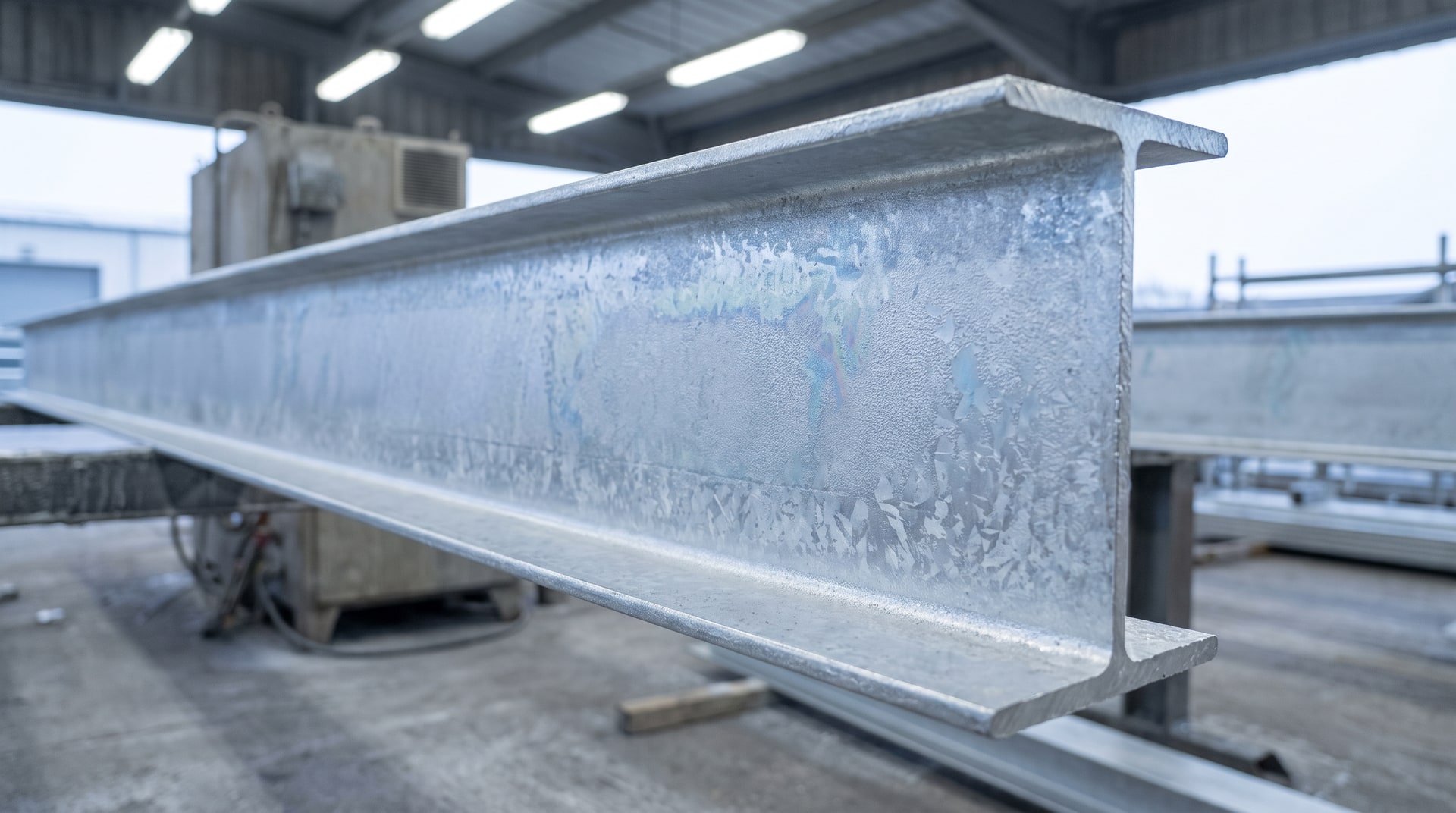
When a freshly galvanized part comes out of the zinc kettle, the coating is reactive. The zinc surface is clean, bright, and metallurgically bonded to the steel, but it's also vulnerable during the early hours and days after processing. Moisture, condensation, and atmospheric contact can all initiate wet storage stain, commonly called white rust, which compromises the aesthetic quality of the coating even when the underlying corrosion protection remains largely intact. To manage this, many galvanizers use a chromate quench immediately after the part exits the zinc bath. What that quench does at the chemical level, and specifically what happens to hexavalent chromium during and after the process, is something that comes up more often than you'd expect, both from a surface appearance standpoint and from an occupational health and environmental compliance perspective.
The American Galvanizers Association addresses this directly in their article on how long it takes to convert Chromium VI to Chromium III on galvanized steel. At V&S Galvanizing, we expand on that foundation to explain what is actually happening at the material level, how the conversion timeline influences downstream handling and surface appearance, and why this topic is often misunderstood in the field by fabricators, inspectors, and contractors alike.
Why Chromate Quenching Is Part of the Galvanizing Process
The zinc surface that emerges from a galvanizing bath is highly reactive in its earliest state. Free zinc, particularly in the presence of moisture, will oxidize rapidly to form zinc hydroxide or zinc carbonate, both of which appear as a white, powdery residue on the coating surface. This is wet storage stain, and while it does not in most cases penetrate deeply enough to undermine the corrosion protection provided by the coating, it creates an appearance problem that can trigger unnecessary rejection disputes and rework conversations on job sites.
To slow this initial oxidation and passivate the surface, some galvanizers dip freshly galvanized parts into a chromate quench solution after the zinc bath. The chromate creates a thin passivation layer on the zinc surface, effectively slowing the rate at which the free zinc can react with water and oxygen. This is particularly valuable when galvanized parts need to be bundled, stacked, or shipped in enclosed containers shortly after processing, where condensation risk is higher and airflow is limited.
The quench is a practical solution to a real handling and appearance challenge. Understanding its chemistry, though, requires looking more closely at what chromium is doing in that solution.
The Chemical Distinction Between Chromium VI and Chromium III
Chromium exists in several oxidation states, but two are relevant here: hexavalent chromium (Chromium VI, or Cr(VI)) and trivalent chromium (Chromium III, or Cr(III)). These are not simply different concentrations of the same substance. They are chemically distinct species with different solubility behavior, different biological interactions, and different regulatory classifications.
Chromium VI is the oxidation state associated with chromate compounds. It is water-soluble, mobile in the environment, and classified as a known human carcinogen. It is the form that raises occupational exposure and environmental compliance concerns in industrial settings. Chromium III, by contrast, is far less soluble, far less mobile, and is not classified as a carcinogen. It is actually an essential trace mineral in human nutrition at low concentrations.
When a chromate quench solution is prepared for use in a galvanizing line, it contains Chromium VI as the active passivating agent. The chromate anion (CrO4²-) or dichromate (Cr2O7²-) reacts with the zinc surface to form a protective film. That reaction is the mechanism by which the quench works, and it is also the mechanism by which the Chromium VI begins to convert.
What Happens When Zinc and Chromate React
When freshly galvanized steel is immersed in the chromate quench, the zinc surface acts as a reducing agent. The reaction between the reactive zinc and the chromate solution drives the reduction of Chromium VI to Chromium III. In chemical terms, the zinc is oxidized (zinc goes from Zn⁰ to Zn²+) while the chromium is reduced (Cr(VI) is reduced to Cr(III)). The product of this reaction is a mixed zinc-chromium oxide layer, sometimes called a chromate conversion coating, which is what actually provides the passivation benefit.
This means the quench is doing two things simultaneously: it is depositing a protective film on the zinc surface, and it is chemically converting the hexavalent chromium it carries into trivalent chromium in the process. Most of the Chromium VI present in the quench that reacts with the zinc surface converts during this reaction. However, as the AGA notes, a small residual amount of Chromium VI can remain on the galvanized surface immediately after the quench.
That residual Chromium VI is transient. It continues to convert to Chromium III in the period following galvanizing, driven by continued contact with the zinc surface and by ambient environmental conditions. The AGA's study on this conversion process, published in their Environmental, Health and Safety Note on hexavalent chromium, documents the timeline and extent of this conversion. The key finding that practitioners need to understand is that the residual Chromium VI does not remain on the surface indefinitely. Conversion proceeds, and the passivated surface that results is dominated by the more stable, less hazardous Chromium III species.
Why This Matters for Surface Appearance and Coating Integrity
From a surface appearance standpoint, the chromate conversion coating is nearly invisible. It does not alter the characteristic bright, spangled, or matte appearance of the zinc coating. What it does is extend the window during which the galvanized surface remains free of white rust, which is the powdery zinc oxide formation that can make new galvanized work look weathered or damaged before it has even been installed.
For projects where appearance matters, whether architectural metalwork, exposed structural components, or galvanized fencing and hardware that will be inspected visually before installation, the chromate quench is a meaningful process tool. It is not a cosmetic treatment in the decorative sense. It is a chemical passivation step that preserves the native appearance of the zinc coating during the vulnerable period between fabrication and installation.
Contractors and architects sometimes receive galvanized components and notice that some pieces have a slightly different surface character than others, a shinier or more uniform finish versus pieces that have already begun developing a light gray patina. That difference often comes down to whether a chromate quench was used and how long ago the parts were galvanized. The quenched surface stays brighter longer. Neither surface condition indicates a defect in coating performance, but understanding why the difference exists helps avoid unnecessary disputes over appearance.
The Conversion Timeline and What It Means for Handling
The practical question that arises in the field is straightforward: how long before the Chromium VI that remains after quenching converts to Chromium III? The AGA's EHS study addresses this directly, and while we encourage readers to consult that document for the specific data, the broader takeaway is that conversion is relatively rapid and is essentially complete within a short period after galvanizing under normal conditions.
This has real implications for how galvanized parts should be handled in the period immediately after processing. Workers handling freshly quenched steel should follow appropriate occupational hygiene practices consistent with the known properties of hexavalent chromium, including avoiding prolonged skin contact and following applicable workplace safety protocols. This is not an unusual precaution; it is standard practice in any industrial process that involves chromate compounds during active use.
Once conversion is complete and the residual Chromium VI has been reduced to Chromium III, the surface hazard profile changes substantially. The passivated coating on a fully converted galvanized surface is a zinc-chromium oxide film where the chromium present is in the trivalent state, which does not carry the same regulatory or occupational exposure concerns as the hexavalent form.
Regulatory and Environmental Context for Chromate Quenching
Hexavalent chromium is regulated under multiple frameworks in the United States, including OSHA's occupational exposure limit for Cr(VI), EPA regulations governing industrial process water and discharge, and various state-level environmental standards. Galvanizing operations that use chromate quenches operate within these frameworks, and responsible galvanizers maintain appropriate controls over quench solution management, worker exposure, and wastewater handling.
The fact that the quench converts Chromium VI to Chromium III during normal operation is relevant to process emissions and discharge characterization. A spent chromate quench solution that has been actively used on zinc will contain a different distribution of chromium species than a fresh solution, because the zinc-chromate reaction is continuously driving conversion throughout the quench's service life. This is one of the reasons why the AGA's EHS study on hexavalent chromium conversion was conducted and published. Quantifying how quickly and how completely the conversion occurs on the galvanized surface informs both worker safety protocols and environmental compliance assessments.
Fabricators and specifiers who are working on projects with stringent environmental or occupational health requirements should be aware that chromate quenching is not universally required or universally applied. Whether a part receives a chromate quench is typically determined by the galvanizer's standard process, the customer's specification, or the nature of the parts being processed. If a project has specific restrictions on chromate use, that requirement should be communicated to the galvanizer at the specification stage.
What This Means for Inspection and Acceptance
Inspectors and quality personnel who are evaluating galvanized steel shortly after processing need to understand how the timing of inspection relative to galvanizing affects what they observe at the surface. A part inspected within hours of a chromate quench may technically have a small residual Chromium VI presence. A part inspected days or weeks later, under normal ambient conditions, will have undergone full conversion.
This distinction matters if the inspection includes any surface chemistry evaluation, though for most standard structural and architectural galvanizing inspections, the focus is on coating thickness, adhesion, and visual appearance rather than surface chemistry speciation. The more common inspection scenario involves an evaluator looking at the surface and noting whether white rust is present, whether the coating appears continuous and well-bonded, and whether the finish is consistent with the applicable specification. The chromate passivation layer supports a clean, bright surface that makes this visual evaluation easier in the period immediately after processing.
Where inspection protocols do require chromium speciation, as they might in high-sensitivity environmental or occupational contexts, the AGA's published EHS data on conversion timing provides the technical basis for understanding what to expect and when.
Work With a Team That Understands the Full Process
The chromate quench is a small but technically meaningful part of the hot-dip galvanizing process. It exists to solve a real problem, protecting the zinc surface from early white rust formation during the period immediately after galvanizing. The chemistry behind it, specifically the conversion of hexavalent chromium to trivalent chromium through reaction with the zinc surface, is well-documented and the conversion is predictable. Understanding that process helps fabricators, contractors, and inspectors make better decisions about handling, timing, and specification.
At V&S Galvanizing, our team works with customers throughout the project lifecycle to make sure galvanized components arrive at the job site in the best possible condition. That includes understanding the role of post-galvanizing treatments like chromate quenching, how they affect surface appearance, and what they mean for downstream handling and inspection. If you have questions about surface treatment options, appearance expectations, or how our process applies to your specific project, reach out through our contact page and we will walk through it with you.
Frequently Asked Questions About Chromium VI to Chromium III Conversion on Galvanized Steel
What is a chromate quench and why is it used in hot-dip galvanizing?
A chromate quench is a post-galvanizing treatment in which freshly galvanized steel is dipped into a chromate solution. The quench passivates the zinc surface, slowing the early oxidation that causes wet storage stain (white rust) during shipping, handling, and storage. It does not affect the long-term corrosion protection of the coating but does help preserve surface appearance in the period immediately after galvanizing.
How does Chromium VI convert to Chromium III on galvanized steel?
When freshly galvanized steel contacts the chromate quench solution, zinc at the surface acts as a reducing agent. The reaction reduces Chromium VI (hexavalent chromium) to Chromium III (trivalent chromium) while oxidizing the zinc. This produces a mixed zinc-chromium oxide passivation film on the surface. Most of the Chromium VI converts during the quench reaction itself, with a small residual amount completing conversion shortly afterward.
Is the residual Chromium VI on freshly quenched galvanized steel a health hazard?
Hexavalent chromium is a known carcinogen and carries occupational exposure limits under OSHA regulations. A small residual amount of Chromium VI may remain on galvanized steel immediately after a chromate quench. Workers handling freshly quenched steel should follow appropriate occupational hygiene practices. The AGA's published EHS study on hexavalent chromium conversion documents how quickly this residual converts to the significantly less hazardous Chromium III form under normal conditions.
Does all galvanized steel receive a chromate quench?
No. Chromate quenching is not a universal requirement in the hot-dip galvanizing process. Whether a part is quenched depends on the galvanizer's standard practice, the customer's specification, and the nature of the components being processed. If your project has specific requirements around chromate use or restrictions on hexavalent chromium, those requirements should be communicated to the galvanizer before processing.
How does the chromate conversion coating affect the visual appearance of galvanized steel?
The chromate conversion coating is effectively transparent and does not alter the characteristic bright, spangled, or matte appearance of the zinc surface. What it does is extend the period during which the surface stays free of white rust. Parts that receive a chromate quench will typically appear brighter and more uniform for a longer period after galvanizing compared to unquenched parts. Neither condition represents a defect in corrosion protection.
What is the difference between Chromium VI and Chromium III in terms of environmental and regulatory concern?
Chromium VI is water-soluble, mobile in the environment, and classified as a carcinogen under U.S. and international regulatory frameworks. It is subject to OSHA exposure limits and EPA discharge regulations. Chromium III is far less soluble, far less mobile, and is not classified as a carcinogen. The conversion from Cr(VI) to Cr(III) on galvanized surfaces is therefore significant from both an occupational safety and environmental compliance perspective.
When can galvanized steel that has been chromate quenched be safely handled without special precautions for hexavalent chromium?
According to the AGA's EHS study on hexavalent chromium conversion, the small residual Chromium VI that remains on a galvanized surface after quenching converts to Chromium III within a short period under normal conditions. Once conversion is complete, the surface hazard profile associated with hexavalent chromium is no longer present. For specific timing data, consult the AGA's published EHS Note on the hexavalent chromium study, which documents conversion rates directly.
Does the chromate passivation layer affect paint adhesion or duplex coating systems applied over galvanized steel?
The thin chromate conversion film on a galvanized surface can influence adhesion if a duplex system is applied very shortly after galvanizing. For most duplex coating applications, standard surface preparation protocols, including sweep blasting or specific primer systems, are used regardless of whether a chromate quench was applied. If a tight timeline between galvanizing and painting is anticipated, surface preparation requirements should be discussed with both the galvanizer and the coating applicator at the specification stage.
