

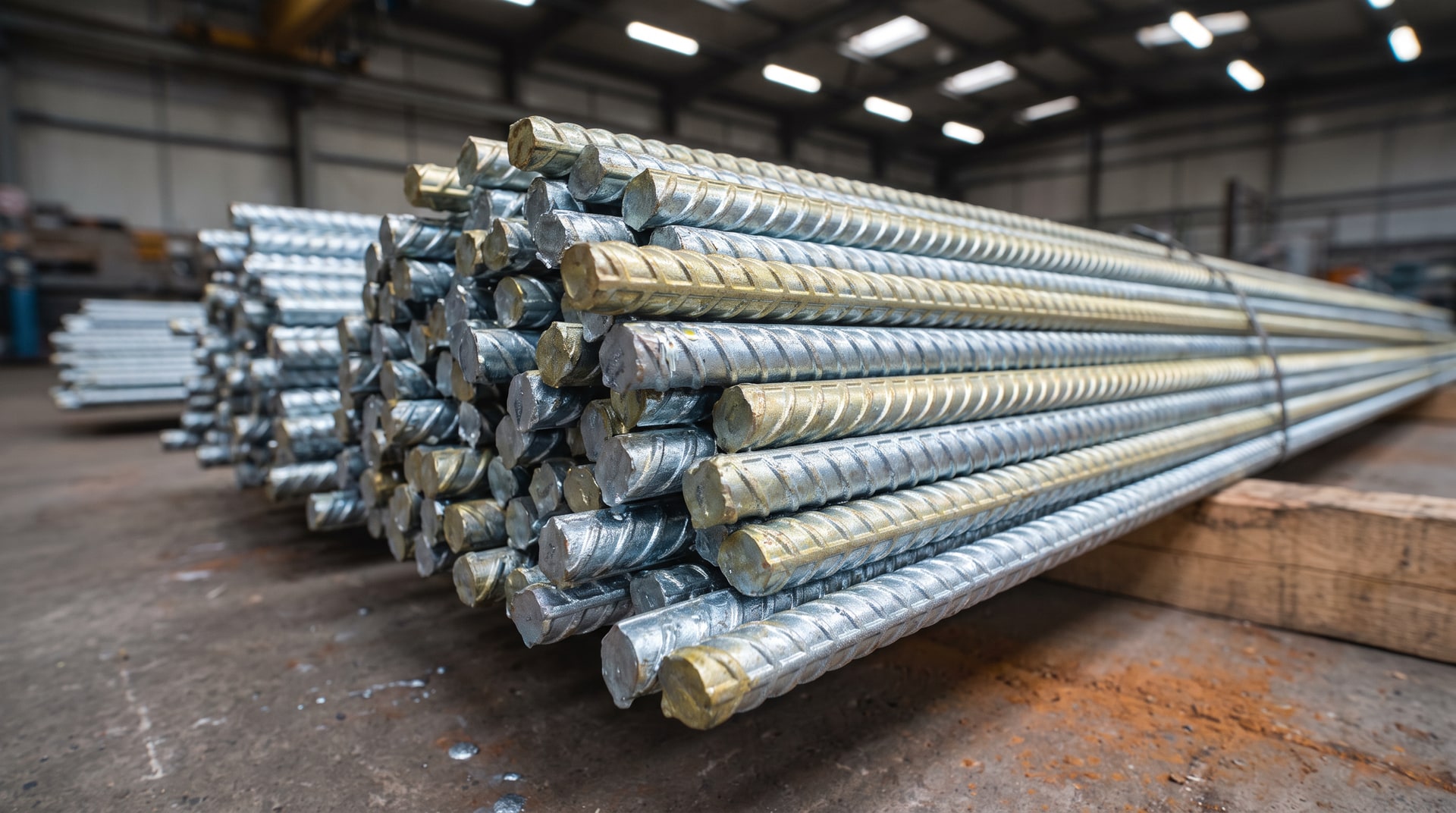
When galvanized steel leaves the zinc bath, the story isn't over. The zinc surface is chemically active and, depending on how the steel is stored or used, it can begin reacting almost immediately with moisture, oxygen, and alkaline environments. For galvanized reinforcing steel in particular, two distinct problems emerge: wet storage stain during the weeks following galvanizing, and hydrogen gas evolution when fresh concrete cures around the rebar. Both of these are manageable, and chromate passivation treatment is a well-established response to both.
What gets lost in the conversation is the actual chemistry. Chromate treatments are often treated as a checkbox item on a specification rather than a meaningful material decision. Understanding what the treatment does at the molecular level, why it works, and where its limitations lie gives engineers and specifiers a much better basis for requiring it, inspecting for it, and understanding what to expect after it's gone.
The American Galvanizers Association addresses this directly in their article on the chemical reaction between chromates and galvanized steel. At V&S Galvanizing, we expand on that foundation to explain what is actually happening at the material level, how the oxidation state of chromium influences the film's protective character, and why the behavior of galvanized rebar in concrete is often misunderstood in the field.
Why the Zinc Surface Needs Passivation in the First Place
Hot-dip galvanizing produces a zinc coating that is, by design, sacrificial. Zinc corrodes preferentially to protect the underlying steel, and it does so by forming stable corrosion products over time. In outdoor exposure, zinc develops a tightly adherent patina of zinc carbonate that slows further corrosion to a very low rate. That patina takes time to form, though, and the newly galvanized surface doesn't have it yet.
In the first weeks after galvanizing, the zinc surface is particularly vulnerable. If freshly galvanized steel is stored in conditions where moisture can accumulate between stacked pieces and can't freely evaporate, the zinc reacts rapidly with oxygen and water. The result is zinc oxide and zinc hydroxide, a white, powdery deposit commonly called wet storage stain or white rust. While wet storage stain is generally superficial and doesn't compromise the long-term corrosion protection of the coating, it looks poor and can trigger rejection on the job site.
The zinc coating is most vulnerable to this during the first six weeks after galvanizing. Chromate passivation creates a thin film over the zinc surface that inhibits the formation of these early-stage oxides during that critical window. After roughly six weeks, the chromate film is consumed and the galvanized steel begins to weather naturally, eventually developing the protective patina it would have formed anyway.
The Two Forms of Chromium and How They Work Together
The protective character of a chromate film comes from the presence of two chemically distinct forms of chromium: hexavalent chromium (Cr+6) and trivalent chromium (Cr+3). These aren't interchangeable, and each plays a different role in how the film functions.
Trivalent chromium is the structural backbone of the film. It is present primarily as an insoluble hydrated oxide, specifically chromium hydroxide or zinc chromate, depending on conditions. This insoluble matrix gives the film its physical integrity and provides a barrier between the zinc surface and the environment.
Hexavalent chromium, on the other hand, is soluble, and that solubility is exactly what makes it useful. When the film is attacked by aggressive species like chloride ions, the soluble hexavalent chromium can migrate toward the site of attack and re-deposit as trivalent chromium compounds. This is what the AGA refers to as the "self-healing" character of the chromate film. The film can partially repair itself during early oxidative attack in a way that a purely inert barrier coating cannot.
The combination of an insoluble trivalent chromium matrix with a reservoir of soluble hexavalent chromium gives chromate films a performance profile that is genuinely difficult to replicate with simpler passivation approaches.
What the Chemical Reactions Actually Look Like
Chromate films are formed by immersing galvanized steel in an acidic solution containing hexavalent chromium along with other components called activators. Several reactions happen in sequence, and understanding them helps clarify why the process is sensitive to process control.
The first step is a redox reaction in which hexavalent chromium is reduced to trivalent chromium while zinc is simultaneously oxidized. This can be written as:
3Zn + 2Cr⁶ → 3Zn₂⁺ + 2Cr₃⁺
At the same time, the acid in solution attacks the zinc surface directly, producing hydrogen gas and driving a local rise in pH at the metal interface:
Zn + 2H⁺ → Zn₂⁺ + H₂ (gas)
The full electrochemical picture of the redox reaction shows zinc being oxidized while hexavalent chromium is reduced:
Zn → Zn₂⁺ + 2e⁻HCrO₄⁻ + 14H⁺ + 6e⁻ → 2Cr₃⁺ + 7H₂O
As the acid is consumed at the zinc surface, the pH at the interface rises. This changes the combining behavior of the chromium species in solution and triggers the precipitation of chromium hydroxide. A film builds outward from the zinc surface. Once the layer immediately adjacent to the zinc becomes non-acid, the reaction stops. The gel-like film that remains is allowed to harden, producing the characteristic yellow chromate coating: a complex mixture of hydrated basic chromium chromate (Cr2O3·CrO3·xH2O) and hydrous oxides of both chromium and zinc.
The yellow color of the finished coating is a practical indicator that both trivalent and hexavalent chromium are present in the film. A coating that processes correctly has that distinctive yellow appearance and contains both forms working in concert.
Galvanized Rebar in Concrete: A Different Set of Reactions
The use of chromate treatment on galvanized reinforcing steel in concrete structures addresses a different problem entirely, and it's worth separating these two applications clearly in the engineer's mind.
Concrete is a highly alkaline environment. During curing, the pore solution in fresh concrete is dominated by calcium hydroxide and can reach a pH well above 12. Zinc is amphoteric, meaning it reacts in both acidic and strongly alkaline conditions. At pH values above 12.5, the rate of zinc attack increases significantly. Below that threshold, roughly in the pH range of 8 to 12.5, zinc passivates naturally through the formation of a zinc hydroxide layer and, subsequently, a more complex compound: calcium hydroxy-zincate, written as Ca[Zn(OH)3]2·2H2O.
The problem during the active curing period is that the highly alkaline calcium hydroxide attacks the zinc coating, producing two byproducts: calcium hydrozincate as a relatively protective layer, and hydrogen gas. That hydrogen evolution is the concern. If hydrogen gas evolves at the interface between the rebar and the concrete while the concrete is still curing, it can disrupt the bond line, creating voids that reduce the mechanical bond between the two materials.
Chromate passivation helps suppress this hydrogen evolution during the critical curing window. The chromate film limits the initial rate of zinc attack, giving the concrete time to begin setting before significant gas can accumulate at the interface.
What Happens After the Concrete Sets
Once the concrete fully sets, the hydrogen evolution essentially stops on its own. The calcium zincate layer that forms at the zinc surface during the early curing phase provides a degree of protection that prevents further chemical attack from continuing. This is an important point: the chromate treatment doesn't need to last forever in this application. It only needs to moderate the reaction during the relatively brief curing window.
After setting, bond strength testing of galvanized rebar against black steel rebar consistently shows equal or slightly better bond performance for galvanized steel. The calcium zincate reaction products, while forming through a mechanism that initially causes some concern, ultimately contribute to a reliable mechanical bond. The galvanized rebar, once embedded in cured concrete, behaves well from a bond standpoint, and the zinc coating continues to provide its primary function: corrosion protection for the steel core over the service life of the structure.
Many other factors affect the bond between galvanized rebar and concrete beyond the zinc-concrete chemistry. Concrete mix design, the presence of admixtures, curing conditions, and the age of the concrete at loading all play roles. Chromate treatment addresses one specific variable in a multi-variable system, and specifiers should understand it in that context.
How Long the Chromate Film Actually Lasts
One of the most common misconceptions about chromate treatment is that it provides ongoing corrosion protection throughout the service life of the structure or assembly. It doesn't, and it isn't intended to. For galvanized steel in atmospheric service, the chromate film typically lasts approximately six weeks before it is consumed. After that, the galvanized steel weathers naturally.
This six-week window aligns with the period when the zinc coating is most vulnerable to wet storage stain. It also roughly matches the early curing period for concrete when hydrogen evolution is the primary concern for rebar applications. The treatment is a transitional measure, not a permanent protective layer. Expecting chromate to function beyond that timeframe is a misunderstanding of what the chemistry can sustain.
For structural applications where the galvanized steel will be exposed to aggressive chloride environments over its full service life, the long-term corrosion protection comes from the zinc coating itself, not the chromate passivation layer on top of it. The chromate just gives the zinc surface time to stabilize and begin developing its own natural protective carbonate patina.
Specifying Chromate Treatment: What to Ask and Why
For engineers and project specifiers, the practical question is when to require chromate passivation and how to verify it has been applied. The answer depends on how the galvanized steel will be handled and used in the weeks immediately after galvanizing.
If freshly galvanized reinforcing steel will be stored outdoors before installation, or if it will be transported and stacked in conditions where moisture can accumulate between pieces, chromate passivation is a straightforward specification addition. It reduces the risk of wet storage stain complaints and helps ensure the steel arrives at the job site looking presentable.
For galvanized rebar that will be embedded in concrete, chromate passivation is specifically useful for controlling hydrogen evolution during curing. This is particularly relevant in applications where concrete mix design or structural geometry make the early bond quality especially critical.
Visually, correctly applied chromate treatment produces a uniform yellow film. This is the simplest field verification: the characteristic yellow appearance confirms both forms of chromium are present and the treatment was applied at processing conditions that produced the intended film. A film that is clear or inconsistently colored warrants a closer look at the application process.
At V&S Galvanizing, our hot-dip galvanizing process can accommodate chromate passivation treatment for reinforcing steel and other applications where wet storage stain prevention or concrete bond quality are specified requirements. The chemistry is well understood, the process is reliable, and the performance window is predictable.
Work With a Team That Understands the Full Chemistry
Chromate passivation is a straightforward process in execution, but the underlying chemistry involves multiple simultaneous reactions, careful pH control, and a clear understanding of what the film can and cannot do. Getting the treatment right means understanding why each step matters, from the acid concentration in the chromating bath to the final harden of the gel film, and matching that to the actual performance requirements of the project.
Engineers and fabricators who understand the mechanism behind chromate treatment are better positioned to specify it accurately, inspect for it correctly, and interpret what they're seeing when the film is present or absent. The self-healing character of the hexavalent chromium component, the role of trivalent chromium in forming the insoluble matrix, and the behavior of zinc in high-pH concrete environments are all connected pieces of a coherent technical picture.
If you're working on a project that involves galvanized reinforcing steel in concrete, or if you have questions about chromate passivation requirements for structural or architectural galvanizing, our team is ready to work through the specifics with you. Reach out through our contact page and we'll connect you with a technical resource who can help.
Frequently Asked Questions About Chromate Passivation of Galvanized Steel
What is chromate passivation on galvanized steel and why is it applied?
Chromate passivation is a chemical treatment applied to the zinc surface of galvanized steel after the galvanizing process. It forms a thin gel-like film containing both trivalent and hexavalent chromium compounds. The treatment is primarily used to prevent wet storage stain during the first six weeks after galvanizing and, on reinforcing steel, to reduce hydrogen gas evolution when the rebar is embedded in curing concrete.
How does the self-healing property of chromate films actually work?
The soluble hexavalent chromium fraction in the chromate film can migrate toward sites of localized attack, such as areas where chloride ions are initiating corrosion, and re-deposit as trivalent chromium compounds. This re-deposition partially repairs the film during early oxidative attack, extending its protective effectiveness in a way that a purely inert barrier coating cannot replicate.
Why does galvanized rebar produce hydrogen gas in fresh concrete?
Zinc is amphoteric, meaning it reacts in both acidic and highly alkaline conditions. Fresh concrete during curing has a pH that can exceed 12.5, primarily due to dissolved calcium hydroxide. At these pH levels, the alkaline environment attacks the zinc coating, producing calcium hydrozincate and hydrogen gas as byproducts. The hydrogen evolution occurs at the rebar-concrete interface during curing and can disrupt the forming bond if not controlled.
Does chromate treatment permanently protect galvanized steel against concrete attack?
No. The chromate film is consumed over approximately six weeks. For rebar in concrete, its role is to moderate the initial zinc-concrete reaction during the curing window, not to provide permanent barrier protection. Once the concrete sets, the zinc attack essentially stops on its own due to the calcium zincate layer that forms at the interface, and no further passivation is needed.
What does the yellow color of a chromate-treated galvanized surface indicate?
The yellow color indicates that both trivalent and hexavalent chromium are present in the film. Chromate coatings on galvanized steel are characteristically yellow and consist of a mixture of trivalent and hexavalent chrome compounds in a hydrated oxide matrix. A uniform yellow appearance is a basic visual confirmation that the treatment was applied under conditions that produced the intended film chemistry.
How does bond strength of galvanized rebar compare to black steel rebar in concrete?
Testing of bond strength on galvanized rebar shows performance equal to or slightly better than that of uncoated black steel rebar. The calcium zincate layer that forms during the initial zinc-concrete reaction, while produced through a process that generates some hydrogen gas, ultimately becomes a stable compound at the interface that contributes to a reliable mechanical bond once the concrete is fully cured.
At what pH does zinc passivate naturally in concrete environments?
Zinc passivates naturally in the pH range of 8 to 12.5. In this range, the zinc surface initially forms a zinc hydroxide layer, which then develops into a more complex calcium hydroxy-zincate compound (Ca[Zn(OH)3]2·2H2O). Above a pH of 12.5, the rate of zinc attack increases significantly, which is why the early concrete curing environment presents a specific challenge for galvanized rebar.
Does chromate passivation need to be reapplied after the initial treatment wears off?
No. The chromate film is intended as a transitional treatment, not a renewable protective layer. After roughly six weeks, the film is consumed and the galvanized steel begins to weather naturally, eventually developing its own stable zinc carbonate patina through atmospheric exposure. Reapplication is not a standard practice, and the long-term corrosion protection of the assembly comes from the zinc coating itself rather than from the chromate film.
