
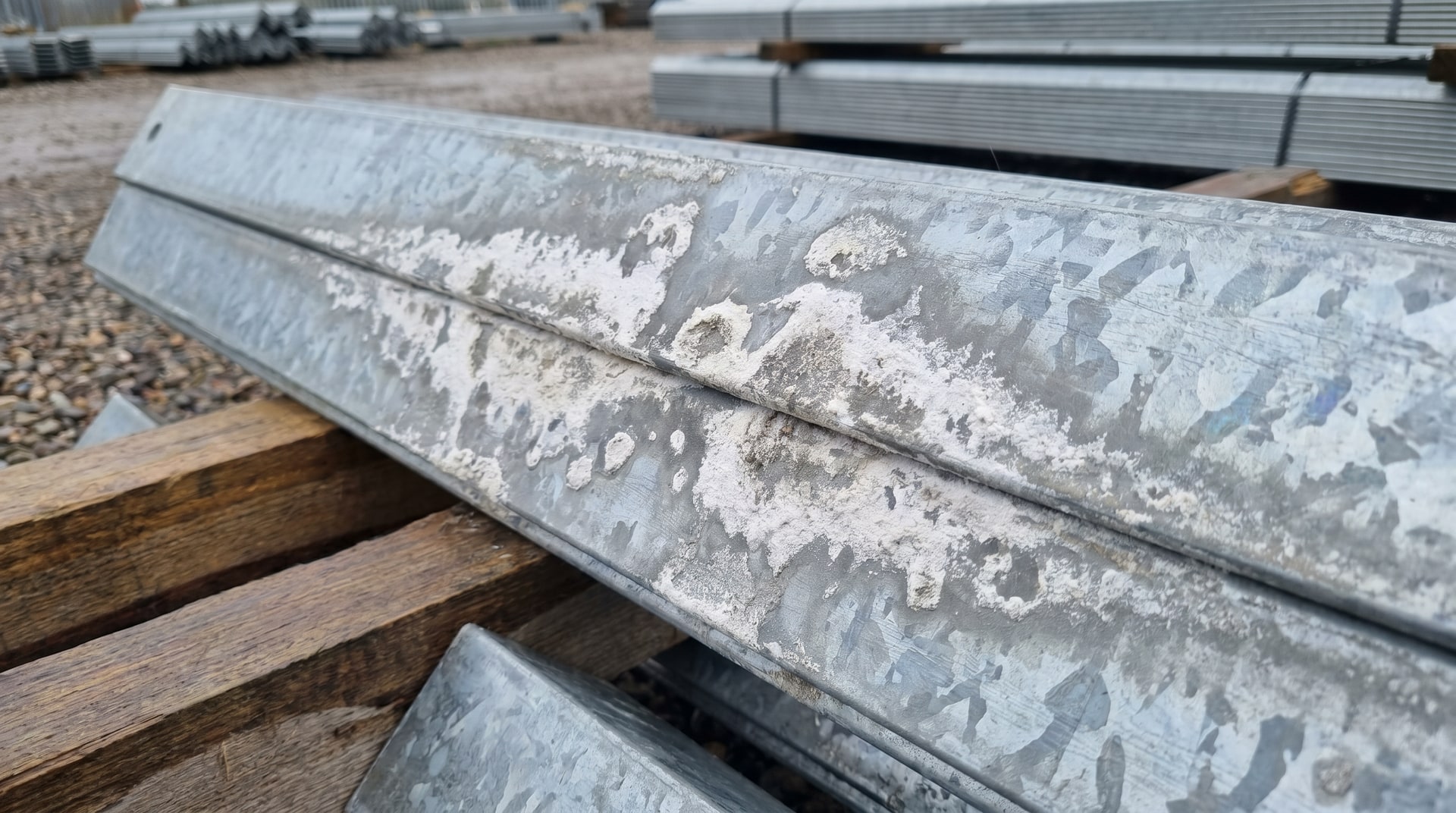
Wet storage stain is often dismissed as purely cosmetic—but that is only partially true. While many cases of white rust have little to no impact on long-term performance, there are conditions where it can result in measurable zinc loss and reduced coating life.
At V&S Galvanizing, we help customers evaluate whether wet storage stain is simply an appearance issue or something that needs corrective action. The American Galvanizers Association provides technical context on this topic, which we expand on here to explain how and when wet storage stain actually causes damage.
What Wet Storage Stain Actually Is at the Material Level
Wet storage stain forms when freshly galvanized steel is exposed to continuous moisture without proper airflow. Instead of forming a stable zinc carbonate patina, the zinc reacts to form zinc hydroxide.
This distinction matters.
- Zinc carbonate (stable patina) → slows corrosion and protects the coating
- Zinc hydroxide (white rust) → porous, unstable, and continues reacting
When the surface cannot dry and convert to a stable layer, the reaction continues, consuming zinc at a faster rate than normal atmospheric exposure.
Cosmetic vs. Damaging Wet Storage Stain
Not all wet storage stain is equal. The severity determines whether performance is affected.
Light Wet Storage Stain (Cosmetic)
- Thin, powdery white film
- Easily brushed or weathered away
- Minimal zinc consumption
- No measurable impact on coating life
This is the most common scenario and typically resolves naturally once proper exposure conditions are restored.
Moderate Wet Storage Stain (Localized Zinc Loss)
- Thicker white or gray buildup
- May leave a slightly etched surface after removal
- Some measurable zinc consumption
- Slight reduction in coating thickness
At this stage, evaluation becomes important—especially in critical environments.
Heavy Wet Storage Stain (Performance Impact)
- Dense, bulky white/gray deposits
- Surface may appear darkened or uneven after cleaning
- Noticeable zinc loss
- Potential exposure of underlying steel in extreme cases
This condition represents actual coating degradation and should be addressed.
Why Continuous Moisture Accelerates Zinc Loss
Zinc corrosion is normally a controlled process that slows over time. Wet storage stain interrupts that balance.
When moisture is trapped:
- Oxygen availability is limited
- Carbon dioxide cannot reach the surface
- Protective patina cannot form
- Corrosion continues at an elevated rate
This creates a micro-environment where zinc consumption is significantly higher than under normal atmospheric conditions.
How to Evaluate Whether Damage Has Occurred
The key question is not “Does it look bad?” but rather:
“Has zinc thickness been reduced below acceptable limits?”
Evaluation typically includes:
- Visual assessment of severity
- Checking for remaining coating continuity
- Measuring coating thickness if needed
- Reviewing exposure conditions
In many cases, even moderate staining still leaves sufficient zinc for long-term protection.
When Wet Storage Stain Requires Action
Corrective action should be considered when:
- The coating has been visibly eroded
- Thickness may no longer meet specification
- The application involves aggressive environments (marine, industrial, deicing exposure)
- Aesthetic requirements are critical for the project
This is where inspection moves from observation to decision-making.
Cleaning and Restoration Considerations
If action is needed, the goal is to stabilize the surface and assess remaining protection.
Typical approaches include:
- Dry brushing or light cleaning for minor cases
- More thorough cleaning for heavier buildup
- Allowing natural weathering where appropriate
- Applying repair methods if zinc loss is significant
The most important step is ensuring the surface can dry and form a stable patina moving forward.
Why Prevention Still Matters More Than Repair
Wet storage stain is one of the most preventable conditions in galvanizing—and once zinc is consumed, it cannot be restored without repair.
Avoiding:
- Tight stacking
- Poor drainage
- Trapped moisture
Is far more effective than correcting the issue after it develops.
The Bigger Picture: Lifecycle Impact
Even when wet storage stain causes some zinc loss, it does not automatically mean coating failure.
Hot dip galvanized coatings are designed with:
- Significant thickness margins
- Long service life expectations
- Ability to tolerate early-stage exposure events
The key is understanding whether the remaining coating still meets performance requirements for the environment.
Work With a Team That Helps You Evaluate Real Impact
Wet storage stain often creates unnecessary concern—or worse, gets ignored when it shouldn’t be. The difference between a cosmetic issue and a performance problem comes down to proper evaluation, not assumption.
At V&S Galvanizing, we work with project teams to assess coating condition, determine whether zinc loss is meaningful, and recommend the right path forward based on actual performance requirements.
Wet storage stain can range from a harmless surface condition to a situation that reduces coating life, depending on severity and exposure conditions. Understanding the difference between cosmetic staining and actual zinc loss is critical to making the right decision in the field. If you are seeing wet storage stain on your material and want to understand whether it impacts your project, reach out to our team through our contact page.
Frequently Asked Questions About Wet Storage Stain Damage
Does wet storage stain always damage galvanized steel?
No. In many cases, it is purely cosmetic and does not affect coating performance. Damage depends on severity and duration of exposure.
How do you know if zinc has been lost?
Zinc loss can be indicated by heavy buildup, surface etching, or confirmed through coating thickness measurement.
Can wet storage stain expose bare steel?
In severe cases, yes. Prolonged exposure can consume enough zinc to expose the underlying steel.
Should all white rust be removed?
Light staining does not always require removal. Heavier buildup may need to be cleaned to evaluate the surface.
Does wet storage stain shorten coating life?
It can, if zinc is consumed significantly. Minor cases typically have little to no impact on long-term performance.
Can the coating recover after wet storage stain?
Yes. Once proper drying conditions are restored, a stable protective patina can form and slow further corrosion.
Is repair always required?
No. Repair is only necessary if coating thickness has been reduced below acceptable levels or steel is exposed.
What is the most important step after identifying wet storage stain?
Restoring proper storage conditions to stop further zinc consumption is the most critical step.