

When a fabricator or project inspector receives a batch of hot-dip galvanized steel, most of the evaluation centers on coating thickness measurements and visual checks for obvious surface defects. Both are important. But there is a third property that underpins everything else: how well the zinc coating actually bonds to the underlying steel. A coating that meets every thickness requirement on paper provides very little real-world protection if it can be lifted away from the base metal under mechanical stress or thermal cycling in service. That is where adherence becomes a critical variable, and where field testing methodology matters.
The American Galvanizers Association addresses this directly in their article on the adherence test for hot-dip galvanized coatings. At V&S Galvanizing, we expand on that foundation to explain what is actually happening at the material level, how the metallurgical bond influences coating performance, and why this particular test is often misunderstood or misapplied in the field.
How Zinc Actually Bonds to Steel During Hot-Dip Galvanizing
Understanding the adherence test starts with understanding what you are testing. Hot-dip galvanizing does not produce a paint-like film sitting on top of the steel surface. When properly prepared steel is immersed in a bath of molten zinc at approximately 840 degrees Fahrenheit, a series of iron-zinc intermetallic alloy layers form through a diffusion reaction at the steel surface. These layers grow outward from the steel, transitioning from iron-rich compounds nearest the base metal to nearly pure zinc at the outermost surface.
The result is a coating that is metallurgically bonded to the steel, not mechanically adhered or chemically glued. The zinc and the steel become part of a continuous layered structure. This is fundamentally different from organic coatings, and it is the reason galvanized steel can withstand handling, transport, and mechanical abuse that would chip or peel a paint system. When adherence is sound, the coating resists delamination even under concentrated stress because there is no true interface to fail in the same way a film coating can.
What this means in practice is that loss of adherence in a properly galvanized coating is genuinely uncommon. When it does occur, it is usually a signal that something went wrong during surface preparation, flux application, or the galvanizing process itself.
What the Stout Knife Test Actually Does
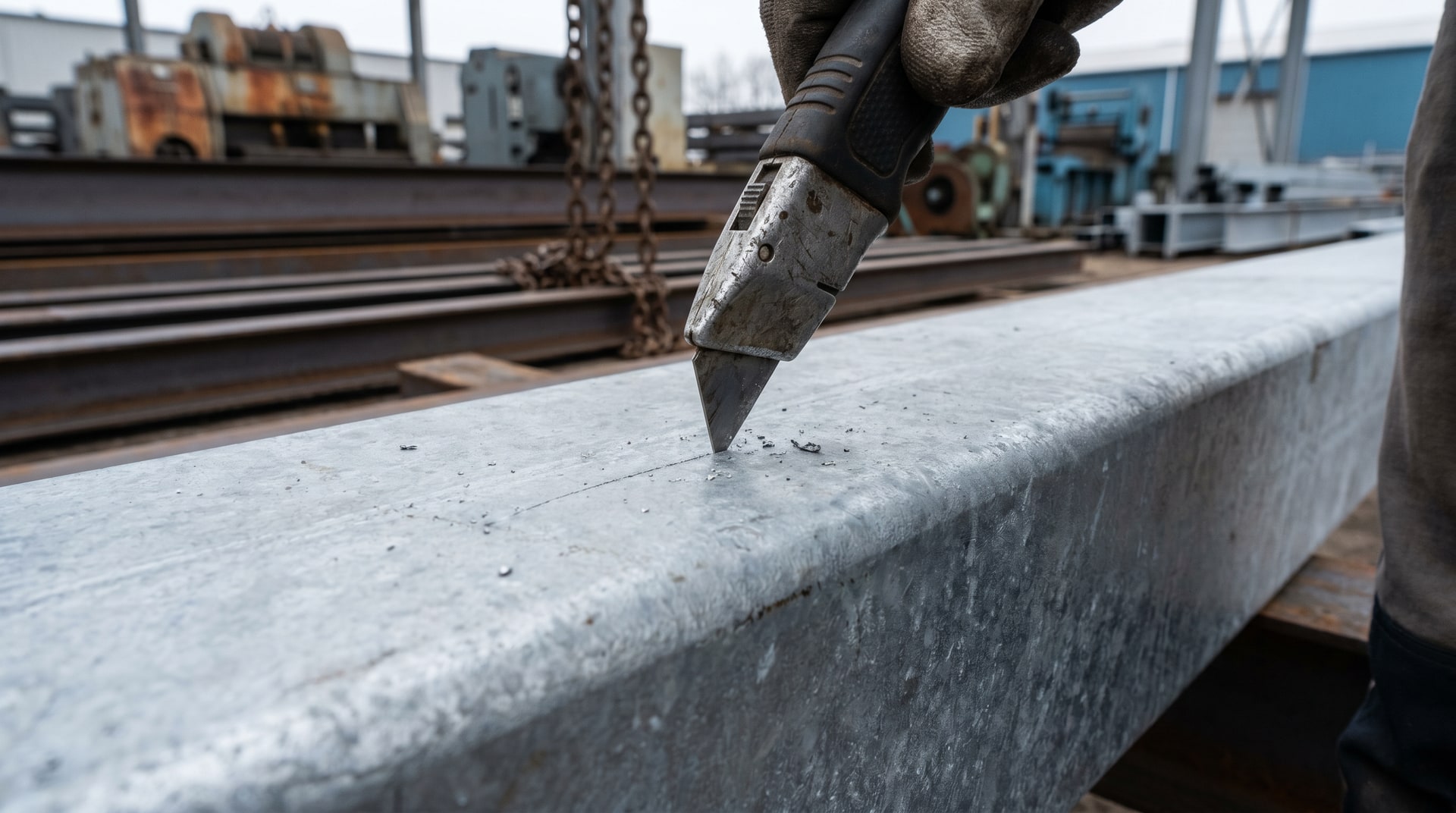
The adherence test described in ASTM A123/A123M and ASTM A153/A153M is a straightforward mechanical evaluation using a stout knife. The procedure calls for running the blade smoothly along the surface of the zinc coating without whittling or gouging into the metal. The intent is to apply a shearing stress to the coating in a controlled, sliding motion rather than a digging or prying action.
A properly adherent coating will accept a slight surface mark from the knife edge without flaking, peeling, or separating from the steel beneath. The blade is essentially trying to shear the coating laterally off the surface. If the metallurgical bond is intact, the intermetallic alloy layers resist this force and the coating stays put. If there is a weak boundary layer, the coating will separate in visible flakes or sheets.
The distinction between a passing and failing result is usually unambiguous. A thin scratch line left by the knife is acceptable and expected. Flaking, peeling back of the coating, or delamination of any kind indicates a bond failure. There is not much gray area in interpreting results, which is part of why the test is effective as a referee evaluation.
What the Test Is Not Designed to Do
This point causes a fair amount of confusion in the field. The stout knife test is specifically a smooth sliding motion along a flat surface area. Paring or whittling into the coating with the knife tip is explicitly not acceptable test procedure under the ASTM specifications. When someone digs the knife tip into the zinc and levers up a chip, they are not performing the adherence test. They are mechanically destroying a well-bonded coating and misinterpreting the result.
Similarly, the test should never be performed on corners or edges of galvanized products. At corners and edges, the geometry of the part creates stress concentrations in the coating during galvanizing, and the intermetallic alloy layers can be thicker or more brittle than on flat surfaces. Running a knife across an edge introduces mechanical prying forces that would cause even a well-adhered coating to release locally. Testing corners produces unreliable data and unfairly penalizes what may be a perfectly sound coating on the rest of the part.
The value of the test lies in its application to flat, accessible surface areas where the coating formation and the test mechanics are both straightforward. Applied correctly, it gives clear information. Applied incorrectly, it generates noise.
Recognizing Why Adherence Failures Are Rare in Practice
One of the most important practical points about the adherence test is that it rarely needs to be performed. Flaking or peeling of a hot-dip galvanized zinc coating is genuinely uncommon when the galvanizing process is executed properly. This is not an overstatement. Because the zinc coating grows through a metallurgical reaction rather than being applied as a film, the conditions that produce poor adherence are process failures that tend to be visible in other ways as well.
Poor surface preparation is one such condition. If steel arrives at the galvanizing bath with residual mill scale, contamination, or inadequate pickling, the zinc reaction may not proceed uniformly, resulting in bare spots or rough, poorly formed coating rather than a delaminating one. Flux failures can produce similar results. In most cases, a batch with a genuine adherence problem will also show visual surface defects that flag the issue before a knife ever touches the steel.
The rarity of adherence failures is actually a reflection of how robust the galvanizing metallurgy is under proper process conditions. When our team at V&S sees the stout knife test invoked, it is typically in a dispute resolution context, which is precisely the role the ASTM specifications assign it: a referee test rather than a routine inspection step.
The Role of Steel Chemistry in Coating Bond Quality
Although the source specifications focus on the testing procedure, it is worth addressing a related variable that affects why some coatings are more susceptible to adherence issues than others: steel chemistry. Certain silicon and phosphorus content ranges in steel can produce an exaggerated zinc-iron reaction during galvanizing, leading to thick, brittle intermetallic layers that are more prone to cracking or surface roughness. This is sometimes called reactive steel behavior.
When the intermetallic layers grow abnormally thick due to reactive steel chemistry, the outermost zinc layer may be thinner or absent, and the coating can appear matte gray or rough. In extreme cases, the brittle nature of the thick iron-zinc intermetallic can contribute to localized flaking under mechanical stress, even when the galvanizing process itself was executed correctly. This is a material selection and design consideration, not a galvanizing failure per se, but it is relevant context for anyone evaluating adherence in the field.
Designers and fabricators working with steels in the reactive silicon range should communicate with their galvanizer early in the project. There are bath chemistry adjustments and alloy additions that can moderate the reaction rate and produce a more ductile, adherent coating on these materials. The hot-dip galvanizing process is not one-size-fits-all when reactive steels are involved, and early coordination avoids problems downstream.
Where the Adherence Test Fits Within the Broader Inspection Framework
ASTM A123/A123M covers zinc coatings on fabricated iron and steel products, while ASTM A153/A153M addresses zinc coatings on hardware. Both specifications include the stout knife test as a referee provision, meaning it is available when there is a dispute or question about coating quality rather than being mandated as a routine check for every lot.
The primary inspection tools under these specifications are visual examination and magnetic thickness gauging. Visual inspection catches obvious surface defects, bare spots, and gross anomalies. Thickness measurements verify that the coating meets the minimum weight and thickness requirements for the product class. Adherence, by contrast, is assessed last and only when there is a specific reason to question it, because normal galvanized coatings with acceptable thickness and appearance almost always have sound metallurgical bond as well.
This hierarchy reflects engineering pragmatism. The tests that are fast, non-destructive, and cover the most common failure modes are used routinely. The referee test that requires physical intervention and can leave a mark on the product is held in reserve. An inspector who understands this framework will know when to reach for the knife and when it adds no value to the evaluation.
Performing the Test Consistently and Interpreting Results Correctly
For anyone who does need to conduct an adherence test, execution consistency matters. The blade should be a genuinely stout knife, not a thin utility blade that flexes. The motion should be firm and smooth, with the blade held at a shallow angle to the surface and moved with consistent forward pressure rather than a sawing action. The goal is to apply a uniform shearing force to the coating across a short path, not to cut through the zinc.
The surface area chosen for testing should be representative: a flat, accessible region away from corners, edges, welds, and any areas with obvious surface roughness. If the product has features that make finding a suitable test location difficult, that itself is worth documenting. Testing near complex geometry increases the risk of mechanical leverage artifacts that do not reflect true bond quality.
After the pass, inspect the test path closely. A visible scratch or burnish line in the zinc surface is normal and expected given the hardness difference between the knife steel and the zinc. What you are looking for is any lifting, flaking, or loss of material away from the immediate knife path. If the coating on either side of the scratch remains fully intact and shows no tendency to peel, the test is a pass. If material separates or can be encouraged to lift with light finger pressure adjacent to the cut, the test should be reported as a failure and the lot flagged for further review.
Work With a Team That Understands the Full Picture of Coating Quality
Adherence is one of the foundational properties of a hot-dip galvanized coating, and understanding what it means, how to test it correctly, and when that test is actually warranted separates effective inspection from procedural box-checking. A metallurgically sound zinc coating that is properly bonded to the steel beneath it performs its corrosion protection function over decades, not years. The stout knife test, used as intended by ASTM A123 and A153, is a reliable tool for verifying that bond when questions arise, precisely because it tests the mechanism that matters: whether the coating will stay put under real-world mechanical stress.
At V&S Galvanizing, our process is built to produce coatings that pass this standard by a wide margin as a matter of routine, not exception. We take surface preparation, flux quality, and bath chemistry seriously because those variables determine coating integrity at the metallurgical level, long before any inspector picks up a knife. If you have questions about adherence requirements for an upcoming project, specifications your fabricated steel needs to meet, or concerns about coating performance on reactive steel grades, our team is ready to help. Reach out through our contact page to start the conversation.
Frequently Asked Questions About the Adherence Test for Hot-Dip Galvanized Coatings
What is the stout knife adherence test for galvanized coatings?
The stout knife test is a referee inspection method specified in ASTM A123/A123M and ASTM A153/A153M. An inspector runs a stout knife blade smoothly along the surface of the zinc coating without whittling or gouging. A properly adherent coating will accept a slight mark but show no flaking or delamination. The test verifies the metallurgical bond between the zinc coating and the base steel.
When is the adherence test actually required during inspection?
The stout knife test is a referee test under ASTM A123 and A153, meaning it is not a routine inspection step. It is invoked when there is a dispute or specific concern about coating bond quality. Routine inspection relies on visual examination and magnetic thickness gauging. Because coating delamination is uncommon in properly galvanized steel, the knife test is rarely needed in practice.
Why is whittling or paring with the knife not allowed during the adherence test?
Paring or digging the knife tip into the zinc and levering upward applies a prying force rather than a shearing force, which can dislodge even a well-bonded coating. The test is designed to assess shear adhesion, not resistance to mechanical prying. Using the knife incorrectly produces false failures and is explicitly prohibited by the ASTM test procedure.
Why should the adherence test not be performed on corners or edges?
Corners and edges create stress concentrations during galvanizing that can result in thicker, more brittle intermetallic layers at those locations. Running a knife across an edge introduces mechanical leverage that is not representative of the coating's actual bond strength on flat surfaces. Testing edges produces unreliable results and can cause a passing coating to appear to fail the test.
What causes hot-dip galvanized coatings to fail an adherence test?
Genuine adherence failures typically trace back to inadequate surface preparation before galvanizing, flux contamination, or reactive steel chemistry that produces excessively thick and brittle iron-zinc intermetallic layers. These conditions interfere with the normal metallurgical bond that forms when properly prepared steel reacts with molten zinc. Process failures of this kind often produce visible surface defects in addition to poor adherence.
How does steel chemistry affect zinc coating adherence?
Steels with certain silicon or phosphorus content levels can produce an accelerated zinc-iron diffusion reaction during galvanizing, creating thicker intermetallic layers that are more brittle than normal. In extreme cases, these brittle layers can crack or flake under mechanical stress even when the galvanizing process itself was correct. Communicating with your galvanizer about steel chemistry before fabrication allows for process adjustments that can moderate this reaction and improve coating ductility and adherence.
Does a scratch from the knife mean the coating failed the adherence test?
No. A visible scratch or burnish mark in the zinc surface is expected and acceptable. Steel knife blades are harder than zinc, so some surface marking is inevitable. The test is failed only if the coating flakes, peels, or delaminates along or adjacent to the knife path. If the coating on either side of the scratch remains fully bonded with no tendency to lift, the test result is a pass.
Is the adherence test destructive? Does it damage the galvanized coating permanently?
The test does leave a slight mark on the zinc surface, so it is minimally invasive. However, because it is a referee test performed only when there is an active quality dispute, the minor surface mark is an acceptable trade-off for the verification it provides. The scratch does not remove a meaningful amount of zinc or create a corrosion vulnerability, but test locations should still be documented and noted on the inspection record.
