

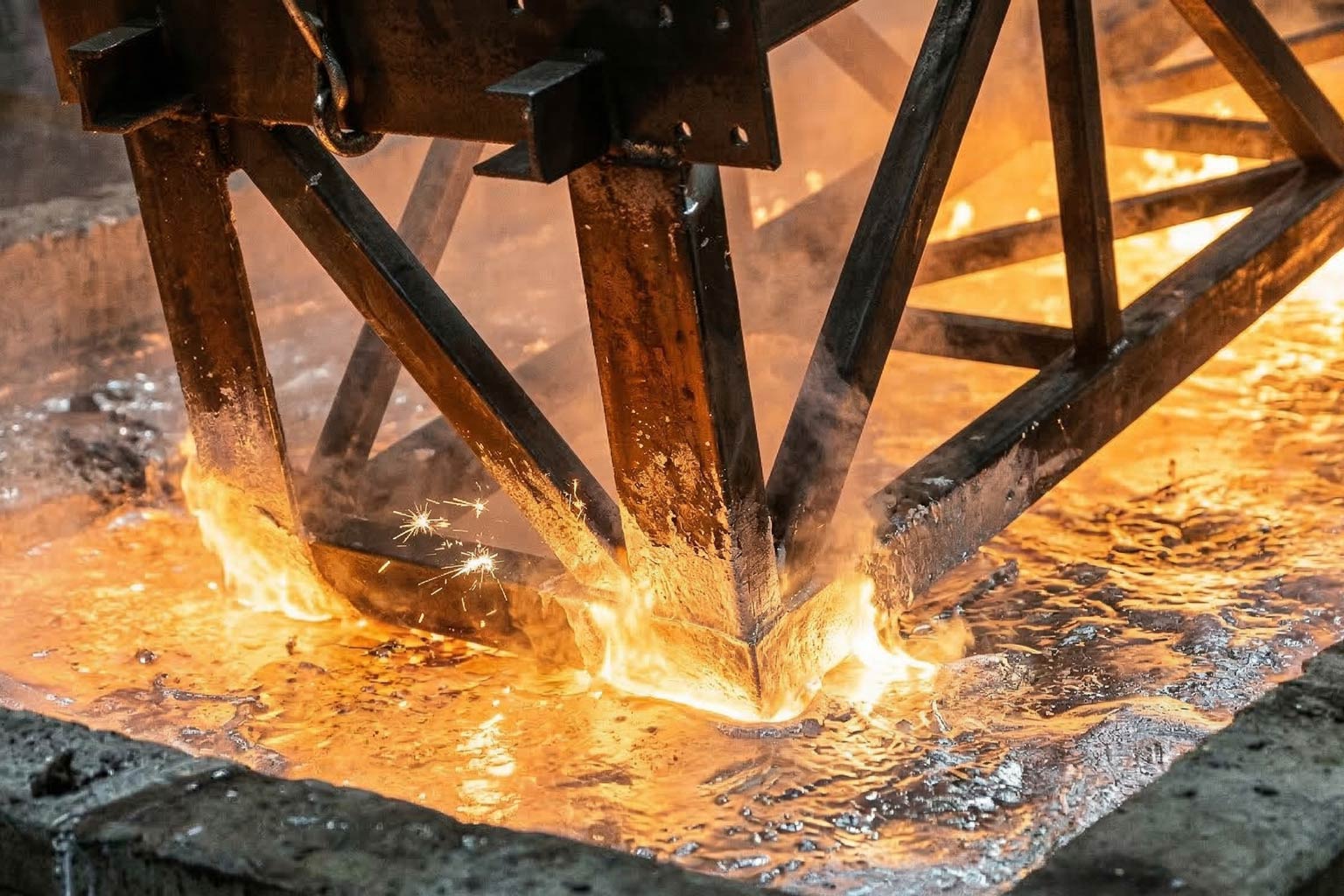
Batch hot dip galvanizing is a controlled industrial process that applies a metallurgically bonded zinc coating to fabricated steel components. Unlike continuous sheet galvanizing, the batch process is designed for structural steel, assemblies, fasteners, and custom fabricated parts.
The American Galvanizers Association provides an overview of the batch hot dip galvanizing production process in its knowledgebase article available here.
This expanded technical discussion explains each stage of the batch galvanizing process in greater depth, including surface preparation chemistry, immersion dynamics, alloy layer formation, cooling, and inspection procedures.
1. Surface Condition Evaluation
Before processing begins, incoming steel is evaluated for:
- Surface contaminants
- Weld condition
- Fabrication complexity
- Venting and drainage adequacy
- Dimensional suitability
Proper design and fabrication are critical to successful galvanizing. Inadequate venting or sealed cavities can prevent proper immersion and drainage.
Early review ensures efficient processing and uniform coating formation.
2. Caustic Cleaning
The first chemical stage removes:
- Oil
- Grease
- Organic residues
- Water based paint
An alkaline cleaning solution prepares the surface for subsequent acid treatment.
This step does not remove mill scale or rust, but it eliminates organic contaminants that would interfere with pickling.
3. Rinse Cycle
After alkaline cleaning, steel is thoroughly rinsed to:
- Remove cleaning solution residue
- Prevent cross contamination
- Maintain bath chemistry control
Water quality and rinse management are important for process stability.
4. Pickling
Pickling uses hydrochloric acid to dissolve:
- Mill scale
- Rust
- Iron oxides
This step exposes clean iron required for the metallurgical reaction with molten zinc.
Pickling parameters such as concentration, temperature, and immersion time are controlled to ensure complete oxide removal without excessive base metal loss.
5. Secondary Rinse
Following pickling, a second rinse removes residual acid and prepares the surface for flux application.
Proper rinsing prevents contamination of the flux bath and zinc kettle.
6. Flux Application
A zinc ammonium chloride flux is applied to:
- Prevent re oxidation prior to immersion
- Promote uniform wetting by molten zinc
- Support even alloy layer formation
The flux layer assists in producing continuous coating coverage during immersion.
7. Immersion in Molten Zinc
Steel is immersed in molten zinc at approximately 840 to 850 degrees Fahrenheit.
During immersion:
- Zinc reacts with iron
- Zinc iron alloy layers form through diffusion
- A protective outer zinc layer develops
Immersion time varies depending on:
- Steel thickness
- Geometry
- Thermal mass
The metallurgical bond created during this stage distinguishes hot dip galvanizing from mechanically adhered coatings.
8. Withdrawal and Drainage
As steel is removed from the zinc bath:
- Excess zinc drains from surfaces
- Complex geometries require proper venting
- Surface smoothness develops during cooling
Drainage design directly influences coating uniformity and surface finish.
9. Cooling and Solidification
After withdrawal, components are cooled in air or by controlled quenching.
Cooling stabilizes the zinc iron alloy layers and finalizes coating structure.
Surface appearance may vary based on cooling rate and steel chemistry.
10. Inspection and Quality Control
Final inspection includes:
- Coating thickness measurement using magnetic gauges
- Visual inspection for coverage and continuity
- Verification against ASTM requirements
Thickness must meet minimum values defined in ASTM A123 or applicable standards.
Inspection focuses on measurable compliance rather than cosmetic uniformity.
Advantages of the Batch Process
Batch hot dip galvanizing provides:
- Complete immersion coverage
- Internal and external protection
- Thick, durable coatings
- Predictable long term corrosion resistance
Because coating formation is metallurgical, adhesion is exceptionally strong.
The batch process is particularly well suited for:
- Structural steel
- Utility structures
- Transportation infrastructure
- Industrial assemblies
- Custom fabricated components
Design and Fabrication Coordination
Successful batch galvanizing depends on proper design practices, including:
- Adequate venting and drainage holes
- Avoidance of sealed cavities
- Removal of weld slag
- Surface cleanliness prior to delivery
Early coordination between fabricator and galvanizer improves efficiency and minimizes rework.
V&S Hot Dip Galvanizing Services
At V&S, our batch hot dip galvanizing services follow this controlled multi stage process to ensure consistent coating thickness, metallurgical bonding, and ASTM compliance for structural and fabricated steel components.
If you would like to review our full hot dip galvanizing capabilities, process details, or project coordination requirements, please visit our hot dip galvanizing services page.
Our team works directly with engineers, fabricators, and contractors to align design requirements with production and inspection standards.
Batch hot dip galvanizing is a highly controlled metallurgical process involving surface preparation, chemical cleaning, pickling, fluxing, immersion in molten zinc, and final inspection. Each stage directly influences coating quality and long term corrosion protection. Understanding the full production sequence allows engineers and fabricators to design components that optimize coating performance and ensure specification compliance.
Frequently Asked Questions About the Batch Galvanizing Process
What is the difference between batch and continuous galvanizing?
Batch galvanizing immerses fabricated steel components individually, while continuous galvanizing applies zinc to sheet steel during rolling operations.
Why is surface preparation necessary before immersion?
Zinc must react directly with clean iron to form metallurgical alloy layers. Oils, mill scale, or contaminants prevent proper bonding.
How thick is the zinc coating applied during batch galvanizing?
Thickness depends on steel thickness, chemistry, and process control. Minimum values are defined by ASTM standards.
Does the process coat internal cavities?
Yes, provided proper venting and drainage are designed into the fabrication.
How is coating thickness verified?
Magnetic thickness gauges measure coating depth at representative locations in accordance with ASTM inspection procedures.
Can large assemblies be galvanized?
Yes, provided they fit within kettle dimensions and meet design requirements for venting and drainage.
Does the galvanizing process weaken the steel?
No. The process temperature is below critical transformation temperatures for structural steel, and mechanical properties are not adversely affected under normal conditions.
How long does the galvanizing process take?
Processing time varies based on fabrication complexity, size, and production scheduling. Chemical preparation and immersion stages are carefully controlled to ensure consistent results.
