

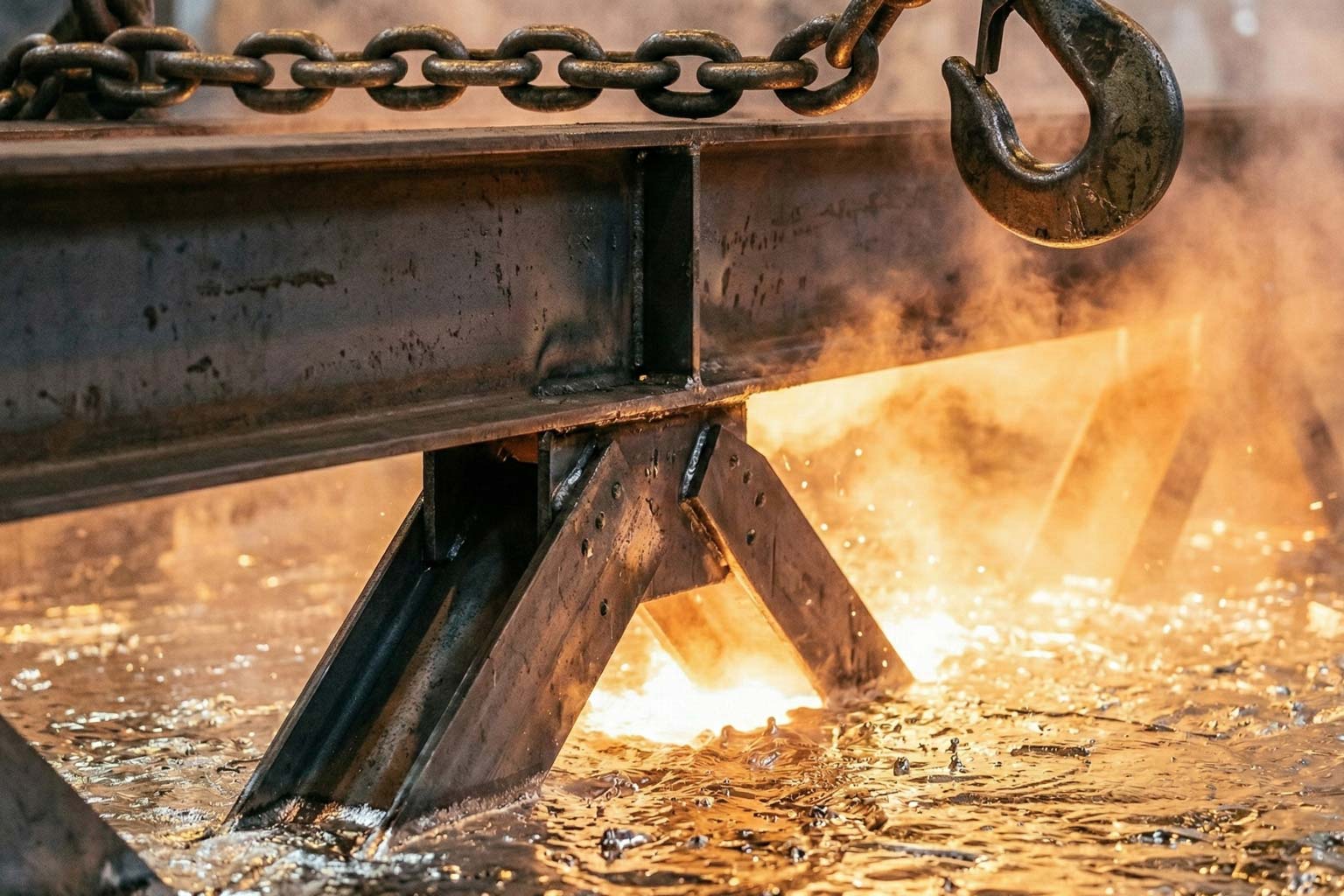
Hot dip galvanizing is a total immersion process. Ideally, the entire steel fabrication is submerged into the molten zinc bath in a single movement. However, when a component exceeds the length or depth of the galvanizing kettle, full immersion in one step may not be possible. In these situations, a controlled technique known as progressive dipping is used.
Progressive dipping allows oversized fabrications to be galvanized by immersing portions of the assembly sequentially. This method is widely used for long beams, poles, bridge components, and other structural members that exceed kettle dimensions.
The Galvanize It technical article discussing progressive dip charts and methodology can be reviewed here.
Understanding how progressive dipping works is important for engineers designing large steel components and for fabricators planning production sequencing.
When Progressive Dipping Is Required
Progressive dipping becomes necessary when:
- The steel member length exceeds kettle length
- The member depth exceeds kettle depth
- Fabricated assemblies have geometric dimensions that prevent full immersion
Because hot dip galvanizing requires immersion to form the zinc iron alloy layers, partial dipping must be executed carefully to maintain coating continuity.
Before fabrication, engineers should confirm maximum kettle dimensions with the selected galvanizer. For large projects requiring hot dip galvanizing, coordination with an experienced provider such as V&S Galvanizing can help determine whether progressive dipping will be required. Technical inquiries can be directed through https://www.hotdipgalvanizing.com/contact.
How Progressive Dipping Works
In progressive dipping, one portion of the steel member is immersed into the molten zinc bath. After adequate reaction time, the piece is withdrawn slightly and repositioned so that the uncoated section can be submerged.
The overlap region between dips is carefully controlled to ensure that:
- The zinc coating forms continuously
- There is no uncoated band
- Coating thickness meets ASTM requirements
Because galvanizing is a diffusion process forming intermetallic layers, the previously dipped area does not lose adhesion when reheated during subsequent immersion.
Proper lifting orientation and dip sequencing are critical to achieving uniform results.
Overlap Zones and Coating Continuity
The area where two immersion stages overlap is sometimes referred to as the transition zone.
Key considerations include:
- Ensuring sufficient overlap distance
- Maintaining adequate immersion time during each stage
- Controlling withdrawal speed to prevent runs or excess buildup
The Galvanize It article explains that properly executed progressive dipping does not negatively impact coating performance or corrosion protection when performed according to established procedures. (galvanizeit.org)
Inspection of overlap areas should confirm coating thickness and continuity consistent with ASTM A123 requirements.
Design Implications for Engineers
When specifying large steel components that may require progressive dipping, designers should consider:
- Venting and drainage placement appropriate for multiple orientations
- Lifting points compatible with staged immersion
- Structural geometry that permits safe handling
Progressive dipping may influence orientation during galvanizing. Therefore, vent hole placement and drain openings must function effectively in more than one position.
Early coordination between engineer, fabricator, and galvanizer reduces the risk of field modifications or processing delays.
Appearance Considerations
Progressive dipping can create visible lines at overlap regions due to differences in cooling patterns or zinc crystallization. These lines are typically cosmetic and do not indicate coating failure.
Surface variations may include:
- Slight color differences
- Minor texture transitions
- Visible dip lines
Acceptance criteria under ASTM A123 focus on coating thickness and continuity rather than uniform color or visual perfection.
Understanding this distinction prevents unnecessary rejection of acceptable galvanized products.
Inspection and Compliance
Inspection of progressively dipped members should verify:
- Minimum average coating thickness
- Minimum single spot thickness
- Complete coverage across overlap zones
- Absence of uncoated areas
Magnetic thickness gauges can be used across the entire member, including transition areas.
When properly executed, progressive dipping produces corrosion protection equivalent to single immersion galvanizing.
Practical Project Planning
For bridge girders, light poles, long structural beams, or custom fabrications, progressive dipping is often a practical solution that allows galvanizing without sectional cutting or field welding.
Specifiers should:
- Confirm maximum kettle dimensions
- Account for transport and handling logistics
- Review galvanizer capabilities early in the design phase
Hot dip galvanizing facilities equipped for large fabrications routinely perform progressive dipping to meet project requirements while maintaining ASTM compliance.
Progressive dipping is a well established technique that allows oversized steel components to be hot dip galvanized when kettle dimensions limit single immersion. When properly planned and executed, coating continuity, thickness compliance, and long term corrosion protection are maintained.
For further technical background and dip chart illustrations, consult the original Galvanize It article at:
https://galvanizeit.org/knowledgebase/article/progressive-dip-charts
Frequently Asked Questions About Progressive Dipping
What is progressive dipping in hot dip galvanizing?
Progressive dipping is a method used to galvanize oversized steel components by immersing different sections sequentially when full immersion in one step is not possible.
Does progressive dipping affect corrosion protection?
No. When performed correctly, coating thickness and continuity meet ASTM requirements and corrosion protection remains equivalent to single immersion.
Will progressive dipping leave visible lines?
Yes. Overlap areas may show cosmetic lines or slight texture changes, but these do not indicate coating failure.
How is coating thickness verified on progressively dipped members?
Magnetic thickness gauges are used across all areas, including overlap zones, to confirm compliance with ASTM A123.
Should engineers plan for progressive dipping during design?
Yes. For large members, early coordination with the galvanizer ensures proper venting, lifting orientation, and handling considerations.
