

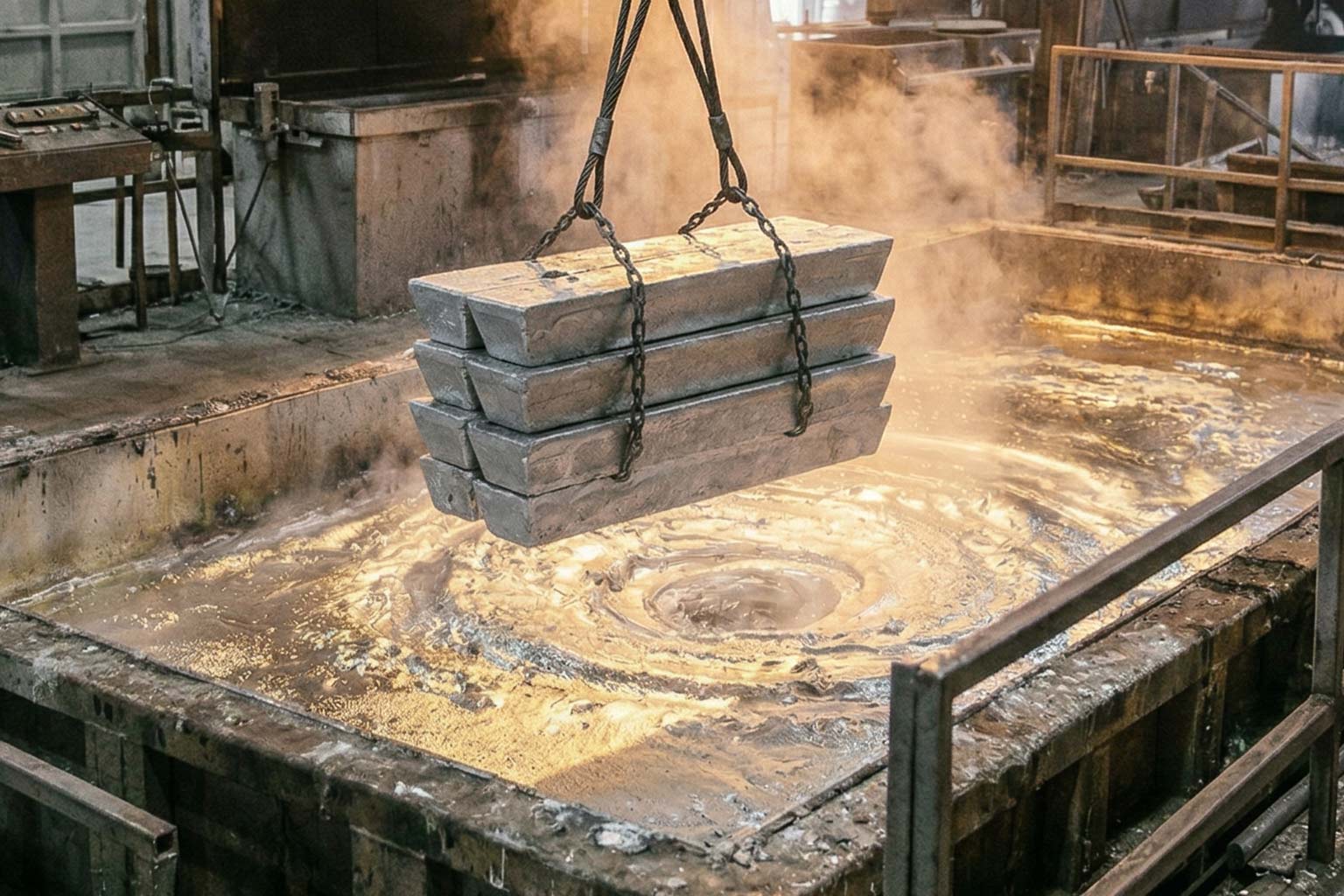
The galvanizing kettle is the heart of the batch hot dip galvanizing process. While most discussions focus on surface preparation and coating thickness, consistent coating quality depends heavily on how the molten zinc bath is maintained. Engineers and fabricators often ask how zinc is added to the kettle and how bath chemistry is controlled over time.
The American Galvanizers Association provides a helpful overview of how zinc is added to the galvanizing kettle here. Expanding on that foundation, this article explores zinc purity requirements, alloying additions, dross management, and how operational control ensures consistent coating performance.
Zinc Purity Requirements
Hot dip galvanizing typically uses high purity zinc conforming to recognized standards. Zinc purity is critical because impurities can influence:
- Coating fluidity
- Alloy layer formation
- Surface appearance
- Dross generation
Primary zinc ingots are introduced into the kettle to replenish zinc consumed during coating formation and removed through drag out.
Maintaining proper purity levels ensures predictable metallurgical reactions with steel.
How Zinc Is Physically Added
Zinc is commonly added in solid ingot form.
The process generally involves:
- Introducing zinc ingots into the molten bath at controlled intervals
- Allowing ingots to melt and integrate into the bath
- Monitoring bath temperature and composition
- Adjusting alloying elements as required
Additions are carefully timed to avoid temperature instability or localized chemistry fluctuations.
Because the kettle operates continuously during production, zinc additions must be coordinated to maintain consistent bath volume and chemical balance.
Alloying Elements in the Bath
In addition to primary zinc, small controlled amounts of alloying elements may be added to influence:
- Coating appearance
- Fluidity
- Dross formation
- Drainage characteristics
Common alloy additions may include elements that improve surface finish or reduce oxidation.
Precise chemistry control supports:
- Uniform coating growth
- Stable alloy layer development
- Reduced surface defects
Bath chemistry is routinely monitored through sampling and analysis.
Dross and Ash Management
As steel reacts with molten zinc, zinc iron intermetallic particles form and settle to the bottom of the kettle as dross.
Simultaneously, surface oxidation may form zinc ash at the top of the bath.
Operational management includes:
- Periodic dross removal
- Surface ash skimming
- Chemistry monitoring
Controlling dross accumulation helps maintain bath cleanliness and coating quality.
Temperature Control
Kettle temperature typically ranges between approximately 840 and 850 degrees Fahrenheit.
Temperature stability is essential because it influences:
- Diffusion rate
- Coating thickness
- Surface smoothness
- Reaction kinetics
Zinc additions must not significantly disrupt thermal stability.
Careful coordination between zinc charging and production sequencing supports consistent process conditions.
Process Stability and Coating Consistency
Consistent zinc addition practices ensure:
- Predictable coating thickness
- Uniform alloy layer structure
- Controlled surface finish
- Compliance with ASTM minimum requirements
Without proper chemistry control, coating variability may increase.
This is why galvanizing operations implement routine testing, documentation, and process oversight.
V&S Hot Dip Galvanizing Operations
At V&S, our hot dip galvanizing services rely on controlled kettle chemistry, disciplined zinc replenishment practices, and continuous monitoring to maintain stable production conditions.
Each of our locations is configured to support structural and fabricated steel galvanizing with kettles sized to accommodate a wide range of assemblies. Kettle capacity and handling systems are matched to the types of projects processed at each facility, whether utility components, transportation infrastructure, structural assemblies, or custom fabricated parts.
By maintaining consistent zinc purity, temperature control, and bath chemistry management, we ensure uniform coating performance across projects and facilities.
To review the capabilities of our hot dip galvanizing operations and learn more about how we support engineered projects, please visit our hot dip galvanizing services page.
Early coordination allows us to align kettle capacity, process parameters, and production scheduling with your project requirements.
Adding zinc to the galvanizing kettle is a controlled process designed to maintain bath purity, temperature stability, and alloy balance. High purity zinc ingots are introduced as needed to replace consumed material while alloying elements and dross management practices ensure consistent coating quality. Stable kettle chemistry is fundamental to predictable metallurgical bonding and ASTM compliant coating thickness.
Frequently Asked Questions About Zinc Addition in the Galvanizing Kettle
How often is zinc added to the galvanizing kettle?
Zinc is added periodically as it is consumed during coating formation and removed through drag out. The frequency depends on production volume and kettle size.
What type of zinc is used in galvanizing kettles?
High purity zinc conforming to industry standards is used to ensure predictable coating formation and chemical stability.
Why is bath chemistry monitoring important?
Bath chemistry influences coating thickness, appearance, dross formation, and overall process consistency. Routine monitoring ensures stable operation.
What is dross and how does it form?
Dross consists of zinc iron intermetallic particles that form during the galvanizing reaction and settle at the bottom of the kettle.
Does adding zinc affect coating thickness?
Zinc additions are managed to maintain stable bath chemistry. Thickness is primarily influenced by steel thickness, chemistry, and immersion conditions rather than the act of adding zinc itself.
Are alloying elements always added?
Small alloy additions may be used to improve process control and surface finish, depending on operational practices.
How is kettle temperature controlled during zinc addition?
Zinc additions are coordinated to maintain thermal stability. Kettle temperature is continuously monitored to ensure consistent reaction conditions.
Do different galvanizing facilities have different kettle sizes?
Yes. Kettle dimensions vary by facility and are selected to accommodate the size and type of structural or fabricated steel components processed at that location.
