

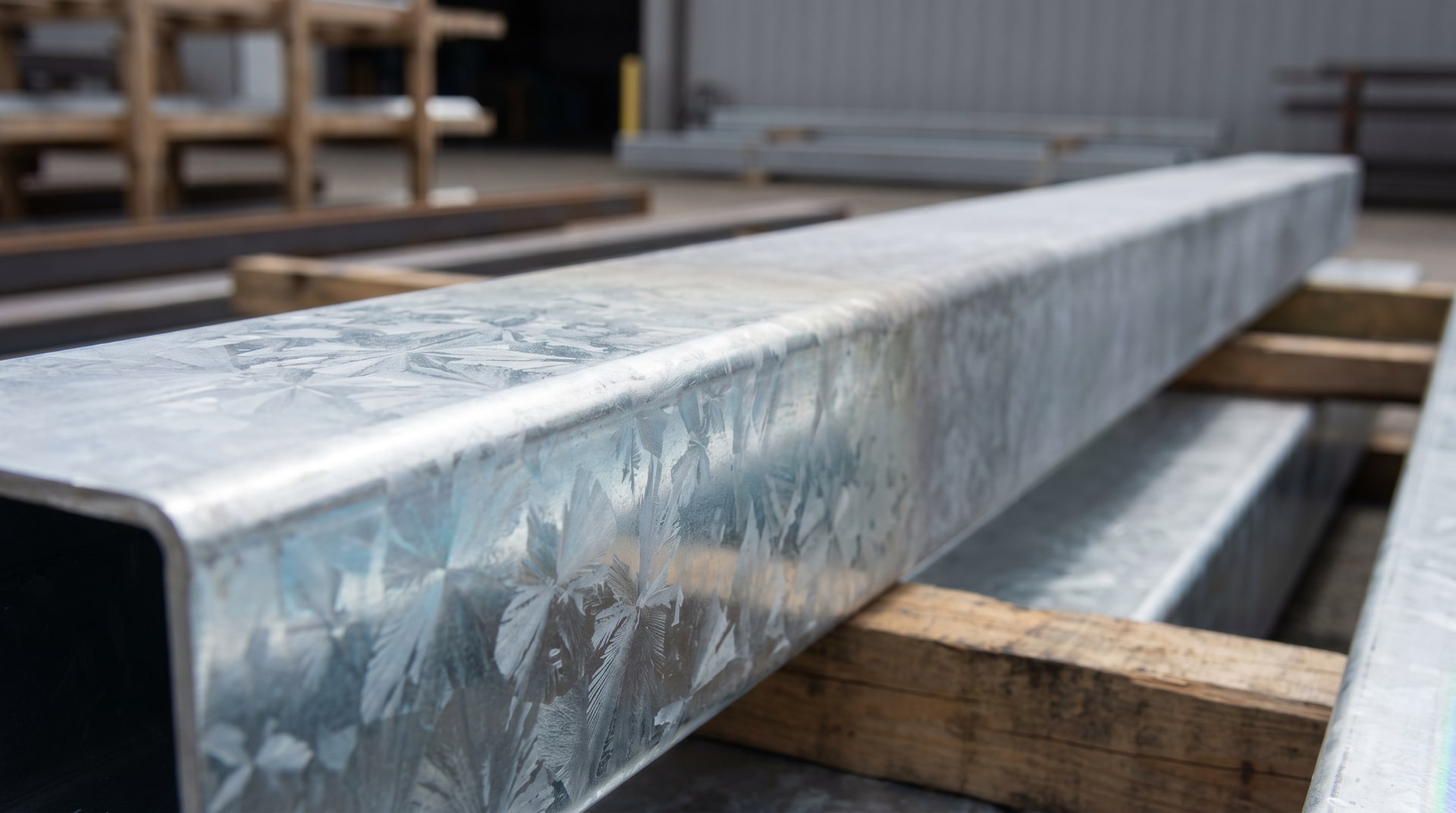
Freshly galvanized steel is often recognized by its bright, reflective finish. In many applications, that appearance is desirable. In others, particularly architectural, roadway, or public-facing installations, that same reflectivity can become a concern due to glare.
The American Galvanizers Association addresses this directly in their article on dulling galvanized steel. At V&S Galvanizing, we expand on that foundation to explain what is actually happening at the coating level, how the surface naturally evolves over time, and what realistic options exist when a less reflective finish is required.
Why Galvanized Steel Starts Out Bright
The initial appearance of galvanized steel is a function of how the zinc solidifies after it is withdrawn from the bath. The surface may appear bright, shiny, or even spangled depending on cooling conditions and steel chemistry.
At this stage, the coating is still in an early phase of exposure. The surface has not yet reacted fully with the environment, which is why it reflects light more intensely.
This brightness is not a coating feature that needs to be removed. It is simply the starting point of the coating’s lifecycle.
How the Surface Naturally Changes Over Time
Once exposed to the atmosphere, the zinc surface begins reacting with oxygen, moisture, and carbon dioxide. These reactions gradually transform the outermost layer of the coating.
As this process progresses, the surface shifts from reflective to more matte in appearance. The formation of zinc carbonate, which is the stable patina, softens the visual finish and reduces glare naturally.
This transformation is not cosmetic in the sense of a coating being applied or removed. It is a chemical stabilization process that also improves corrosion resistance.
In most environments, this change occurs relatively quickly in terms of appearance, even though the full development of the patina continues over a longer period.
Why Forced Dulling Is Not Always Recommended
When glare is a concern, the instinct is often to try to mechanically or chemically alter the surface immediately after galvanizing. However, forced dulling methods can interfere with the natural development of the coating.
Aggressive surface treatments may:
- Remove or disrupt the outer zinc layer
- Create uneven appearance
- Affect long-term coating behavior
Because the zinc coating is a functional system, not just a finish, altering it without understanding the impact can introduce unintended consequences.
This is why, in many cases, allowing the coating to weather naturally is the preferred approach.
Situations Where Appearance Needs to Be Controlled
There are legitimate scenarios where glare reduction cannot wait for natural weathering. These typically involve safety or visual integration concerns.
Examples include:
- Roadway infrastructure where reflection could affect visibility
- Architectural elements where a uniform matte appearance is required
- Public installations where aesthetics are a priority
In these cases, the approach to dulling must balance appearance goals with maintaining coating integrity.
Controlled Methods for Reducing Reflectivity
When immediate appearance control is required, the most effective solutions are those that work with the coating rather than against it.
Surface treatments can be applied in a controlled manner to reduce reflectivity while preserving the zinc layer. These approaches are designed to modify the surface condition without removing protective material.
In other cases, a duplex system may be used, where an additional coating is applied over the galvanized surface. This not only reduces glare but also extends the overall service life of the system.
The key is that these methods are intentional and engineered, not improvised.
Why Appearance Does Not Equal Performance
One of the most important distinctions to make is that brightness has no relationship to corrosion protection. A highly reflective surface and a fully weathered matte surface can perform identically in terms of durability.
The change in appearance is simply the visible result of surface chemistry evolving. It does not indicate improvement or degradation in performance.
Understanding this helps prevent unnecessary intervention when the coating is already functioning as intended.
How to Set Expectations Before Galvanizing
Many appearance concerns can be avoided through early communication. If a project has specific visual requirements, those should be discussed before galvanizing takes place.
This allows for:
- Alignment on expected initial appearance
- Consideration of post-treatment options if needed
- Planning for how the coating will change over time
Galvanizing is not a static finish. It is a dynamic system that evolves, and expectations should reflect that reality.
Work With a Team That Understands Both Performance and Appearance
Balancing performance and appearance is one of the more nuanced aspects of galvanizing. While the coating is designed for durability, its visual characteristics are often part of the project requirements.
Hot dip galvanized steel naturally transitions from a bright, reflective surface to a more matte finish as it reacts with the environment and forms a stable protective patina. In most cases, this natural weathering process is the most effective way to reduce glare without impacting coating performance. When immediate appearance control is required, it must be approached carefully to preserve the integrity of the zinc coating.
At V&S Galvanizing, we work with customers to align expectations, explain how coatings will change over time, and recommend the right approach when appearance control is important.If you are planning a project where galvanized steel appearance matters or need guidance on reducing glare without compromising performance, reach out to our team through our contact page.
Frequently Asked Questions About Dulling Galvanized Steel
Will galvanized steel lose its shine over time?
Yes. It naturally becomes more matte as the zinc surface reacts with the environment and forms a protective patina.
Can galvanized steel be dulled immediately after processing?
Yes, but it should be done using controlled methods that do not damage the coating.
Does dulling affect corrosion protection?
If done improperly it can, but natural weathering does not reduce protection.
Why is new galvanized steel so shiny?
Because the surface has not yet formed a stable patina and reflects light more strongly.
Is it better to let the surface weather naturally?
In most cases, yes. Natural weathering provides a uniform appearance while maintaining coating integrity.
What is a duplex system?
It is a combination of galvanizing and an additional coating to control appearance and extend service life.
Can glare be a safety concern?
Yes. In certain environments such as roadways, reflectivity may need to be reduced for visibility reasons.
Should appearance requirements be discussed before galvanizing?
Yes. Early coordination helps ensure expectations are met without compromising performance.
