

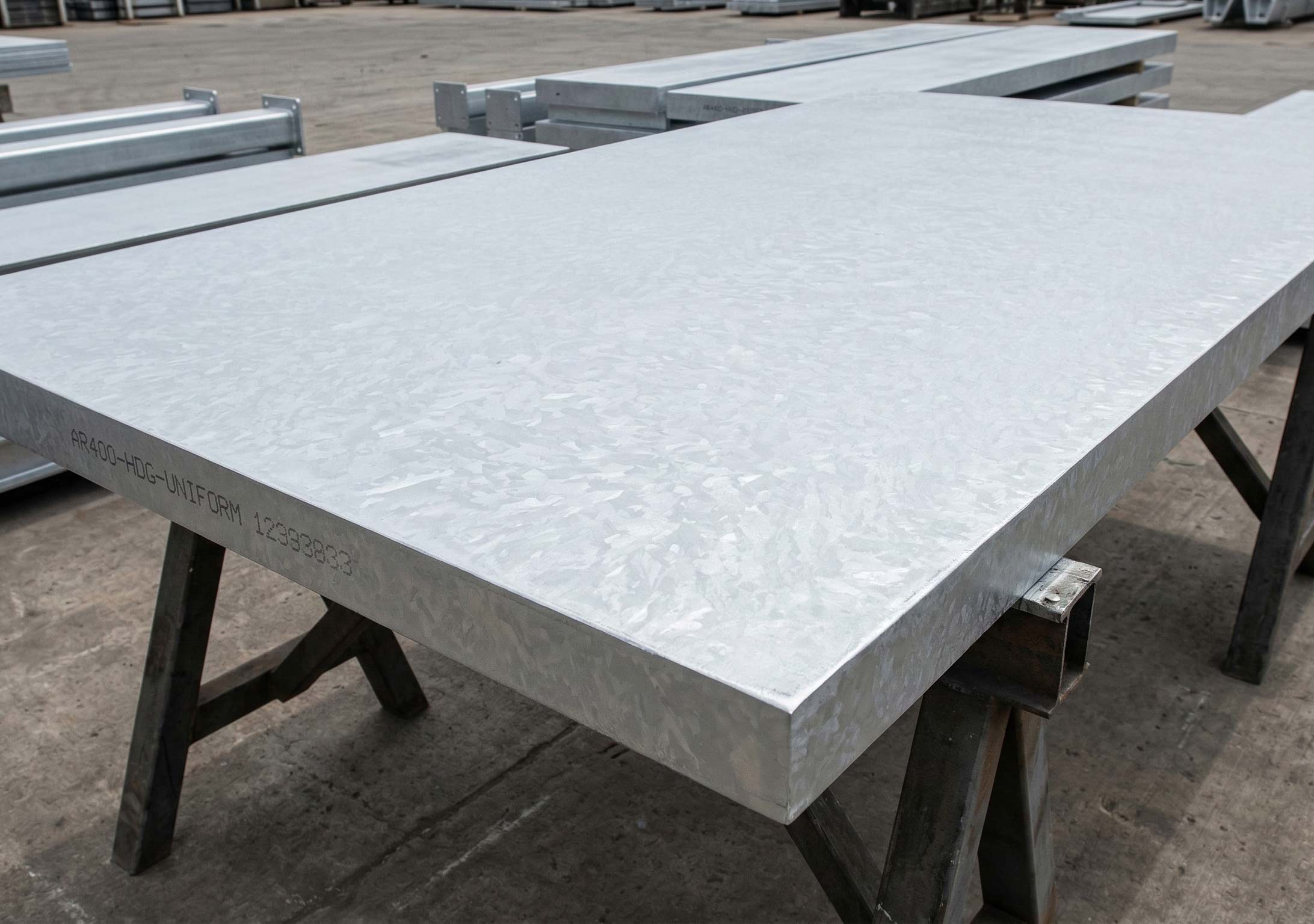
Abrasion resistant steel is engineered for high hardness and wear resistance. It is commonly specified in applications such as material handling equipment, mining components, heavy industrial systems, and structural elements exposed to mechanical wear. When corrosion protection is required in addition to abrasion resistance, engineers often consider hot dip galvanizing.
Galvanizing abrasion resistant steel requires understanding how hardness, alloy chemistry, and microstructure influence coating formation. This Galvanize It article on galvanizing abrasion resistant steel provides foundational guidance. Expanding on that technical base, this article examines how abrasion resistant steel chemistry interacts with molten zinc, what to expect in coating development, and how to evaluate performance outcomes.
Characteristics of Abrasion Resistant Steel
Abrasion resistant steels, often designated as AR grades, achieve hardness through:
- Controlled carbon content
- Alloy additions such as manganese, chromium, or molybdenum
- Heat treatment and quenching processes
These steels typically exhibit high surface hardness and tensile strength relative to conventional structural steel.
Hardness alone does not prevent galvanizing. However, alloy chemistry and prior heat treatment influence how zinc reacts with the surface.
Metallurgical Bonding on Hard Steels
Hot dip galvanizing forms a series of zinc iron alloy layers through diffusion between molten zinc and the steel substrate.
The diffusion process is temperature dependent and chemistry sensitive.
In abrasion resistant steels:
- Elevated alloy content may alter reaction kinetics
- Silicon and phosphorus levels may increase coating growth
- Surface condition from heat treatment may influence reactivity
The resulting coating may exhibit:
- Increased thickness relative to mild steel
- Matte gray appearance
- Slightly different alloy layer proportions
These characteristics are chemical, not mechanical, in origin.
Influence of Silicon and Reactive Chemistry
Silicon content plays a significant role in galvanizing reaction rate.
Steels within certain reactive silicon ranges may experience accelerated alloy growth, producing thicker coatings.
Abrasion resistant steels sometimes fall within these reactive ranges, depending on grade.
Effects may include:
- Heavier zinc iron alloy layer formation
- Reduced free zinc outer layer thickness
- Darker surface finish
Thickness measurement remains the governing performance metric.
Hardness Versus Coating Adhesion
A common question is whether high hardness affects zinc adhesion.
Because galvanizing is metallurgical rather than adhesive bonding, hardness does not prevent coating formation.
The zinc iron alloy layers form through atomic diffusion, creating strong metallurgical bonding even on hardened substrates.
Proper surface preparation remains critical to ensure oxide removal prior to immersion.
Surface Preparation Considerations
Abrasion resistant steels may exhibit:
- Mill scale from rolling
- Surface oxidation from heat treatment
- Increased hardness that affects fabrication grinding
Effective pickling removes mill scale and oxides, allowing uniform zinc bonding.
Fabrication contaminants such as weld slag must be removed prior to galvanizing.
We evaluate incoming steel surface condition as part of our preparation process before immersion. If you have questions regarding AR plate compatibility or surface preparation requirements, please reach out via our contact page:
https://www.hotdipgalvanizing.com/contact
Early coordination ensures proper processing and predictable results.
Distortion and Thermal Exposure
Galvanizing temperatures are below the critical transformation temperature for most structural steels.
Abrasion resistant steels are typically heat treated during production. Exposure to galvanizing temperature does not normally reverse hardness characteristics, but engineering evaluation is recommended for highly specialized grades.
Distortion risk is influenced more by fabrication stress and geometry than by hardness alone.
Balanced welding and proper support during immersion reduce distortion potential.
Performance Implications in Abrasive Environments
Galvanizing provides corrosion protection. It does not replace abrasion resistance.
In applications involving:
- Impact
- Sliding wear
- Abrasive particulate flow
The zinc coating may experience mechanical wear over time.
However, galvanizing protects against corrosion in areas not subject to constant abrasion.
Designers should evaluate whether the application requires:
- Combined abrasion and corrosion resistance
- Additional wear liners
- Localized coating protection
Understanding exposure conditions ensures appropriate specification.
Inspection and Thickness Verification
As with any galvanized product, inspection focuses on:
- Coating thickness
- Coating continuity
- Absence of uncoated areas
Reactive chemistry may produce thicker coatings than minimum specification.
Thickness measurement confirms compliance regardless of appearance differences.
Engineers should base acceptance on measurable criteria rather than visual color variation.
Galvanizing abrasion resistant steel is technically feasible and commonly performed. Alloy chemistry influences coating growth behavior, but hardness does not prevent metallurgical bonding. Proper surface preparation, thickness verification, and exposure assessment ensure predictable corrosion protection performance. When abrasion and corrosion resistance are both required, coordinated specification and design planning are essential.
If you would like to discuss galvanizing compatibility for abrasion resistant grades in your project, please reach out through our contact page.
Frequently Asked Questions About Galvanizing Abrasion Resistant Steel
Can abrasion resistant steel be hot dip galvanized?
Yes. Abrasion resistant steel can be successfully hot dip galvanized. The metallurgical bonding process allows zinc alloy layers to form even on hardened substrates.
Does hardness prevent zinc from bonding?
No. Zinc bonds through diffusion, not adhesion. Hardness does not prevent coating formation when surface preparation is properly performed.
Will AR steel develop thicker coatings?
It may. Reactive silicon content in some abrasion resistant grades can accelerate alloy growth, potentially producing thicker coatings than mild steel.
Does galvanizing reduce abrasion resistance?
No. Galvanizing does not alter the base steel hardness. However, the zinc coating itself is softer than hardened steel and may wear in highly abrasive environments.
Can galvanizing affect heat treated properties?
Galvanizing temperatures are typically below critical transformation temperatures for most structural steels. However, specialized grades should be evaluated on a case by case basis.
Should coating thickness be measured differently on AR steel?
No. Standard magnetic thickness gauges are used. Acceptance is based on ASTM requirements regardless of steel grade.
Is galvanizing recommended for mining or heavy wear applications?
It depends on whether corrosion protection is required in addition to wear resistance. In corrosive environments, galvanizing can significantly extend service life in non wear exposed areas.
