
The Galvanized Surface Adhesion Challenge
Hot-dip galvanized steel surfaces demonstrate notoriously poor adhesion characteristics for common consumer-grade adhesives, tapes, and stickers despite zinc's chemical reactivity and metallic nature seemingly favorable for bonding. Everyday adhesive products—masking tape, packing tape, wood glue, cyanoacrylate (Super Glue), hot melt adhesives, wallpaper paste, and mounting putty—exhibit initial tack on galvanized surfaces but rapidly lose bond strength through hours, days, or weeks as zinc surface chemistry, moisture exposure, and thermal cycling degrade adhesive-substrate interfaces. This adhesion difficulty stems from zinc's surface characteristics: rapid atmospheric oxidation forming loosely-bonded zinc oxide and hydroxide layers that provide weak boundary layers for adhesive attachment, surface contamination from handling oils and atmospheric deposits, relatively smooth as-galvanized surface texture limiting mechanical interlocking, and zinc's chemical incompatibility with many common adhesive polymer systems.
However, engineered industrial adhesive formulations combined with appropriate surface preparation achieve reliable long-term bonding to galvanized steel for applications ranging from non-structural labeling and identification to moderate-strength assembly bonding. Success requires understanding zinc surface chemistry, selecting adhesive chemistries demonstrating zinc compatibility, implementing proper surface preparation removing contaminants and weak boundary layers, and following manufacturer application protocols ensuring optimal cure conditions and bond development.
Why Common Adhesives Fail on Galvanizing
Zinc Surface Chemistry
Atmospheric Oxidation:
Freshly galvanized zinc surfaces immediately react with atmospheric components:
Oxygen Reaction: 2Zn + O₂ → 2ZnO (zinc oxide)
Moisture and CO₂: ZnO + H₂O → Zn(OH)₂ (zinc hydroxide) Zn(OH)₂ + CO₂ → ZnCO₃ + H₂O (zinc carbonate)
Resulting Surface: Thin (0.1-1 micrometer) layer of zinc oxide, hydroxide, and carbonate forms within hours to days of galvanizing.
Adhesion Implication:
These corrosion product layers:
- Demonstrate weak cohesive strength (powder-like in thick accumulations)
- Provide poor mechanical properties for adhesive bonding
- Create weak boundary layer between adhesive and metallic zinc substrate
- Lead to adhesive failure at zinc oxide/metallic zinc interface rather than within adhesive itself
Analogy: Attempting to glue object to dusty surface—adhesive bonds to dust layer, which then separates from underlying surface.
Surface Contamination
Manufacturing and Handling:
Galvanized surfaces accumulate contaminants:
Oil and Grease:
- Rolling oils from steel mill (if not fully removed during galvanizing)
- Handling oils from workers' gloves
- Atmospheric hydrocarbon deposits
- Equipment lubricants during fabrication
Particulate Matter:
- Dust and dirt from storage and transportation
- Weld spatter residue
- Construction debris
Contaminant Effects:
Oils create barrier preventing adhesive contact with zinc surface:
- Adhesive wets oil film rather than zinc
- Weak oil-zinc interface becomes failure plane
- Time-dependent oil migration undermines adhesive bond
Inadequate Surface Energy
Surface Energy Concept:
Materials exhibit characteristic surface energy measured in dynes/cm (or mN/m):
- High surface energy: Good wetting by liquids, favorable for adhesion
- Low surface energy: Poor wetting, difficult adhesion
Comparative Surface Energies:
- Polyethylene (difficult to bond): ~31 dynes/cm
- Aluminum (moderate): ~840 dynes/cm
- Clean zinc metal: ~780 dynes/cm
- Zinc oxide (galvanized surface): ~200-300 dynes/cm
Implication:
Zinc oxide surface layer reduces effective surface energy by 60-70%, approaching difficult-to-bond polymer territory. Many adhesives formulated for high-energy metal surfaces demonstrate poor wetting on oxidized zinc.
Thermal Expansion Mismatch
Coefficient of Thermal Expansion:
- Zinc coating: 39 × 10⁻⁶ per °C
- Steel substrate: 12 × 10⁻⁶ per °C
- Typical rigid adhesives: 20-80 × 10⁻⁶ per °C
Temperature Cycling Stress:
Outdoor galvanized structures experience:
- Daily temperature swings: 40-80°F typical
- Seasonal extremes: -20°F to 150°F (surface temperature)
Differential Expansion:
Creates cyclical stress at adhesive interface:
- Rigid adhesives (epoxies, cyanoacrylates) experience high stress
- Repeated cycling causes interfacial crack initiation
- Progressive bond degradation
Solution:
Flexible adhesives accommodate expansion differentials without excessive stress accumulation.
Recommended Adhesive Types
Two-Part Acrylic Adhesives
Chemistry:
Methacrylate or acrylate monomers that polymerize when mixed or when activator applied:
No-Mix Acrylics:
- Adhesive applied to one surface
- Activator applied to other surface
- Surfaces joined, polymerization initiated
- Example: Loctite AA 330, 3M Scotch-Weld DP8005
Mix Acrylics:
- Two-part components mixed immediately before application
- Working time: 3-10 minutes typical
- Full cure: 24 hours
- Example: Loctite AA H8600, Permabond TA4610
Properties:
Advantages:
- Excellent peel strength (ability to resist peeling forces)
- Good impact resistance from flexible polymer network
- Fast fixturing time (handling strength in minutes to hours)
- Gap-filling capability (0.010-0.125" gaps)
- Room temperature cure
Bond Strength:
- Typical shear strength on galvanized steel: 1,500-2,500 PSI
- Peel strength: 20-50 lbs/inch width
Applications:
- Bonding brackets, mounting hardware
- Attaching nameplates, identification plates
- Assembly bonding where moderate strength required
Two-Part Epoxy Adhesives
Chemistry:
Epoxy resin + hardener (amine, polyamide, or other) react forming three-dimensional cross-linked polymer:
Mix Ratio:
- Typically 1:1 or 2:1 by volume
- Critical to measure accurately for proper cure
- Working time: 5 minutes to 2 hours depending on formulation
Properties:
Advantages:
- Highest strength among common adhesives (2,000-4,000 PSI shear typical)
- Excellent chemical resistance once cured
- Wide formulation range (fast to slow cure, flexible to rigid)
- Good elevated temperature performance (up to 200-300°F)
Limitations:
- More rigid than acrylics (less accommodation of thermal cycling)
- Requires accurate mixing and proper cure conditions
- Longer cure times than acrylics
Recommended Formulations:
Metal-bonding epoxies specifically formulated for difficult substrates:
- Loctite EA 9466 (flexible structural adhesive)
- 3M Scotch-Weld DP460 (toughened epoxy)
- J-B Weld (steel reinforced epoxy for general use)
- Devcon Plastic Steel (multipurpose epoxy)
Applications:
- Structural bonding requiring maximum strength
- Attaching heavy components
- Applications requiring chemical resistance
Polyurethane Adhesives
Chemistry:
Polyurethane polymers formed from isocyanate + polyol reaction, often moisture-cured:
Common Products:
- Gorilla Glue (polyurethane foam adhesive)
- Loctite PL Premium (construction adhesive)
- Sikaflex (polyurethane sealant-adhesive)
Properties:
Advantages:
- Excellent flexibility accommodating thermal movement
- Good gap-filling (expands during cure for some formulations)
- Moisture-activated cure (convenient single-component)
- Good impact and peel resistance
- Wide temperature range (-40°F to 200°F)
Characteristics:
- Foaming during cure (Gorilla Glue type products)
- Slower cure than acrylics (full cure 24-72 hours)
- Requires clamping during cure for optimal bond
Bond Strength:
- Shear strength: 800-1,500 PSI typical
- Excellent peel and impact resistance
Applications:
- Bonding dissimilar materials (galvanized to wood, plastic, rubber)
- Applications requiring flexibility
- Gap-filling scenarios
- Non-structural assembly
Adhesive Tapes and Stickers
Industrial Acrylic Foam Tapes
Products:
3M VHB (Very High Bond) Tapes:
- Acrylic foam core with acrylic adhesive both sides
- Thickness: 0.015-0.090"
- Permanent bonding alternative to mechanical fasteners
Tesa ACXplus:
- Similar technology to VHB
- Variety of formulations for different substrates
Properties:
Advantages:
- Excellent long-term durability (decades in proper applications)
- Distributes stress over bond area (unlike mechanical fasteners)
- Seals against water and air infiltration
- Viscoelastic properties dampen vibration
- Accommodates thermal expansion through controlled creep
Bond Strength:
- Shear strength: 200-400 PSI
- Peel strength: 15-40 lbs/inch width
- Dynamic shear strength: Higher due to viscoelastic behavior
Applications:
- Bonding trim panels, cladding
- Attaching signs, architectural elements
- Applications avoiding visible fasteners
Preparation Requirements:
Acrylic foam tapes demand very clean, smooth surfaces:
- Remove all contaminants with isopropanol or specified cleaner
- Apply firm pressure with roller ensuring full contact
- Allow 72 hours for adhesive flow and bond development to full strength
Rubber-Based Adhesive Tapes
Products:
- 3M 4950 VHB tape (rubber adhesive formulation)
- Tesa 4965 (rubber adhesive on foam carrier)
- Duct tapes with quality rubber adhesives
Properties:
Advantages:
- Excellent immediate tack (instant handling strength)
- Good conformability to irregular surfaces
- Lower cost than acrylic tapes
- Cold temperature performance
Limitations:
- UV degradation (not suitable for long-term outdoor exposure)
- Temperature limitations (typically -20°F to 180°F)
- Plasticizer migration can reduce bond over time
Applications:
- Temporary bonding and holding
- Indoor applications
- Short to moderate term outdoor use (1-3 years)
Labels and Identification Stickers
Vinyl Labels:
Durable identification labels use:
- Vinyl face stock (weather-resistant)
- Aggressive acrylic or rubber adhesive
- Often UV-resistant inks
Performance:
Quality metal-grade labels:
- 3-10+ year outdoor durability typical
- Withstand power washing (if properly adhered)
- Chemical and solvent resistance
Application Requirements:
Clean surface critical for label adhesion:
- Wipe with isopropanol removing oils and dust
- Apply to smooth portion of galvanizing (avoid rough crystalline areas)
- Apply firm pressure eliminating air bubbles
- Allow 24 hours before exposing to harsh conditions
Surface Preparation Methods
Solvent Cleaning (SSPC-SP 1)
Purpose:
Remove oil, grease, dirt, and soluble contaminants
Procedure:
1. Initial Wipe:
- Use clean lint-free cloth
- Apply solvent liberally (isopropyl alcohol, acetone, or specialized metal cleaner)
- Wipe surface removing visible contamination
2. Final Wipe:
- Fresh clean cloth with fresh solvent
- Wipe until cloth shows no contamination transfer
- Allow solvent evaporation (typically <5 minutes)
Solvents:
Isopropyl Alcohol (IPA):
- 90-99% concentration
- Excellent general-purpose cleaner
- Safe on galvanizing
Acetone:
- More aggressive solvent
- Evaporates very quickly
- Good for heavy oils
Commercial Degreasers:
- Specially formulated for metal preparation
- Often contain multiple solvents and surfactants
- Examples: 3M Prep Solvent-70, Loctite SF 7063
Avoid:
- Water-based cleaners (may leave residues)
- Cleaners with heavy surfactants (can leave films)
- Harsh acids or bases (attack zinc coating)
Light Abrasion
When Required:
For structural adhesive applications requiring maximum bond strength, light surface abrasion:
- Removes zinc corrosion products
- Increases surface roughness improving mechanical interlocking
- Exposes fresh zinc metal with higher surface energy
Methods:
Hand Sanding:
- 80-120 grit aluminum oxide paper
- Light pressure, uniform coverage
- Remove approximately 0.5-1 mil of surface
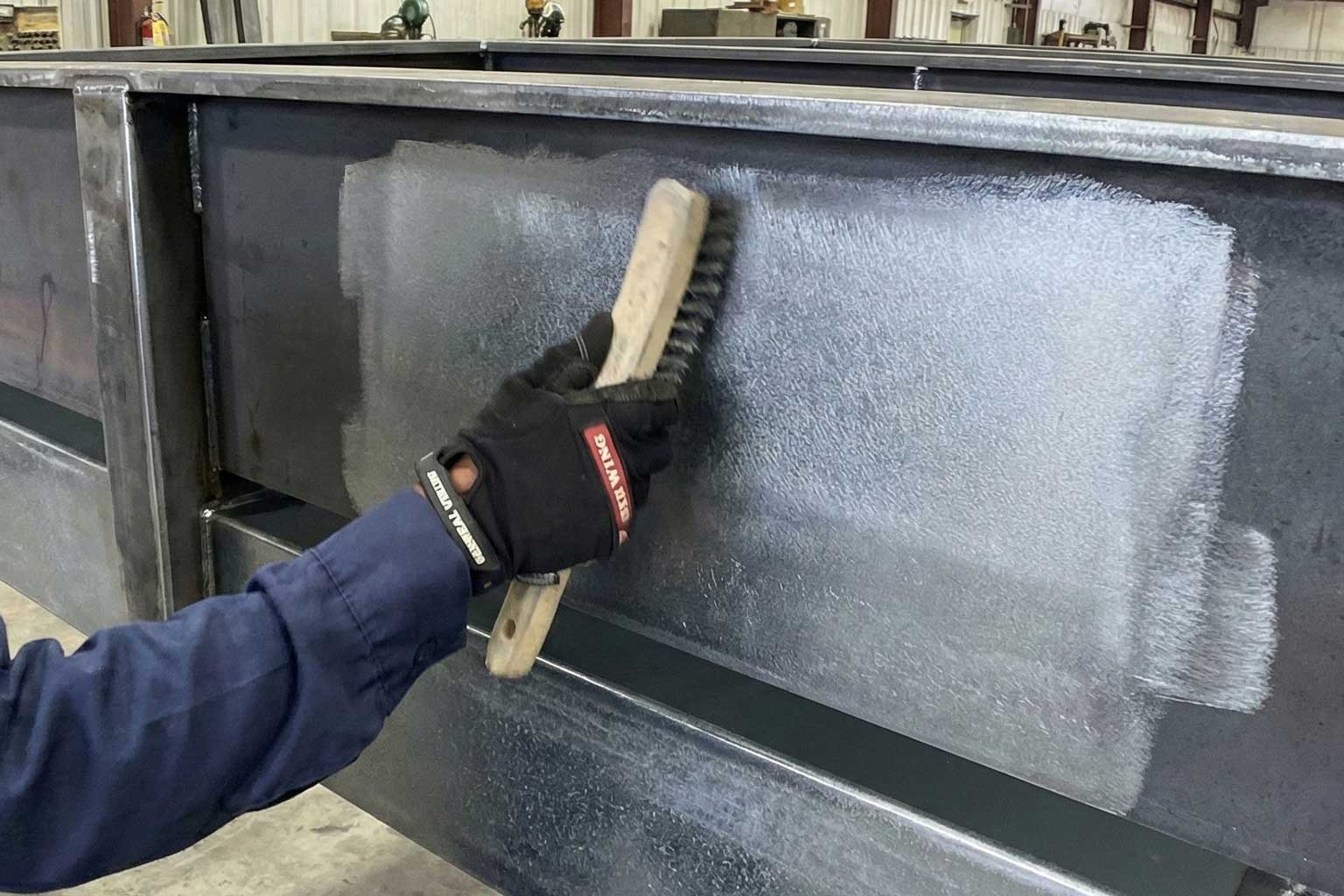
Wire Brushing:
- Stainless steel brush (avoid carbon steel contamination)
- Light circular motion
- Clean surface thoroughly after brushing
Scotch-Brite Pads:
- Medium or coarse grade
- Good control preventing over-abrasion
- Excellent for large areas
Critical:
Avoid excessive abrasion:
- Don't remove more than 1-2 mils of coating
- Preserve corrosion protection
- Balance adhesion improvement with coating preservation
Post-Abrasion:
Always solvent clean after abrasion:
- Remove dust and abraded material
- Clean oils deposited from hands during abrasion
- Ensure completely clean surface for adhesive
Chemical Treatment (Optional)
Phosphate Conversion Coating:
Process:
- Apply dilute phosphoric acid solution (zinc phosphate conversion coating)
- Creates microcrystalline zinc phosphate surface layer
- Improves adhesion for some adhesive systems
Commercial Products:
- Zinc phosphate pretreatment solutions
- Typically 1-5 minute immersion or spray application
- Rinse thoroughly with clean water (twice) after treatment
Caution:
Acidic treatments attack zinc coating if over-applied:
- Follow manufacturer timing precisely
- Limit exposure to specified duration
- Ensure complete rinsing neutralizing residual acid
When Beneficial:
Primarily for critical structural bonding requiring absolute maximum adhesion strength.
Application Best Practices
Timing
Immediate Application:
Apply adhesive as soon as possible after surface preparation:
- Zinc surface begins re-oxidizing within minutes of cleaning
- Fresh surface provides optimal bonding
- Target <30 minutes from final clean to adhesive application
Environmental Control:
Temperature:
- Follow manufacturer specifications (typically 60-90°F)
- Cold temperatures slow cure, reduce bond strength
- High temperatures accelerate cure potentially reducing working time
Humidity:
- Moderate humidity (40-70% RH) optimal for most adhesives
- Very low humidity can slow moisture-cure adhesives (polyurethanes)
- Very high humidity can interfere with some cure mechanisms
Surface Condition:
Ensure surface completely dry before adhesive application:
- No visible moisture
- Solvent fully evaporated
- Condensation absent (surface temperature above dew point)
Application Technique
Adhesive Coverage:
Apply adhesive per manufacturer instructions:
- Full coverage for maximum strength applications
- Bead pattern acceptable for non-structural applications
- Avoid voids or air pockets
Pressure Application:
Critical Step:
Apply firm, sustained pressure during initial cure:
- Clamps, weights, or fixtures maintaining contact
- Target 10-25 PSI contact pressure
- Duration: Minimum fixturing time per manufacturer (typically 10 minutes to 24 hours)
Benefit:
Pressure:
- Maximizes adhesive contact with surface
- Minimizes interfacial voids
- Promotes adhesive flow into surface texture
- Optimizes bond development
Cure Conditions
Full Cure Timeline:
Adhesive strength develops over time:
- Handling strength: 30 minutes to 2 hours (can move part carefully)
- Functional strength: 24 hours (can apply moderate loads)
- Full cure: 72 hours to 7 days (maximum strength achieved)
Critical:
Avoid loading bonded joints before full cure:
- Premature loading disrupts developing polymer network
- Permanent strength reduction possible
- Follow manufacturer cure schedule for full performance
Performance Expectations and Limitations
Structural vs. Non-Structural
Non-Structural Applications:
Labeling, identification, trim attachment:
- Tapes and stickers adequate
- Lower strength requirements (typically <50 lbs/in²)
- Ease of application prioritized
Structural Applications:
Load-bearing bonds:
- Two-part acrylics or epoxies required
- Engineering analysis necessary
- Consider mechanical fasteners for critical loads
Limitation:
Adhesive bonding should not replace mechanical fasteners for life-safety or primary structural connections without engineering analysis.
Durability
Expected Service Life:
With proper surface preparation and adhesive selection:
- Indoor applications: 10-20+ years typical
- Outdoor applications: 5-10+ years for industrial adhesives, 1-5 years for quality tapes
Degradation Factors:
- UV exposure (some adhesives)
- Extreme temperatures
- Chemical exposure
- Mechanical cycling
Successful adhesive bonding to hot-dip galvanized steel requires overcoming zinc surface chemistry challenges including rapid atmospheric oxidation forming weak boundary layers, surface contamination from handling oils, and reduced surface energy from zinc oxide formation—necessitating proper surface preparation and engineered adhesive selection. Recommended adhesive types include two-part acrylic adhesives (1,500-2,500 PSI shear strength, excellent peel and impact resistance), two-part epoxies (2,000-4,000 PSI maximum strength for structural applications), and polyurethane adhesives (800-1,500 PSI with superior flexibility for thermal cycling accommodation), while industrial acrylic foam tapes like 3M VHB provide permanent bonding alternatives to mechanical fasteners for appropriate applications. Surface preparation following ASTM D6386 and SSPC-SP 1 protocols requires solvent cleaning with isopropyl alcohol or acetone removing oils and contaminants, optional light abrasion with 80-120 grit sandpaper or wire brushing for structural bonds, and immediate adhesive application within 30 minutes of preparation preventing re-oxidation. Critical application factors include proper cure temperature and humidity conditions per manufacturer specifications, sustained pressure application (10-25 PSI) during initial cure maximizing interfacial contact, and respecting full cure timelines (72 hours to 7 days) before loading bonded joints to achieve maximum strength. Common consumer adhesives including wood glue, Super Glue, hot melt adhesives, masking tape, and mounting putty universally fail on galvanizing through poor zinc compatibility and inability to wet oxidized surfaces, while engineered industrial formulations specifically designed for metal bonding demonstrate reliable 5-20+ year service when properly applied to prepared surfaces. For additional information, visit the original AGA resource article.
