
Hot dip galvanized steel is frequently selected because it provides predictable, long term corrosion protection across a wide range of atmospheric environments. The challenge for specifiers is translating a real world site description such as coastal, industrial, urban, or rural into an estimated zinc corrosion rate that can be used for service life planning.
ISO 9223 provides a global framework for classifying atmospheric corrosivity using categories C1 through CX. In North America, the American Galvanizers Association also provides tools built from regional exposure data, including the Time to First Maintenance chart and the Zinc Coating Life Predictor model. The source reference for the ISO category discussion and North American comparison is the Galvanize It knowledgebase article here.
When you need hot dip galvanizing support for structural steel projects, V&S Galvanizing provides hot dip galvanizing services and technical assistance for specifiers and fabricators. More information is available by contacting us here.
Why ISO categories and North American classification tools do not map one to one
The AGA Time to First Maintenance chart was developed from real world North American corrosion data and a prediction model called the Zinc Coating Life Predictor. The chart uses ASTM style environmental labels such as rural, suburban, temperate marine, tropical marine, and industrial to describe corrosion rate curves derived from multiple representative locations.
These labels are not equivalent in naming or scope to ISO 9223 corrosivity categories C1 through CX. One of the key points is that in the United States, many atmospheric environments often fall within the broad ISO C3 range even when they are described informally as more severe.
Table based corrosion rate guidance
AGA Time to First Maintenance chart environment inputs
The Galvanize It article summarizes how the AGA environmental classifications and averaged zinc corrosion rates relate to ISO categories, and lists the city data used to build each curve.
If your project team is using North American planning tools, this is a practical way to move from a general environment label to an estimated zinc corrosion rate.
ISO 9223 categories and zinc corrosion rates
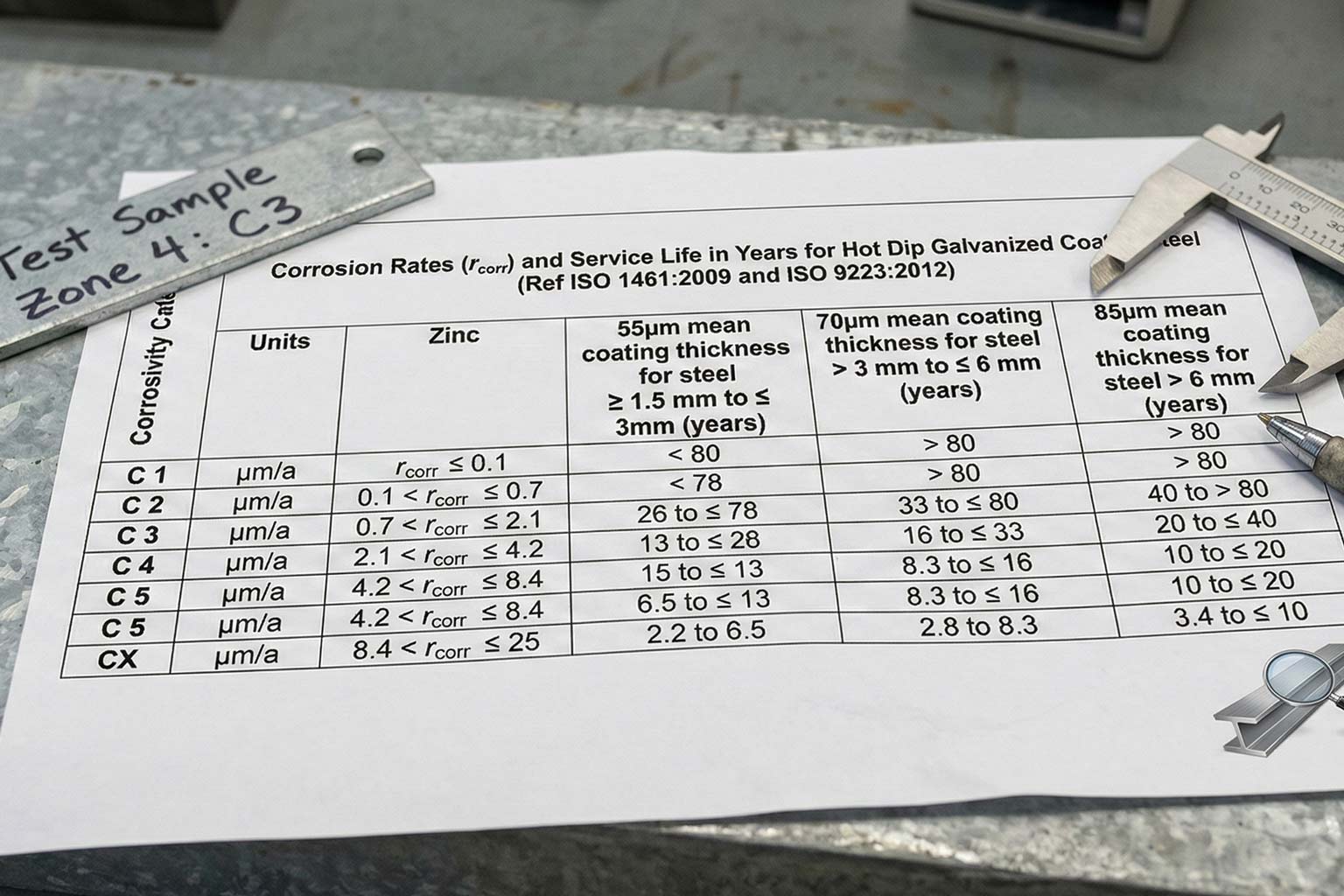
ISO 9223 provides corrosivity categories for metals and alloys based on atmospheric conditions. For zinc, the Galvanize It article summarizes category descriptors and associated first year corrosion rate ranges, from C1 through CX.
A key example highlighted is ISO C3, which is defined for zinc as 0.7 to 2.1 µm per year, and the article explains how that range can translate to a wide span of time to first maintenance depending on actual site conditions and coating thickness.
How to apply ISO categories for service life thinking
Step 1: Identify the likely ISO category for the site
ISO 9223 categories are tied to environment characteristics such as time of wetness, pollution levels including sulfur dioxide, and chloride effects in coastal regions.
Step 2: Use the zinc corrosion rate range as a starting point
ISO category ranges are broad. They are intended for classification, not precise prediction, so the corrosion rate within a category can vary significantly by microclimate and exposure conditions.
Step 3: Connect corrosion rate to coating thickness
Once you have an estimated corrosion rate, you can relate it to coating thickness to estimate time to first maintenance. The Galvanize It article provides an example using a typical minimum coating thickness for structural steel and explains how service life estimates can span decades depending on where the corrosion rate falls within the ISO C3 range.
Step 4: Use modeling when higher confidence is needed
If a site is expected to fall in ISO C1, C4, C5, or CX, the Galvanize It article notes that the Zinc Coating Life Predictor can be used when the required environmental inputs are available. If not, ISO 9223 Table C.1 is referenced as a conservative general indicator based on one year exposures.
Practical specification notes for engineers and architects
- Use ISO 9223 categories as a classification tool, not a guarantee of exact corrosion rates at every site.
- For North American projects, compare site expectations to regionally derived tools when available, then validate using engineering judgment and project requirements.
- When the environment is expected to be highly corrosive, consider whether a duplex system may be appropriate based on desired design life and maintenance strategy.
Key takeaways for project teams
ISO 9223 categories provide a common language for atmospheric corrosivity from very low to extreme. The AGA Time to First Maintenance chart is built from North American exposure data and uses different environment labels that often fall within ISO C3 when translated by zinc corrosion rate range. Use ISO categories for classification, then connect corrosion rate ranges to coating thickness and design life expectations, and apply modeling tools when higher confidence estimates are required.
For the original technical reference used to develop this article, review: https://galvanizeit.org/knowledgebase/article/hdg-corrosion-rates-for-iso-categories-c1-c5-x.
Frequently Asked Questions
What does ISO 9223 measure and classify?
ISO 9223 classifies atmospheric corrosivity for metals and alloys using categories such as C1 through CX, based on environmental factors like time of wetness, pollution, and chloride influence.
Why do many US environments fall within ISO C3?
The Galvanize It article explains that measured atmospheric corrosion rates in many US locations commonly fall within the ISO C3 zinc corrosion rate range, even when the environment is described informally as more severe.
What is the zinc corrosion rate range for ISO C3?
For zinc, ISO C3 is defined as 0.7 to 2.1 µm per year, which is also shown in mils per year.
What is the difference between the AGA Time to First Maintenance chart and ISO categories?
The AGA chart uses ASTM style environment labels and is built from North American exposure data and the Zinc Coating Life Predictor model, while ISO categories are an international classification system using C1 to CX corrosivity levels.
When should the Zinc Coating Life Predictor be used?
When you have the necessary environmental data inputs and need to estimate zinc corrosion rates for ISO categories outside the broad C3 range, the Galvanize It article notes the Zinc Coating Life Predictor as an option.
