
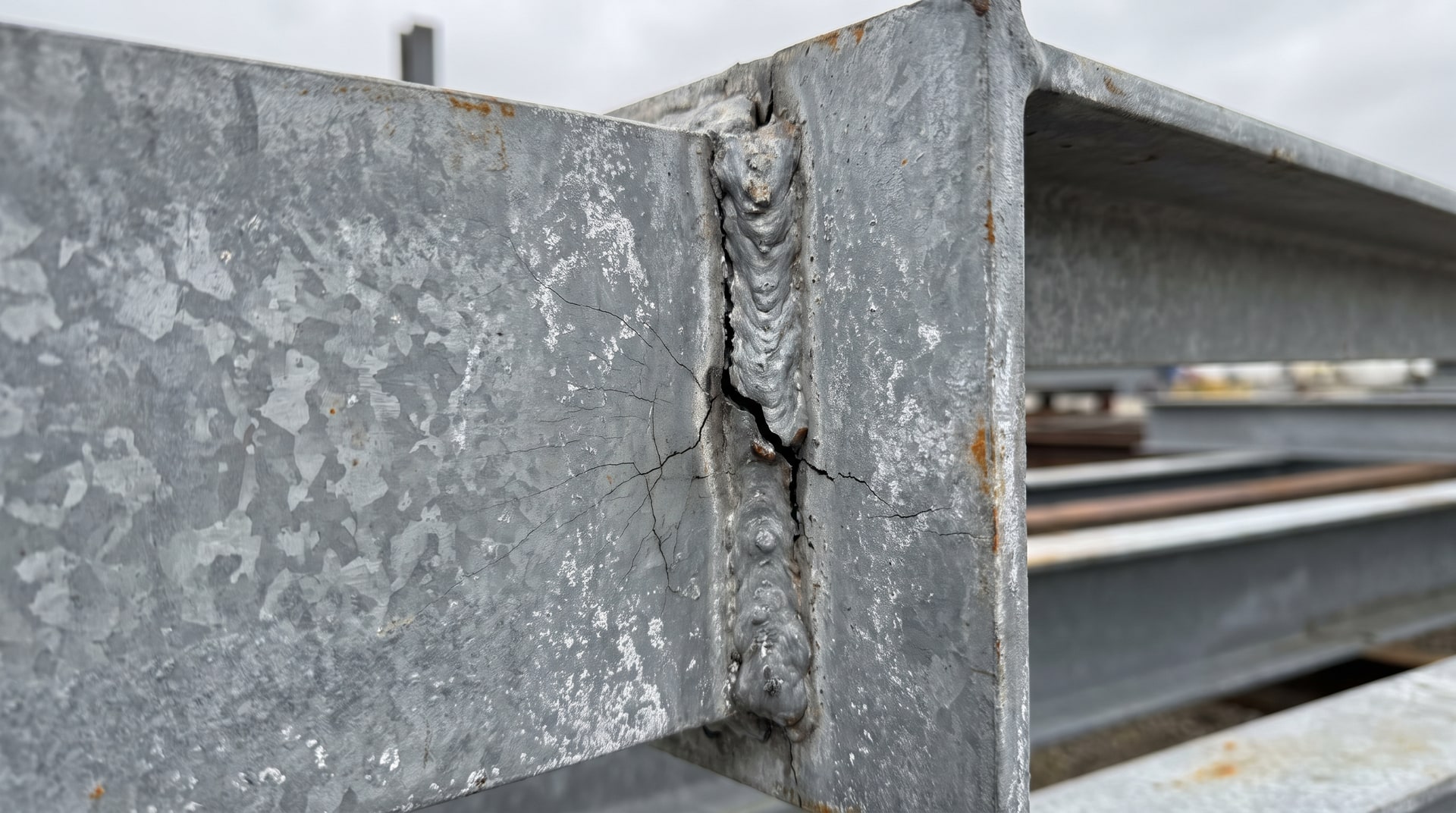
A fabricated steel assembly comes off the galvanizing line with a crack running through a weld or along a thermally cut edge. The zinc coating is intact everywhere else. The steel looks right. The process was done correctly. So what happened? For engineers and fabricators who have sent the same structure through the galvanizing process a dozen times without incident, that question can be genuinely confusing, and the answer is rarely as simple as pointing to a single mistake.
What is actually happening in these cases is a convergence of pre-existing material stresses and the rapid, uneven thermal loading that hot-dip galvanizing inherently introduces. The result is occasional, unpredictable cracking that emerges at the points where residual stress was already highest, even when every procedural step was followed correctly.
The American Galvanizers Association addresses this directly in their article on cracking due to high residual stress. At V&S Galvanizing, we expand on that foundation to explain what is actually happening at the material level, how residual stress influences performance, and why this is often misunderstood in the field.
What Residual Stress Actually Means in Fabricated Steel
Residual stress is stress that remains locked into a material after the external forces that caused it have been removed. In fabricated steel, this is almost always a consequence of thermal or mechanical processing: welding, cutting, bending, punching, or shearing. The steel deforms plastically in one region while surrounding material resists that deformation. When everything cools or the tooling is withdrawn, the internal forces do not disappear. They balance themselves within the part, creating a distribution of tension and compression that stays in the steel indefinitely.
This matters because residual stress does not show up in a visual inspection. It does not appear on a drawing. A beam that has been punched, flame-cut along a complex profile, and welded into a rigid frame can look perfectly sound while carrying internal stresses that approach a significant fraction of the steel's yield strength. When that beam enters a galvanizing kettle at roughly 830 degrees Fahrenheit, the residual stress field interacts with a new and powerful set of thermal stresses, and the combined loading can exceed what the material can tolerate at its weakest points.
How the Galvanizing Process Adds Thermal Stress to an Already Loaded Structure
Hot-dip galvanizing is not a slow, controlled heat treatment. Fabricated assemblies are dipped at an angle into a molten zinc bath, and different sections of the part reach bath temperature at different rates. Thin members heat quickly. Thick sections lag behind. Connections between the two, which are typically welds, sit at the interface of that thermal mismatch and experience the differential expansion directly.
The rate of temperature change also matters. Going from ambient temperature to approximately 830 F in a matter of minutes is a significant thermal event. Steel expands predictably, but when one element of a rigid assembly tries to expand faster than a connected element, the weld or joint between them bears the resulting load. In a structure with no pre-existing residual stress and a forgiving design, this is generally manageable. In a structure where fabrication has already introduced locked-in stress at those same joints, the additional thermal load can push a susceptible area past its limit.
Beyond the primary thermal shock, trace elements in the zinc bath can assist in the propagation of cracks once they initiate. This is not the root cause, but it does mean that a crack that begins at a stressed location can extend further than it might in a purely mechanical scenario.
The Heat-Affected Zone: Where Welds Create Vulnerability
Every weld introduces two distinct sources of stress. The weld metal itself is typically harder and stronger than the base metal, which creates a mechanical mismatch at the fusion boundary. More critically, the surrounding steel passes through a rapid thermal cycle during welding, transforming its microstructure in ways that increase hardness and reduce ductility. This region is the heat-affected zone, or HAZ.
A steel microstructure that has been hardened by rapid heating and cooling is more susceptible to brittle fracture. Ductile steel can redistribute load by yielding locally. Steel in the HAZ has reduced capacity to do that. When thermal stress from galvanizing concentrates at a weld, the HAZ is the area least able to accommodate that stress through plastic deformation, which is exactly what makes it the most common initiation point for galvanizing cracks.
The welding sequence also matters more than many fabricators realize. A sequence that locks components together early in the process, or that results in welds being made under constraint, elevates the residual stress in the finished joint significantly. Balanced welding techniques, where passes are distributed to counteract distortion rather than compound it, reduce the final stress state and improve the assembly's tolerance for subsequent thermal events like galvanizing.
Thermal Cutting and Why Surface Roughness Is Not Just Cosmetic
Flame cutting, plasma cutting, and other thermal separation processes introduce energy into the steel in much the same way welding does. The cut edge passes through a rapid thermal cycle, and the HAZ along the cut can be substantially altered in terms of microstructure and mechanical properties. Thermally cut steel is, as a result, particularly sensitive to residual stress.
Surface roughness on a thermally cut edge amplifies this effect. A rough cut surface creates stress concentrations at irregularities in the profile. These notch-like features act as initiation sites for cracking under the thermal loading of galvanizing. This is not primarily an appearance concern; it is a structural one. Smoother cut surfaces reduce the density and severity of these initiation sites, which is why cutting practice and edge preparation are legitimate engineering variables in structures destined for hot-dip galvanizing.
Cold Working: Bending, Punching, and Shearing as Sources of Locked-In Stress
Cold working encompasses any forming operation performed at or near room temperature: bending plate, punching holes, shearing edges. All of these processes deform the steel plastically and leave residual stress at the deformed region. Unlike the thermal stresses from welding or cutting, cold working stresses are distributed through the thickness of the material in a pattern determined by the strain gradient during the operation.
At the outer fiber of a bent member, or at the perimeter of a punched hole, the steel has been strained beyond its yield point. The surrounding material that was not deformed constrains recovery, and the result is a balanced internal stress state that persists. When this cold-worked steel enters the galvanizing bath, the thermal stress adds to whatever residual stress was already present. If the combined loading exceeds the local fracture toughness, cracking can occur.
The practical implication is that heavy cold working, particularly in members that will also be welded, creates compounding risk. The weld introduces its own HAZ and residual stress field adjacent to a region already carrying cold-work stress, and the overlap can produce conditions that are difficult to manage through process controls alone.
How Frame Geometry and Section Thickness Variation Make Things Worse
Rigid frame assemblies that connect steel members of different thicknesses present a specific challenge during galvanizing. When such an assembly is immersed in the zinc bath, the thinner members heat up and expand more rapidly than the thicker ones. If those members are welded or otherwise fixed to each other, the faster-expanding element cannot move freely. The thicker section restrains it, and the weld at their connection absorbs the differential expansion as additional stress.
This is the mechanism that explains why customers sometimes successfully galvanize a particular design for years before encountering a cracking problem. The conditions that produce cracking require multiple contributing factors to align simultaneously. Slight variations in steel chemistry, ambient temperature, kettle loading, immersion angle, or the specific residual stress state of a given batch of fabricated parts can all shift the system from a safe state to a cracked one. The design may be consistently marginal rather than consistently safe, and any single variable that increases stress concentration can tip the balance.
Corners in framed structures are particularly at risk. A corner weld in a rigid assembly combines geometric stress concentration with the differential expansion effect, the HAZ, and whatever residual stress the welding sequence introduced. Designs that allow some degree of thermal movement near corners, or that separate highly constrained connections through detailing choices, reduce the severity of this combined loading.
Approaches That Reduce Cracking Risk Before the Part Reaches the Kettle
The galvanizer has some ability to reduce thermal stress by minimizing immersion time and using air cooling rather than quenching, but these measures address a secondary factor. The most effective interventions happen at the design and fabrication stage, before the part is ever assembled.
Design changes that allow for thermal expansion near corners and at transitions between different section thicknesses reduce the constraint that drives differential expansion stress. Fabrication practices that minimize cold working, use smoother thermal cuts, control heat input during welding, and apply balanced welding sequences all reduce the residual stress carried into the galvanizing process. Where assemblies can be designed as separate subcomponents that are bolted or welded together after hot-dip galvanizing, rather than as monolithic welded frames, the risk of constraint cracking is substantially eliminated.
Where residual stress cannot be designed out or reduced through fabrication practice, thermal stress relief before galvanizing is the appropriate response. ASTM A143, Standard Practice for Safeguarding Against Embrittlement of Hot-Dip Galvanized Structural Steel Products and Procedure for Detecting Embrittlement, provides a specific stress-relieving procedure in Paragraph 6.3. This thermal treatment reduces the magnitude of locked-in stress to a level that the galvanizing process is less likely to push past the material's fracture threshold. For complex assemblies with unavoidable high-stress regions, this step is a meaningful risk reduction measure, not an optional add-on.
Repair Is Possible, but Prevention Is the Better Outcome
Structures that crack during galvanizing can be repaired. The coating can be restored in affected areas, and the structural crack itself can be addressed depending on its severity and location. This is not a total loss scenario. That said, repair introduces cost, delay, and scrutiny that no project benefits from. More importantly, a crack in a structural member is a more serious event than a cosmetic defect, and the conversation about whether the repaired part meets its design intent requires engineering judgment that a straightforward coating inspection does not.
The unpredictability of when cracking will occur, and the fact that it can happen to a design that has been galvanized successfully many times before, means that treating this as a rare-but-acceptable outcome is a riskier posture than it might appear. A single cracking event on a high-visibility project carries consequences well beyond the cost of the repair itself. Understanding the contributing mechanisms and addressing them proactively is the more defensible approach, both technically and commercially.
Work With a Team That Understands Stress Before the Steel Hits the Kettle
Cracking from residual stress is not a galvanizing process failure in the conventional sense. It is the result of pre-existing material conditions being exposed by the thermal demands of galvanizing. The galvanizer can take steps to reduce thermal stress at the kettle, but the structural conditions that make cracking possible are established long before the part arrives at the plant. Recognizing which fabrication choices create risk, and making informed adjustments at the design and fabrication stage, is how this problem is actually solved.
At V&S Galvanizing, we work with engineers, fabricators, and contractors to identify potential issues before they become field problems. If you are designing or fabricating structures that involve complex weldments, significant cold working, or mixed section thicknesses, we encourage early conversation about how those details interact with the galvanizing process. Reach out to our team through our contact page to discuss your specific application.
Frequently Asked Questions About Residual Stress Cracking in Hot-Dip Galvanizing
Why does cracking from residual stress happen only occasionally, even with the same design?
Cracking requires multiple contributing factors to align simultaneously. Variations in steel chemistry, residual stress magnitude from a particular fabrication run, immersion angle, ambient temperature, and kettle loading all influence the outcome. A design that is consistently marginal may crack only when several of these variables reach unfavorable values at the same time, which is why the same assembly can be galvanized successfully for years before a problem occurs.
What is the heat-affected zone and why is it the most common crack initiation point?
The heat-affected zone (HAZ) is the region of base metal adjacent to a weld that was altered by the welding thermal cycle without being melted. This zone experiences increased hardness and reduced ductility compared to the original steel. Because it cannot redistribute stress through plastic deformation as effectively as unaffected steel, it is the most vulnerable location when additional thermal stress from galvanizing is applied.
Does the roughness of a thermally cut edge actually affect cracking risk?
Yes. Rough cut surfaces create geometric stress concentrations along the cut edge. These irregularities act as notches that can initiate cracks when thermal stress from galvanizing is applied to an already sensitized HAZ along the cut. Smoother cut edges reduce the number and severity of these initiation sites, making edge quality a meaningful engineering variable for structures that will be hot-dip galvanized.
What does ASTM A143 recommend for structures with unavoidable high residual stress?
ASTM A143, Paragraph 6.3, provides a thermal stress-relief procedure for use before hot-dip galvanizing. When design or fabrication constraints make it impossible to reduce residual stress through other means, performing this thermal treatment reduces the locked-in stress to a level that is less likely to combine with galvanizing thermal loads to produce cracking. This is the primary standard-referenced approach for managing unavoidable high-stress conditions.
Can assemblies with mixed section thicknesses be safely galvanized?
Yes, but the design and welding details matter. When thin and thick members are connected in a rigid welded assembly, the thinner sections heat and expand faster during galvanizing, loading the connecting welds differentially. Designs that allow for some thermal movement near these transitions, or that reduce constraint at the joints, lower the risk. Where possible, designing assemblies to be bolted together after galvanizing rather than welded as a rigid frame before galvanizing eliminates this mechanism entirely.
Is it possible to fix a structure that has already cracked during galvanizing?
Structures and the surrounding coating can be repaired after cracking occurs. However, repair involves additional cost, project delay, and a required engineering assessment of whether the repaired part still meets its structural design intent. Prevention through design and fabrication changes is the preferred outcome, particularly for structural members where crack severity and location determine whether the repair is straightforward or requires more significant remediation.
What welding practices reduce the risk of galvanizing cracks?
Balanced welding techniques that distribute weld passes to counteract distortion, rather than accumulate it, reduce the residual stress in the finished joint. Avoiding welding sequences that force or clamp materials together to close a gap also reduces constraint-induced stress. Controlling heat input and using methods that minimize the size and temperature gradient of the HAZ contribute to a lower overall residual stress state that the galvanizing process is less likely to exceed.
Can the galvanizer prevent cracking through process adjustments alone?
The galvanizer can reduce the additional thermal stress introduced by the process, primarily by minimizing immersion time and using air cooling of parts. However, these measures address a secondary contributor. The residual stress already present in the fabricated assembly is the primary variable, and that is established before the part reaches the galvanizing plant. Design and fabrication changes have the greatest impact on preventing cracking, making early coordination between the design team and the galvanizer the most effective strategy.
