

In hot dip galvanizing specifications, coating thickness and coating weight are frequently referenced, sometimes interchangeably. Although the two measurements are related, they are not identical. Misunderstanding the distinction can lead to confusion during specification development, inspection, and compliance evaluation.
The Galvanize It article discussing coating thickness versus coating weight provides helpful background and can be reviewed here.
This expanded technical discussion clarifies the mathematical relationship between thickness and weight, explains how inspection is performed in the field, and outlines why thickness has become the preferred specification metric for fabricated steel.
Defining Coating Thickness
Coating thickness refers to the physical depth of the zinc layer applied to the steel surface.
It is typically measured in:
- Mils, where one mil equals 0.001 inches
- Microns, where one micron equals 0.001 millimeters
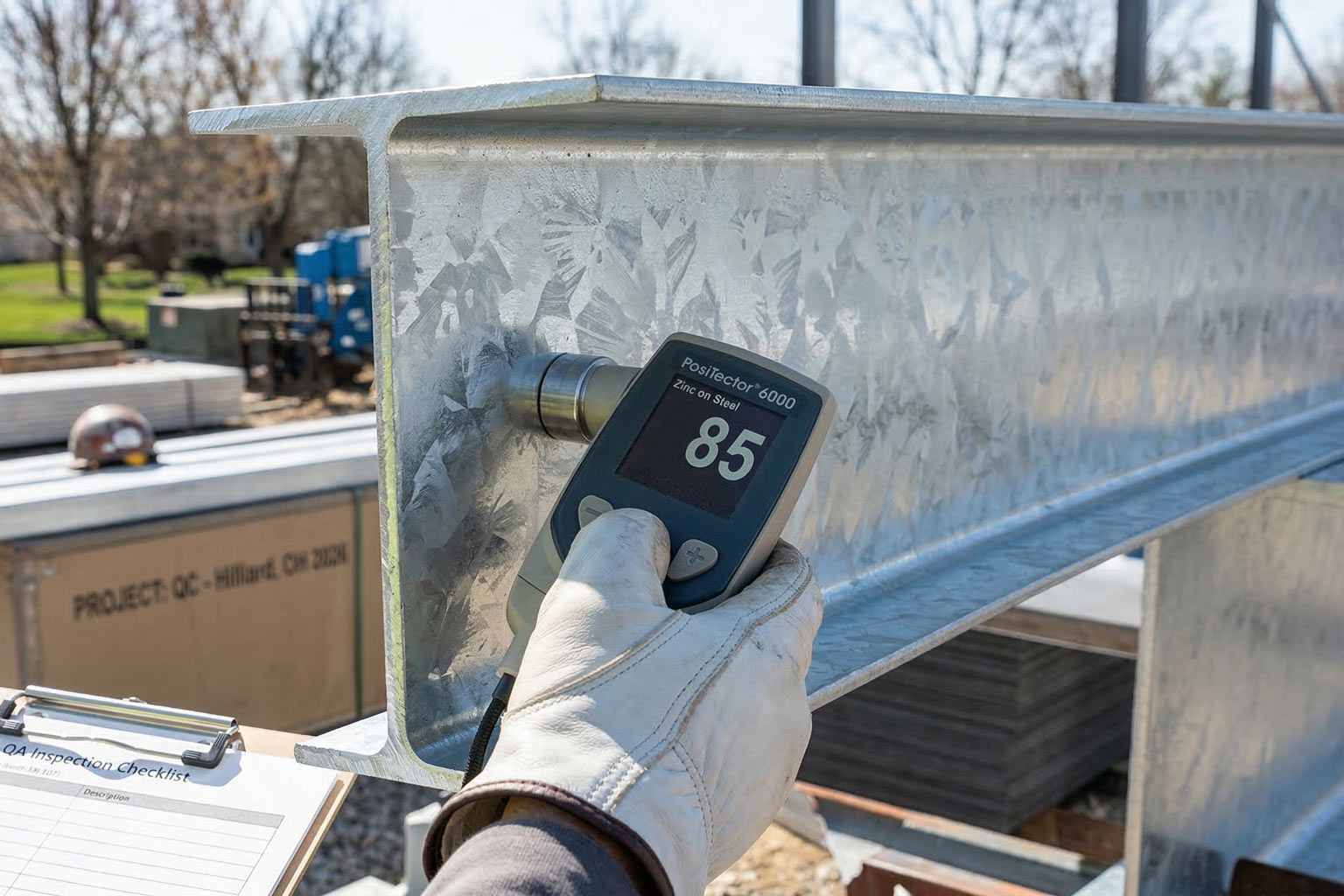
Thickness is measured using magnetic gauges that detect the distance between the steel substrate and the outer zinc surface.
ASTM A123 defines minimum thickness requirements for fabricated steel based on the thickness category of the base material.
Thickness directly correlates with service life in atmospheric exposure.
Defining Coating Weight
Coating weight represents the mass of zinc per unit surface area.
It is commonly expressed as:
- Ounces per square foot
- Grams per square meter
Weight is typically determined through destructive or laboratory testing methods, such as strip and weigh procedures.
Coating weight was historically used in sheet galvanizing standards where uniform flat surfaces made weight measurement practical.
Relationship Between Thickness and Weight
Thickness and weight are mathematically related through zinc density.
Zinc has a density of approximately 0.283 pounds per cubic inch.
Using this value, coating thickness can be converted to weight per unit area.
For example:
- A coating thickness of approximately 3.9 mils corresponds to roughly 2.0 ounces per square foot
- A coating thickness of approximately 1.7 mils corresponds to roughly 1.0 ounce per square foot
These conversions assume uniform coating and standard zinc density.
Because thickness measurement is non destructive and easily performed in the field, it is the preferred method for inspection of fabricated steel.
Why Thickness Is Preferred for Structural Steel
For fabricated and structural components, inspection must be:
- Non destructive
- Rapid
- Repeatable
- Performed on representative areas
Magnetic thickness gauges allow inspectors to verify compliance without damaging the product.
Weight measurement requires chemical stripping or laboratory analysis, making it impractical for routine field inspection.
As a result, ASTM A123 and related structural galvanizing standards define acceptance in terms of thickness rather than coating weight.
Sheet Versus Fabricated Steel Standards
Continuous sheet galvanizing standards often specify coating weight because:
- Coating is uniform across large flat areas
- Production is highly controlled
- Weight measurement correlates efficiently with performance
In contrast, fabricated structural components may have:
- Varying thickness
- Complex geometry
- Non uniform coating growth due to chemistry
Thickness measurement provides better practical evaluation in these cases.
Understanding which standard applies prevents specification conflicts.
Performance Implications
Service life of galvanized steel in atmospheric environments is approximately proportional to coating thickness.
Because weight is simply another expression of total zinc present, either measurement can theoretically predict durability if accurately converted.
However, thickness provides a direct field measurement that correlates clearly with corrosion rate modeling.
Designers should base lifecycle projections on measured or specified thickness values aligned with environmental classification.
Avoiding Specification Confusion
Common issues occur when:
- Coating weight values are applied to fabricated steel governed by ASTM A123
- Thickness values are incorrectly converted
- Sheet galvanizing standards are referenced for structural components
To avoid confusion, specifications should clearly state:
- Applicable ASTM standard
- Measurement unit
- Acceptance criteria
Consistency between design documents and inspection procedures is critical.
If you would like assistance reviewing coating specifications, thickness conversions, or inspection criteria for your project, please reach out through our contact page.
Clear alignment of measurement methods supports predictable compliance.
Coating thickness and coating weight describe the same zinc layer from different measurement perspectives. Thickness represents physical depth, while weight represents mass per unit area. For fabricated and structural steel, thickness measurement is preferred because it is non destructive and practical for field inspection. Understanding the mathematical relationship between these values ensures accurate specification and consistent compliance evaluation.
Frequently Asked Questions About Coating Thickness and Coating Weight
What is the difference between coating thickness and coating weight?
Coating thickness measures the physical depth of the zinc layer, typically in mils or microns. Coating weight measures the mass of zinc per unit area, typically in ounces per square foot or grams per square meter.
Why does ASTM A123 specify thickness instead of weight?
Thickness can be measured non destructively using magnetic gauges, making it practical for field inspection of fabricated steel components.
Can coating weight be converted to thickness?
Yes. Using the density of zinc, coating weight can be mathematically converted to approximate thickness, assuming uniform coating distribution.
Which measurement better predicts service life?
Both relate to total zinc present, but thickness is more commonly used in corrosion rate modeling for structural applications.
Why are sheet galvanizing standards based on weight?
Continuous sheet galvanizing processes produce uniform coatings across flat surfaces, making weight measurement efficient for production control.
Can thickness vary across a fabricated component?
Yes. Coating growth can vary slightly based on steel chemistry and geometry. ASTM standards account for this by requiring average minimum thickness across measured areas.
How is coating thickness measured in the field?
Calibrated magnetic gauges are used to measure the distance between the steel substrate and the outer zinc surface at multiple representative locations.
What happens if coating thickness exceeds minimum requirements?
Exceeding minimum thickness is generally acceptable provided coating adhesion and dimensional tolerances are maintained.
