

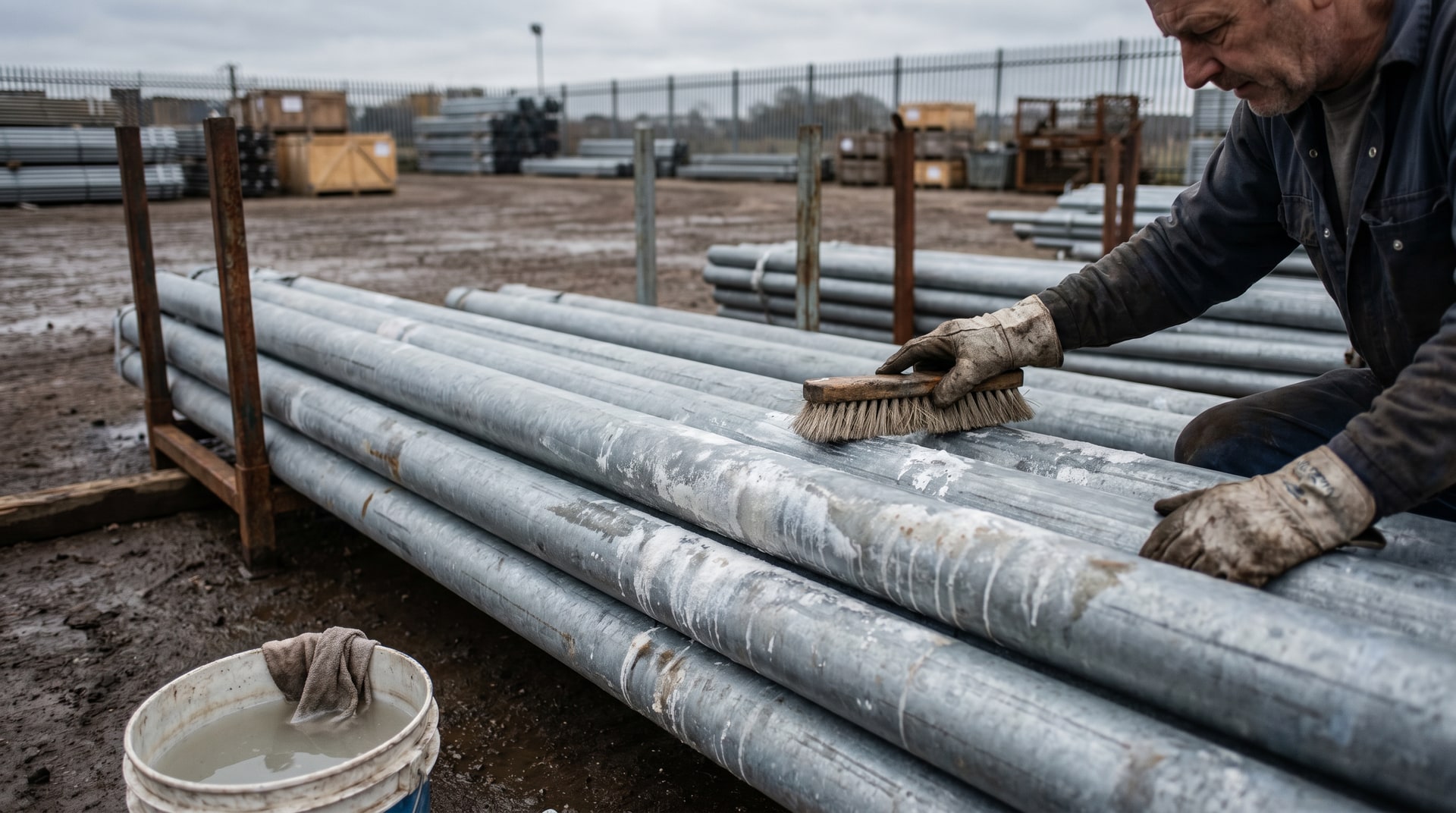
Even the cleanest galvanizing operation cannot control every condition a freshly coated part encounters after it leaves the kettle. Grease picked up during handling, oil from fabrication equipment, or moisture accumulating during outdoor storage: these are routine field realities, not signs of a process failure. What matters is how they are addressed before the steel reaches the end user. Remove the contamination incorrectly and you risk altering the zinc surface in ways that affect both appearance and long-term performance. Remove it correctly and the coating is left functionally intact, cosmetically acceptable, and ready for service.
The American Galvanizers Association addresses this directly in their article on cleaning galvanized steel. At V&S Galvanizing, we expand on that foundation to explain what is actually happening at the material level, how the chemistry of cleaning products influences coating integrity, and why the wrong choice of cleaner is often misunderstood or underestimated in the field.
Why the Zinc Surface Is More Reactive Than People Expect
Hot-dip galvanizing produces a coating that is metallurgically bonded to the steel substrate. The outermost layer is nearly pure zinc, and while zinc is well known for its corrosion resistance, that resistance depends on a controlled surface chemistry. When freshly galvanized steel is exposed to the atmosphere, the zinc reacts with moisture and carbon dioxide to gradually form zinc carbonate, a stable, tightly adherent compound that gives the coating its characteristic matte gray patina and acts as a passive barrier against further corrosion.
The problem with aggressive cleaning chemistry is that it does not distinguish between the contaminant and the zinc surface underneath. Acids dissolve zinc. Strong oxidizers can disrupt the passive layer. Even some alkaline cleaners, if left in contact long enough, will etch the surface. The goal of any cleaning program is to remove the foreign material without disturbing the zinc or the nascent patina layer that has begun to form.
This is not an academic concern. A coating that appears uniform and intact but has been subtly etched by a cleaning agent may show accelerated staining, uneven patina formation, or a dull appearance that raises questions about quality during inspection. Understanding why certain products are safe and others are not requires a basic grasp of how those products interact with zinc chemistry.
Organic Contaminants: What They Are and Where They Come From
Organic contaminants on galvanized steel most commonly take the form of oils, greases, cutting fluids, or handling lubricants that were either present during fabrication or introduced during post-galvanizing handling. In a busy galvanizing plant, parts move through multiple stages: pre-treatment, fluxing, dipping, quenching, and inspection. Despite rigorous cleaning protocols at each stage, a part can pick up contamination from a rack, a transport chain, or simply from contact with a gloved hand.
These contaminants are not chemically aggressive toward zinc, but they are unacceptable from a quality standpoint, particularly when the galvanized steel is going into an architectural application or will receive a topcoat as part of a duplex coating system. Grease and oil create adhesion barriers. They also visually signal a quality concern to customers even when the coating underneath is perfect.
The AGA conducted a study testing commercially available products specifically for their ability to remove organic contaminants from galvanized surfaces without harming the coating. The protocol was systematic: apply the product per the manufacturer's instructions, remove it, rinse with water, and dry. The products that passed without affecting coating appearance or integrity included Comet Bleach, Goof Off, Simple Green, The Must for Rust, and Stainless Steel Cleaner. These represent a range of formulations, from mildly abrasive to solvent-based to enzymatic, demonstrating that multiple chemical approaches can work safely when the product is appropriately formulated and correctly applied.
It is worth emphasizing the study's qualification: even products that performed well should be tested on a small area first. Lot-to-lot variation in commercial cleaning products is real, and the condition of a specific coating, its age, its surface texture, and how recently it was galvanized can all affect the outcome.
Products That Work But Leave a Mark
The AGA study also identified a second category of products: those that effectively removed grease and oil but visibly affected the coating's appearance. Vinegar, muriatic acid, and ammonia all fall into this group.
This is where field practice sometimes goes wrong. Vinegar and muriatic acid are inexpensive, widely available, and highly effective at dissolving surface contamination. They are also acidic, and zinc is amphoteric, meaning it reacts with both strong acids and strong bases. Acetic acid (the active component in vinegar) and hydrochloric acid (the active component in muriatic acid) will attack the zinc surface at a rate that depends on concentration, contact time, and temperature. At low concentrations and brief contact, the visible effect might be subtle. At higher concentrations or extended dwell times, the surface can be noticeably etched, dulled, or stained in ways that are difficult to reverse.
Ammonia is alkaline rather than acidic, but zinc's amphoteric nature means it is also vulnerable to high-pH attack. Ammonia-based cleaners may be perfectly safe on stainless steel or aluminum but can cause surface discoloration on zinc coatings, particularly at elevated concentrations.
The takeaway is not that these products can never be used in any context, but that they are not appropriate as standard cleaning agents for galvanized steel when coating appearance and longevity are priorities. If a contractor reaches for muriatic acid to clean a contaminated galvanized surface because it is what they have on hand, the result may be a zinc surface that is technically still functional but cosmetically compromised in a way that raises concerns with inspectors or end users.
Understanding Wet Storage Stain: Formation, Severity, and What It Means for the Coating
Wet storage stain is one of the most commonly misunderstood phenomena in hot-dip galvanizing. It is not a defect in the galvanizing process itself. It is a corrosion product that forms when freshly galvanized steel is stored in conditions where moisture cannot evaporate freely, specifically when parts are stacked tight or bundled together with insufficient air circulation, or when water is allowed to pool on the surface and remain in contact with the zinc.
The mechanism is straightforward. The fresh zinc surface has not yet developed its protective zinc carbonate patina. In the presence of standing water and restricted airflow, the zinc reacts with oxygen and water to form zinc hydroxide, a white or light gray powder that is sometimes described as a chalky or powdery deposit. If the wet conditions persist, zinc oxide and basic zinc carbonate can also form. The visual result is the characteristic white or gray staining associated with wet storage stain.
Severity matters significantly when deciding how to respond. Light wet storage stain, a faint chalky deposit with no significant coating consumption, typically does not require treatment. Once the steel is dried and exposed to adequate airflow, the normal patina formation process will resume, and the stain will gradually blend into the surrounding surface as the zinc carbonate layer develops. The key condition here is that the steel must stay dry. Light stain left in continued wet conditions will progress.
Medium wet storage stain involves a more substantial deposit and some degree of zinc consumption, but the coating retains enough thickness to perform its corrosion-protection function. Removal is recommended to stop the active zinc consumption and allow the patina to form properly. Heavy wet storage stain indicates that a meaningful portion of the zinc coating has been consumed in the affected area. In severe cases, enough zinc may have been lost that the corrosion protection in that zone is genuinely compromised. When wet storage stain is extremely heavy, the part may need to be stripped and re-galvanized rather than cleaned.
Prevention Is Not Just Best Practice: It Is Part of the Galvanizing Specification
The AGA is clear that the best treatment for wet storage stain is to prevent it in the first place. This is achieved through two interconnected practices: ensuring adequate airflow around newly galvanized surfaces and removing standing water promptly.
In practice, this means that how newly galvanized steel is racked, stacked, and stored matters as much as the galvanizing process itself. Parts stored horizontally in tight bundles, or stacked flat with no spacers, create exactly the conditions that lead to wet storage stain. Moisture becomes trapped between surfaces, airflow is eliminated, and the zinc has no opportunity to dry and begin forming its protective patina. Stacking with appropriate spacers or storing parts vertically where possible dramatically reduces this risk.
Weather timing also plays a role. Parts galvanized and staged for shipping during periods of high humidity or rainfall are at elevated risk. A galvanizing facility with a thoughtful storage protocol, one that anticipates wet weather and adjusts staging accordingly, can prevent most wet storage stain issues before they start. When we galvanize structural steel at V&S, our storage and handling protocols are designed around this principle, because preventing the condition is far less costly than treating it after the fact.
Tested Products for Removing Wet Storage Stain
When wet storage stain cannot be prevented and must be removed, the selection of cleaning product is again critical. The AGA tested multiple products specifically for wet storage stain removal and identified five that meet the dual criteria of effectiveness and coating safety: CLR, lime juice, Naval Jelly Rust Dissolver, Picklex 10G, and white vinegar.
It is worth noting that white vinegar appears here as a recommended product for wet storage stain, while plain vinegar appeared in the organic contaminant study as a product that affected coating appearance. The distinction likely reflects both the dilution and formulation specifics involved and the nature of the target material. Wet storage stain, which is itself a zinc corrosion product, is chemically distinct from the underlying metallic zinc layer. A mild acid can dissolve the hydroxide and carbonate deposits without necessarily etching the zinc metal below, provided it is used carefully and not left in contact for extended periods. This is why following application instructions precisely matters.
The application procedure for wet storage stain removal is consistent across these products: apply to the affected area, scrub with a nylon-bristled brush (not wire, not steel wool, which can introduce ferrous contamination), rinse thoroughly with water, and dry the surface completely. The nylon brush recommendation is important because abrasive metallic scrubbing pads or wire brushes can both physically damage the zinc surface and deposit iron particles that initiate rust staining of their own.
After cleaning, the treated area should be kept dry and well-ventilated to allow the patina to reform. If a treated area will be painted or coated as part of a duplex system, the surface preparation requirements for that topcoat should be followed carefully, since the cleaned area may need additional preparation to ensure adhesion.
Common Misapplications and Field Errors Worth Knowing
Several patterns of field error come up repeatedly when cleaning practices go wrong. First, using products that are effective on related materials but are not appropriate for zinc. Stainless steel cleaners designed for oxide passivation, rust removers formulated for iron oxide, and concrete cleaners based on high-concentration hydrochloric acid are all in common use on construction sites. Each of these can damage a zinc coating in ways that may not be obvious until the coating is inspected or begins to exhibit uneven patina formation.
Second, extended contact time. Even products that are safe for galvanized steel at the prescribed application duration can cause damage if they are allowed to sit on the surface for much longer than intended. This can happen when a product is applied and then a project distraction delays the rinse step. The result is a longer acid or alkaline contact period that etches the surface in the application zone.
Third, skipping the rinse step or using inadequate rinsing. Residual cleaning chemistry left on the surface continues to react with the zinc. A thorough water rinse is not optional; it is a functional part of the cleaning procedure. Some products, particularly those with surfactants, may require more thorough rinsing than others to fully remove residue.
Finally, treating heavy wet storage stain as though it were a cosmetic issue rather than a structural coating concern. Heavy stain can reduce zinc thickness to the point where re-galvanizing is the only appropriate corrective action. Cleaning a heavily stained surface and presenting it as acceptable product can create warranty and performance issues downstream. When in doubt about severity, measuring the remaining coating thickness in the affected zone is a straightforward way to determine whether the coating still meets specification.
Work With a Team That Takes Surface Quality Seriously
Cleaning galvanized steel is not a complicated task when the right products are used correctly and the underlying principles are understood. What makes it go wrong in practice is reaching for whatever cleaner is available, skipping test areas, or underestimating how reactive zinc is to common chemical agents. The AGA's testing work removes the guesswork from product selection, and applying that research carefully protects both the coating and the customer relationship.
At V&S Galvanizing, surface quality does not stop at the kettle. How parts are handled, staged, and cleaned before delivery is part of the service we provide to fabricators, contractors, and engineers who depend on galvanized steel to perform in the field for decades. Our team applies these cleaning and storage practices as standard operating procedure, not as exceptions. When a contamination issue does arise, we address it with products and methods we know are safe for the coating.
If you have questions about wet storage stain, appropriate cleaning procedures, or how to evaluate coating condition before or after cleaning, reach out to our team through our contact page. We are glad to help you work through the specifics of your application.
Frequently Asked Questions About Cleaning Galvanized Steel
Can I use muriatic acid to remove wet storage stain from galvanized steel?
Muriatic acid is not recommended for cleaning galvanized steel. While it is effective at dissolving deposits, it reacts aggressively with zinc and will etch or visibly damage the coating surface. The AGA study identified it as a product that affects coating appearance, even when it removes contaminants. Use one of the AGA-tested products such as CLR, Naval Jelly Rust Dissolver, or white vinegar instead, following manufacturer instructions carefully.
Does light wet storage stain affect the service life of a galvanized coating?
Light wet storage stain does not affect the service life of the coating. The zinc carbonate deposits are superficial and, once the steel is kept dry and exposed to adequate airflow, the normal patina formation process will resume and the stain will gradually blend into the surrounding surface. Medium and heavy wet storage stain are more serious, since they represent actual zinc consumption, and must be treated to prevent further coating loss.
Why is a nylon-bristled brush specified for cleaning wet storage stain rather than a wire brush?
Wire brushes, particularly steel wire brushes, can physically abrade the zinc surface and deposit iron particles on the coating. Those iron particles can then initiate rust staining, which creates a new surface problem. A nylon-bristled brush provides enough mechanical action to loosen and remove wet storage stain without damaging the zinc or contaminating the surface.
How do I know if wet storage stain is severe enough to require re-galvanizing?
In cases of very heavy wet storage stain, the zinc in the affected area may be consumed to the point where the coating no longer meets its original thickness specification. Measuring the remaining coating thickness in the stained zone with a magnetic gauge will tell you whether the zinc is still adequate. If the coating thickness has dropped below the project specification or the applicable ASTM standard, stripping and re-galvanizing is the appropriate corrective action rather than surface cleaning alone.
If white vinegar appears on both the safe list and the caution list, which is correct?
The distinction relates to the specific application. In the AGA's organic contaminant study, plain vinegar was noted as a product that affected coating appearance on clean galvanized steel. In the wet storage stain study, white vinegar was identified as a safe and effective treatment. The difference is that wet storage stain consists of zinc corrosion products (zinc hydroxide, zinc carbonate) that a mild acid can dissolve without attacking the underlying metal beneath, provided contact time and concentration are controlled. In both cases, testing a small area first and rinsing thoroughly after treatment are essential steps.
Can Simple Green or other all-purpose cleaners be used before applying a topcoat in a duplex system?
Simple Green was among the products that the AGA study found safe for removing organic contaminants without damaging the galvanized coating or its appearance. It can be used for pre-cleaning galvanized surfaces. However, surface preparation requirements for topcoats in a duplex coating system may go beyond simple cleaning and include specific profile, cleanliness, or sweep blast criteria depending on the coating manufacturer's instructions. The cleaning step addresses contamination; meeting the full adhesion requirements of the topcoat system is a separate specification that should be verified independently.
How long after galvanizing is wet storage stain likely to form if parts are stored improperly?
Wet storage stain can begin forming within hours of galvanizing if freshly coated steel is stacked tightly in humid conditions without adequate airflow. Newly galvanized steel is most vulnerable because it has not yet developed the stable zinc carbonate patina that provides passive protection. The risk is highest in the first days to weeks after galvanizing, particularly during wet or humid weather. Proper stacking with spacers and covered, well-ventilated storage significantly reduces this risk during the vulnerable early period.
Is it necessary to do anything to a cleaned zinc surface after removing wet storage stain before the part goes into service?
After removing wet storage stain, the surface should be rinsed thoroughly and dried completely. If the part will remain in dry, well-ventilated conditions, the zinc will naturally reform its protective patina over time without any additional treatment. If the cleaned area will be exposed immediately to wet or aggressive environments, or if the coating thickness in that zone is marginal, consulting with your galvanizer about whether a zinc-rich touch-up or topcoat is appropriate for that specific application is a reasonable precaution.
