

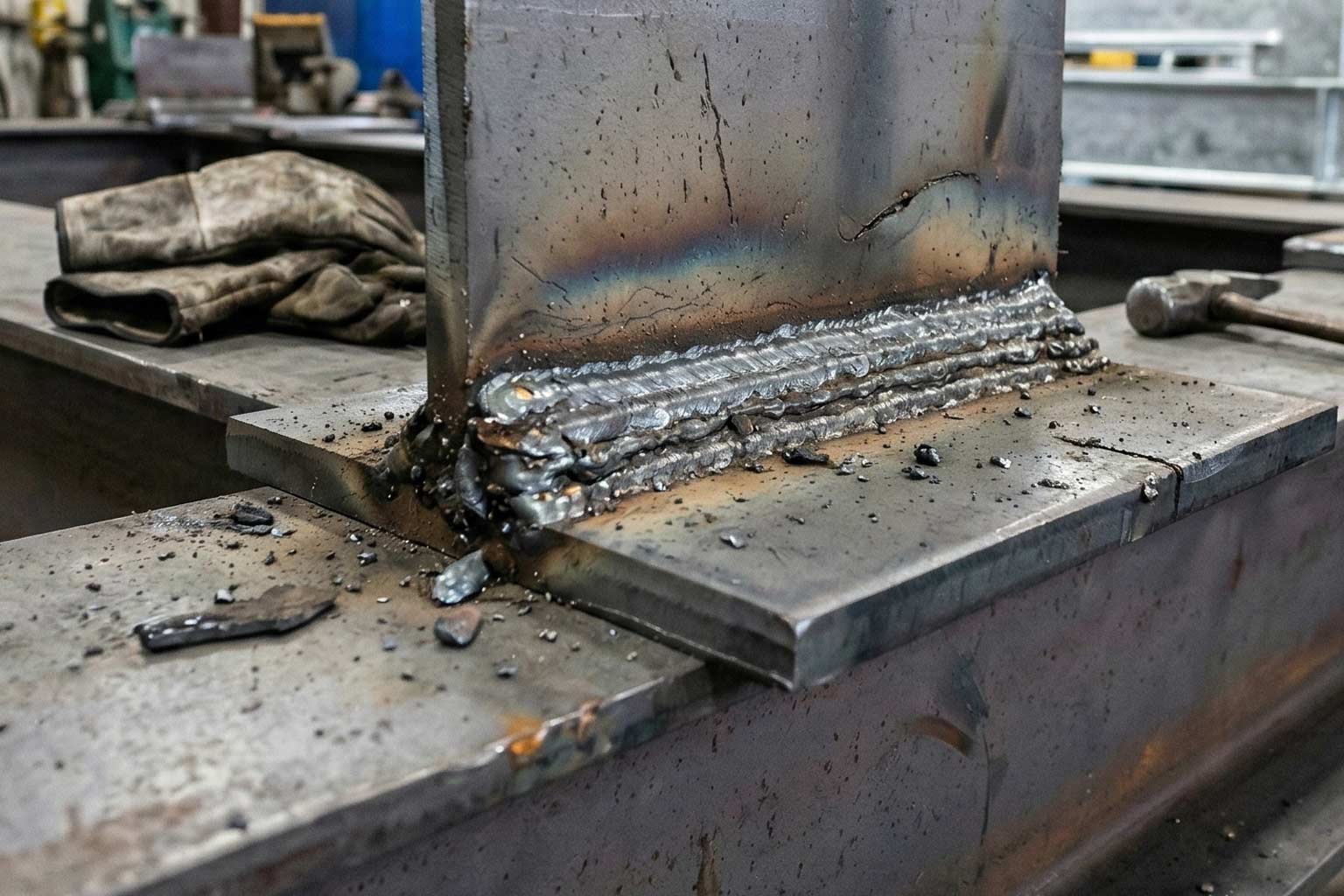
Hot dip galvanizing depends on a metallurgical reaction between molten zinc and clean steel. For that reaction to occur properly, the steel surface must be free of contaminants that prevent bonding. Weld slag is one of the most common fabrication residues that interferes with coating formation.
If slag remains on a weld seam, molten zinc cannot reach the steel beneath it. The result is a bare or poorly coated area that does not meet coating continuity requirements.
The Galvanize It technical article addressing weld slag clean up requirements can be reviewed here:
https://galvanizeit.org/knowledgebase/article/weld-slag-clean-up-requirements-for-galvanizing
Understanding where fabrication responsibility ends and where galvanizer preparation begins is critical for achieving compliant coatings.
What Weld Slag Is and Why It Cannot Be Left in Place
Weld slag is a non metallic residue created during welding processes that use flux materials. It forms a hardened layer over the weld bead and must be mechanically removed once welding is complete.
Unlike oils or light oxidation, weld slag does not dissolve during chemical cleaning or acid pickling. It acts as a physical barrier that blocks zinc from contacting the steel surface.
If not removed prior to galvanizing, slag will create:
- Bare spots
- Incomplete alloy layer formation
- Localized coating discontinuities
- Potential corrosion initiation points
Because galvanizing is a diffusion based coating process, uninterrupted steel exposure is required.
What the Galvanizing Process Removes and What It Does Not
At V&S Galvanizing, the hot dip galvanizing process begins with a structured surface preparation sequence designed to remove mill scale, rust, oils, and other contaminants prior to immersion.
The preparation stages include:
Surface Preparation Assessment
A detailed evaluation of steel surface conditions to determine the optimal cleaning approach and confirm readiness for zinc bonding.
Caustic Cleaning
An advanced alkaline cleaning process that removes oil, grease, organic residue, and water based paint. It is important to note that only organic residues and water based paints are removed during this step. Inorganic materials such as weld slag are not affected.
Rinse and Quality Check
A thorough water rinse removes alkaline cleaning residues and prepares the steel for pickling while maintaining quality control standards.
Pickling Treatment
Hydrochloric acid treatment removes mill scale, rust, and oxidation. This step prepares the steel surface for zinc bonding but does not dissolve weld slag.
Secondary Rinse
Complete removal of pickling residues prevents contamination and ensures proper progression to the next stage.
Flux Application
Application of zinc ammonium chloride flux prevents oxidation prior to immersion and promotes uniform zinc coating during the galvanizing process.
Only after these preparation stages is the steel immersed in molten zinc.
While this sequence removes oils, rust, and mill scale, it does not remove weld slag. Slag must be removed by the fabricator before the material enters the galvanizing cycle.
Fabricator Responsibility for Weld Cleaning
Mechanical contaminants such as slag and heavy weld spatter are the responsibility of the fabricator.
Best practices include:
- Chipping or grinding weld slag completely
- Inspecting weld seams for residue
- Removing excessive spatter
- Ensuring smooth weld transitions
Failure to remove slag will result in visible uncoated areas after galvanizing. These areas may require repair but will not achieve the same metallurgical bonding as a fully immersed coating.
Clear communication between fabricator and galvanizer helps prevent avoidable rework.
For fabrication coordination or clarification on preparation requirements, project teams can reach V&S Galvanizing directly through our contact page.
Inspection and ASTM Compliance
ASTM A123 requires coating continuity and minimum thickness compliance. Areas blocked by weld slag will fail continuity inspection.
Inspectors should review:
- Weld seams
- Reinforcement plates
- Bracket attachments
- Complex welded geometries
Pre galvanizing inspection at the fabrication stage is far more effective than attempting post galvanizing correction.
Long Term Performance Implications
Uncoated areas caused by slag can become localized corrosion initiation points. Because galvanizing provides sacrificial protection across continuous surfaces, maintaining coating integrity is critical.
Proper weld preparation ensures:
- Full metallurgical bonding
- Uniform coating thickness
- Long term corrosion protection
- Compliance with specification requirements
Weld cleaning is not a cosmetic issue. It directly impacts corrosion performance and service life.
Effective weld slag removal is a fundamental prerequisite to successful hot dip galvanizing. While galvanizers perform extensive chemical cleaning and pickling prior to immersion, mechanical residues such as slag must be removed during fabrication. Coordinated preparation ensures coating continuity, ASTM compliance, and durable corrosion protection.
For additional clarification and the original technical explanation, review the Galvanize It article at:
https://galvanizeit.org/knowledgebase/article/weld-slag-clean-up-requirements-for-galvanizing
For project specific guidance on surface preparation or galvanizing requirements, V&S Galvanizing can assist through our contact page.
Frequently Asked Questions About Weld Slag and Galvanizing
Why must weld slag be removed before galvanizing?
Weld slag blocks molten zinc from contacting the steel surface, preventing proper metallurgical bonding and creating uncoated areas.
Does pickling remove weld slag?
No. Hydrochloric acid pickling removes mill scale and rust but does not dissolve slag.
What does caustic cleaning remove?
Caustic cleaning removes oil, grease, organic residue, and water based paint. It does not remove inorganic contaminants such as slag.
Who is responsible for weld slag removal?
The fabricator is responsible for mechanical removal of weld slag prior to galvanizing.
Can uncoated areas caused by slag be repaired?
Yes, but repair methods do not provide the same metallurgical bond as full immersion galvanizing and should be minimized through proper preparation.
